



 Chat with AI
Exam 11: Carbonyl Compounds and Redox Reactions

Exam 1: Measurements in Science and Medicine77 Questions
Exam 2: Atoms, Elements, and Compounds76 Questions
Exam 3: Chemical Bonds82 Questions
Exam 4: Energy and Physical Properties73 Questions
Exam 5: Solution Concentration76 Questions
Exam 6: Chemical Reactions68 Questions
Exam 7: Acids and Bases82 Questions
Exam 8: Nuclear Chemistry65 Questions
Exam 9: Hydrocarbons: An Introduction to Organic Molecules72 Questions
Exam 10: Hydration, Dehydration, and Alcohols59 Questions
Exam 11: Carbonyl Compounds and Redox Reactions70 Questions
Exam 12: Organic Acids and Bases62 Questions
Exam 13: Condensation and Hydrolysis Reactions70 Questions
Exam 14: Proteins64 Questions
Exam 15: Carbohydrates73 Questions
Exam 16: Lipids and Membranes75 Questions
Exam 17: Nucleic Acids, Protein Synthesis, and Heredity69 Questions
Select questions type


Vitamin K (whose simplified structure is given below) is required for blood clotting. One of the reactions involved in blood clotting is shown below. This reaction represents an oxidation. 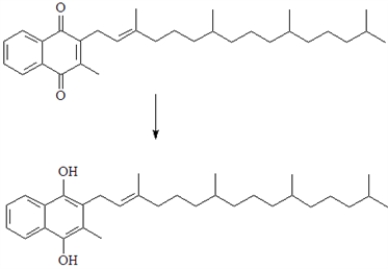
(True/False)
4.9/5  (73)
(73) How many ketone carbonyl groups are present in the following compound? 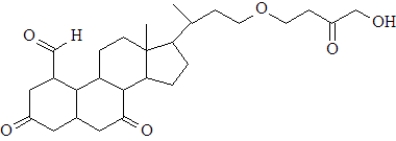
(Multiple Choice)
4.9/5 (83)
(83) 
Consider the structures given below. 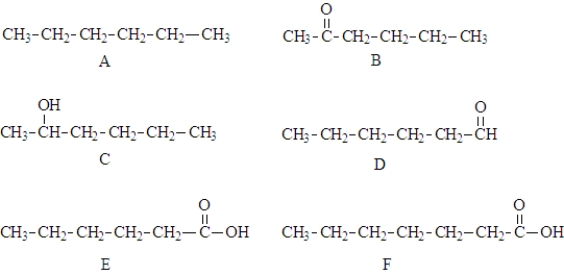 Fill in the blanks with the appropriate letter (A,B,C,D,E,F).
-Structure _______________________ would be the most soluble in water.
Fill in the blanks with the appropriate letter (A,B,C,D,E,F).
-Structure _______________________ would be the most soluble in water. (Short Answer)
4.8/5 (82)
(82) Consider the structures given below. Fill in the blanks with the appropriate letter (A,B,C,D,E,F).
-Structure_______________ could be oxidized to structure ____________________.
Fill in the blanks with the appropriate letter (A,B,C,D,E,F).
-Structure_______________ could be oxidized to structure ____________________. (Short Answer)
4.8/5 (73)
(73) Consider the structures given below. Fill in the blanks with the appropriate letter (A,B,C,D,E,F).
-Structure _____________________ could serve as both a hydrogen bond donor and a hydrogen bond acceptor.
Fill in the blanks with the appropriate letter (A,B,C,D,E,F).
-Structure _____________________ could serve as both a hydrogen bond donor and a hydrogen bond acceptor. (Short Answer)
4.8/5 (75)
(75) Consider the structures given below. Fill in the blanks with the appropriate letter (A,B,C,D,E,F).
-Structure _____________________ would produce an aqueous solution with a pH less than 7..
Fill in the blanks with the appropriate letter (A,B,C,D,E,F).
-Structure _____________________ would produce an aqueous solution with a pH less than 7.. (Short Answer)
4.9/5 (69)
(69) Which of the following types of organic compounds contains a carbonyl group?
(Multiple Choice)
4.7/5 (89)
(89) If 2-hexanol underwent dehydration followed by dehydrogenation, the final product would be:
(Multiple Choice)
4.8/5 (94)
(94) Name the reactant molecule shown below and then draw the product of the dehyrogenation of this substance. The affected part of the molecule is enclosed in the oval. 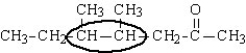
(Essay)
4.9/5 (78)
(78) If the following compound was oxidized as much as possible, CH3CH2CH2CH2CH2CH2CH2CH2OH
Which of the following would be the product of the complete reaction?
(Multiple Choice)
4.7/5 (77)
(77) Consider the structures given below. Fill in the blanks with the appropriate letter (A,B,C,D,E,F).
-With like molecules, structure _______________________ could participate in hydrogen bonding.
Fill in the blanks with the appropriate letter (A,B,C,D,E,F).
-With like molecules, structure _______________________ could participate in hydrogen bonding. (Short Answer)
4.7/5 (84)
(84) Consider the structures given below. Fill in the blanks with the appropriate letter (A,B,C,D,E,F).
-Structure _____________________ would be named hexanal.
Fill in the blanks with the appropriate letter (A,B,C,D,E,F).
-Structure _____________________ would be named hexanal. (Short Answer)
4.9/5 (66)
(66) When our bodies need a sudden burst of energy, glucose is converted into carbon dioxide and water.
(True/False)
4.9/5 (84)
(84) Which of the following products is formed when hydrogen is reacted with 3-methyl-2-butanone under appropriate reaction conditions?
(Multiple Choice)
4.9/5 (76)
(76) The following is a summary of the steps found in the metabolic pathway known as the Citric Acid Cycle.
Step 1:  Step 2:
 Step 3:
 Step 4:
 Step 5:
 Step 6:
 Step 7:
 Step 8:
 Fill in the blanks in the following question with the appropriate term from the list below.
oxaloacetate oxidation
citrate reduction
isocitrate consumes
a-ketoglutarate produces
succinyl-CoA NADH
succinate FAD
fumarate NADPH
malate
-The reactant of step 5 is _______________________.
Step 2: Step 3: Step 4: Step 5: Step 6: Step 7: Step 8: Fill in the blanks in the following question with the appropriate term from the list below.
oxaloacetate oxidation
citrate reduction
isocitrate consumes
a-ketoglutarate produces
succinyl-CoA NADH
succinate FAD
fumarate NADPH
malate
-The reactant of step 5 is _______________________. (Short Answer)
4.9/5 (79)
(79) The following is a summary of the steps found in the metabolic pathway known as the Citric Acid Cycle.
Step 1: Step 2: Step 3: Step 4: Step 5: Step 6: Step 7: Step 8: Fill in the blanks in the following question with the appropriate term from the list below.
oxaloacetate oxidation
citrate reduction
isocitrate consumes
a-ketoglutarate produces
succinyl-CoA NADH
succinate FAD
fumarate NADPH
malate
-Step 7 converts -CH-OH to -C=O. This reaction _____________________ energy.
Step 2: Step 3: Step 4: Step 5: Step 6: Step 7: Step 8: Fill in the blanks in the following question with the appropriate term from the list below.
oxaloacetate oxidation
citrate reduction
isocitrate consumes
a-ketoglutarate produces
succinyl-CoA NADH
succinate FAD
fumarate NADPH
malate
-Step 7 converts -CH-OH to -C=O. This reaction _____________________ energy. (Short Answer)
4.8/5 (91)
(91) The following is a summary of the steps found in the metabolic pathway known as the Citric Acid Cycle.
Step 1: Step 2: Step 3: Step 4: Step 5: Step 6: Step 7: Step 8: Fill in the blanks in the following question with the appropriate term from the list below.
oxaloacetate oxidation
citrate reduction
isocitrate consumes
a-ketoglutarate produces
succinyl-CoA NADH
succinate FAD
fumarate NADPH
malate
-Step 6 converts the -CH2-CH2- of succinate to the -CH=CH- of fumarate. This reaction would be classified as a(n) ______________________ reaction.
Step 2: Step 3: Step 4: Step 5: Step 6: Step 7: Step 8: Fill in the blanks in the following question with the appropriate term from the list below.
oxaloacetate oxidation
citrate reduction
isocitrate consumes
a-ketoglutarate produces
succinyl-CoA NADH
succinate FAD
fumarate NADPH
malate
-Step 6 converts the -CH2-CH2- of succinate to the -CH=CH- of fumarate. This reaction would be classified as a(n) ______________________ reaction. (Short Answer)
4.9/5 (69)
(69) 
Filters
- Essay(0)
- Multiple Choice(0)
- Short Answer(0)
- True False(0)
- Matching(0)