



 Chat with AI
Exam 3: Chemical Bonds

Exam 1: Measurements in Science and Medicine77 Questions
Exam 2: Atoms, Elements, and Compounds76 Questions
Exam 3: Chemical Bonds82 Questions
Exam 4: Energy and Physical Properties73 Questions
Exam 5: Solution Concentration76 Questions
Exam 6: Chemical Reactions68 Questions
Exam 7: Acids and Bases82 Questions
Exam 8: Nuclear Chemistry65 Questions
Exam 9: Hydrocarbons: An Introduction to Organic Molecules72 Questions
Exam 10: Hydration, Dehydration, and Alcohols59 Questions
Exam 11: Carbonyl Compounds and Redox Reactions70 Questions
Exam 12: Organic Acids and Bases62 Questions
Exam 13: Condensation and Hydrolysis Reactions70 Questions
Exam 14: Proteins64 Questions
Exam 15: Carbohydrates73 Questions
Exam 16: Lipids and Membranes75 Questions
Exam 17: Nucleic Acids, Protein Synthesis, and Heredity69 Questions
Select questions type


Phosphorus must gain three electrons to obey the octet rule.

Free
(True/False)
4.8/5  (72)
(72) Correct Answer: Verified
True
How many electrons are associated with a double bond?
Free
(Multiple Choice)
4.9/5 (87)
(87) Correct Answer:Verified
VerifiedC
How many bonding electron pairs are represented in the following Lewis structure? 
Free
(Multiple Choice)
4.9/5 (63)
(63) Correct Answer:Verified
VerifiedA
Consider the molecule shown below. ClCFBrI
Which element in this molecule is the central atom?
(Multiple Choice)
4.8/5 (83)
(83) Phosgene is a compound used as a building block of some pharmaceuticals.It contains two chlorine atoms,one oxygen atom,and one carbon atom.Complete the following statement using the appropriate chemical symbol for the elements.
-The central atom in phosgene is_____________________.
(Short Answer)
4.8/5 (76)
(76) Sodium loses an electron in forming an ion which gives the ion a +1 charge.
(True/False)
4.8/5 (93)
(93) Which of the following is an acceptable way to represent dinitrogen monoxide?
(Multiple Choice)
4.8/5 (83)
(83) Aluminum and oxygen form a compound with the formula Al2O3. Oxygen and gallium (Ga) could from a compound with a formula unit containing two oxygen atoms and three gallium atoms.
(True/False)
4.8/5 (72)
(72) Which Group 5A element has the strongest attraction for electrons? Enter the chemical symbol in the blank.
________
(Short Answer)
4.8/5 (81)
(81) Write the formula that corresponds to the name given below.
phosphorous trichloride
(Short Answer)
4.8/5 (97)
(97) Based on electronegativity values, in the bond shown below, nitrogen will have the negative charge.
H-N
(True/False)
4.7/5 (81)
(81) The following is the Lewis structure for the compound commonly known as acetylene  Fill in the blanks with the appropriate integer including zero if necessary (0,1,2,3,etc.).
-There are____________________single bonds in acetlyene.
Fill in the blanks with the appropriate integer including zero if necessary (0,1,2,3,etc.).
-There are____________________single bonds in acetlyene. (Short Answer)
4.9/5 (80)
(80) The anion in an ionic compound whose name ends in "-ide" is
(Multiple Choice)
4.8/5 (82)
(82) Examine the following image showing a "subatomic" level diagram of two atoms forming a bond. 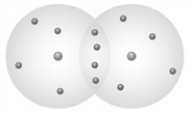 The type of bond formed is a single covalent bond.
 (True/False)
4.7/5 (80)
(80) The following is the Lewis structure for the compound commonly known as acetylene
Fill in the blanks with the appropriate integer including zero if necessary (0,1,2,3,etc.).
-Acetylene contains_____________________nonbonding electrons.
Fill in the blanks with the appropriate integer including zero if necessary (0,1,2,3,etc.).
-Acetylene contains_____________________nonbonding electrons. (Short Answer)
4.8/5 (69)
(69) The following is the Lewis structure for the compound commonly known as acetylene
Fill in the blanks with the appropriate integer including zero if necessary (0,1,2,3,etc.).
-__________________atoms in acetylene obey the octet rule.
Fill in the blanks with the appropriate integer including zero if necessary (0,1,2,3,etc.).
-__________________atoms in acetylene obey the octet rule. (Short Answer)
4.9/5 (81)
(81) 
Filters
- Essay(0)
- Multiple Choice(0)
- Short Answer(0)
- True False(0)
- Matching(0)