



 Chat with AI
Exam 12: Intermolecular Forces and Liquids and Solids

Exam 1: Introduction153 Questions
Exam 2: Atoms, Molecules, and Ions141 Questions
Exam 3: Stoichiometry168 Questions
Exam 4: Reactions in Aqueous Solution156 Questions
Exam 5: Gases109 Questions
Exam 6: Energy Relationships in Chemical Reactions105 Questions
Exam 7: The Electronic Structure of Atoms115 Questions
Exam 8: The Periodic Table119 Questions
Exam 9: Chemical Bonding I: the Covalent Bond118 Questions
Exam 10: Chemical Bonding Ii: Molecular Geometry and Hybridization of Atomic Orbitals120 Questions
Exam 11: Introduction to Organic Chemistry57 Questions
Exam 12: Intermolecular Forces and Liquids and Solids138 Questions
Exam 13: Physical Properties of Solutions109 Questions
Exam 14: Chemical Kinetics114 Questions
Exam 15: Chemical Equilibrium99 Questions
Exam 16: Acids and Bases163 Questions
Exam 17: Acid-Base Equilibria and Solubility Equilibria92 Questions
Exam 18: Thermodynamics112 Questions
Exam 19: Redox Reactions and Electrochemistry138 Questions
Exam 20: The Chemistry of Coordination Compounds76 Questions
Exam 21: Nuclear Chemistry112 Questions
Exam 22: Organic Polymerssynthetic and Natural42 Questions
Select questions type


Vanadium crystallizes in a body-centered cubic lattice, and the length of the edge of a unit cell is 305 pm. What is the density of V?
(Multiple Choice)
4.9/5  (92)
(92) Which one of the following substances crystallizes as a covalent crystal?
(Multiple Choice)
4.8/5 (91)
(91) Which of the following properties indicates the presence of strong intermolecular forces in a liquid?
(Multiple Choice)
4.8/5 (90)
(90) Given the following compound and its boiling point, identify whether it is polar or nonpolar: HCl, -84.9°C.
(Short Answer)
4.8/5 (78)
(78) Which one of the following substances should exhibit hydrogen bonding in the liquid state?
(Multiple Choice)
4.7/5 (88)
(88) Of the pair of compounds given, which would have the stronger intermolecular forces of attraction?
CH4 or CH3OH
(Short Answer)
4.8/5 (98)
(98) The meniscus for water is curved upward at the edges (i.e., it is "concave up"). Explain this phenomenon in terms of cohesion and adhesion.
(Essay)
4.7/5 (77)
(77) Which one of the following is an example of a covalent network solid?
(Multiple Choice)
4.9/5 (69)
(69) The mineral manganosite, manganese(II)oxide, crystallizes in the rock salt structure (the face-centered structure adopted by NaCl)with a density of 5.365 g/cm3. Find the unit cell edge length of manganosite.
(Multiple Choice)
4.8/5 (81)
(81) Acetic acid has a heat of fusion of 10.8 kJ/mol and a heat of vaporization of 24.3 kJ/mol. What is the expected value for the heat of sublimation of acetic acid?
(Multiple Choice)
4.8/5 (87)
(87) Which of the following would be expected to have the lowest vapor pressure at room temperature?
(Multiple Choice)
4.7/5 (91)
(91) Magnesium oxide, MgO, melts at 2,800°C and is very hard. The liquid conducts electricity very well. What kind of crystal is this?
(Short Answer)
4.9/5 (81)
(81) Indicate all the types of intermolecular forces of attraction in CHCl3(l).
(Short Answer)
4.9/5 (74)
(74) The heat capacity of liquid water is 4.18 J/g·°C and the heat of vaporization is 40.7 kJ/mol. How many kilojoules of heat must be provided to convert 1.00 g of liquid water at 67°C into 1.00 g of steam at 100°C?
(Multiple Choice)
4.8/5 (79)
(79) 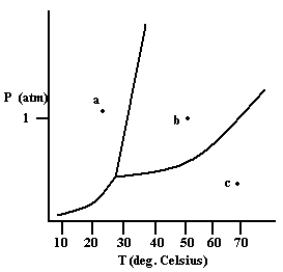
Calculate the amount of heat that must be absorbed by 10.0 g of ice at -20°C to convert it to liquid water at 60.0°C. Given: specific heat (ice)= 2.1 J/g·°C; specific heat (water)= 4.18 J/g·°C; Hfus = 6.0 kJ/mol.
(Multiple Choice)
4.9/5 (71)
(71) Given the following compound and its boiling point, identify whether it is polar or nonpolar: Ar, -185.7°C.
(Short Answer)
4.7/5 (70)
(70) 
Filters
- Essay(0)
- Multiple Choice(0)
- Short Answer(0)
- True False(0)
- Matching(0)