



 Chat with AI
Exam 8: The Wage Structure

Exam 1: Labor Economics: Introduction and Overview13 Questions
Exam 2: The Theory of Individual Labor Supply54 Questions
Exam 3: Population, Participation Rates, and Hours of Work44 Questions
Exam 4: Labor Quality: Investing in Human Capital49 Questions
Exam 5: The Demand for Labor64 Questions
Exam 6: Wage Determination and the Allocation of Labor38 Questions
Exam 7: Alternative Pay Schemes and Labor Efficiency49 Questions
Exam 8: The Wage Structure44 Questions
Exam 9: Mobility,Migration,and Efficiency50 Questions
Exam 10: Labor Unions and Collective Bargaining53 Questions
Exam 11: The Economic Impact of Unions50 Questions
Exam 12: Government and the Labor Market: Employment, Expenditures, and Taxation45 Questions
Exam 13: Government and the Labor Market: Legislation and Regulation49 Questions
Exam 14: Labor Market Discrimination60 Questions
Exam 15: Job Search: External and Internal34 Questions
Exam 16: The Distribution of Personal Earnings39 Questions
Exam 17: Labor Productivity: Wages,Prices,and Employment42 Questions
Exam 18: Employment and Unemployment52 Questions
Select questions type


Compared to present-oriented people,individuals who are more future-oriented tend to have _______ discount rates and consequently tend to obtain _______ education and earnings:
(Multiple Choice)
4.9/5  (76)
(76) Suppose all workers are identical but working for Ajax is more pleasant than working for Acme.In all other nonwage respects the two firms offer the same job characteristics.In equilibrium:
(Multiple Choice)
4.9/5 (79)
(79) Consider a worker who faces a tradeoff between wages on the vertical axis and job safety on the horizontal axis.The less averse a worker is to risk of injury on the job,the:
(Multiple Choice)
4.9/5 (75)
(75) Average hourly pay for production workers in the U.S.in 2010 was:
(Multiple Choice)
4.8/5 (78)
(78) Which of the following research findings would support an efficiency wage explanation of pay differentials?
(Multiple Choice)
4.9/5 (86)
(86) refer to the following diagrams. -From the indifference curves,we can infer that worker A:
 (Multiple Choice)
4.9/5 (82)
(82) "The high psychic costs of leaving friends and family deter migration in response to wage differentials." This statement reflects the existence of:
(Multiple Choice)
4.8/5 (71)
(71) All else equal,large firms tend to pay higher wages.This may be explained by all of the following,except:
(Multiple Choice)
4.8/5 (80)
(80) refer to the following diagram
 -The shape of the worker's indifference curves-I1,I2,and I3-indicates that:
 (Multiple Choice)
4.9/5 (87)
(87) People who receive relatively high pay also tend to work in a relatively desirable work environment.This is probably because:
(Multiple Choice)
4.9/5 (92)
(92) Fringe benefit packages differ substantially from one firm to the next because:
(Multiple Choice)
4.9/5 (75)
(75) refer to the following diagram
-The highest level of utility the worker can possibly achieve is:
-The highest level of utility the worker can possibly achieve is: (Multiple Choice)
4.8/5 (97)
(97) Research by Krueger and Allen suggests that a substantial proportion of the increase in the college wage premium in the 1980s and 1990s can be explained by:
(Multiple Choice)
4.8/5 (69)
(69) refer to the following diagram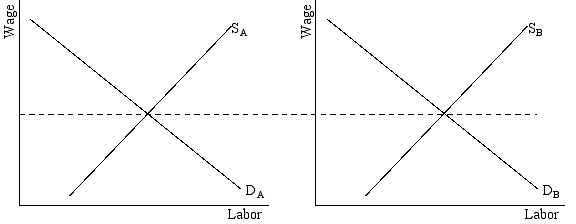 -Suppose that all other nonwage aspects of the jobs in these two markets are identical.We would expect labor supply in B to increase if:
 (Multiple Choice)
4.9/5 (66)
(66) Lower-paid workers often seem to have less desirable working conditions as well because:
(Multiple Choice)
4.9/5 (76)
(76) refer to the following diagram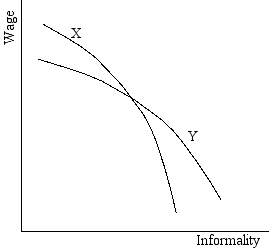 -Consider a worker who faces a trade-off between higher wages and a more relaxed work environment as shown in the diagram.A worker whose indifference curves are relatively steep:
 (Multiple Choice)
4.8/5 (76)
(76) 
Filters
- Essay(0)
- Multiple Choice(0)
- Short Answer(0)
- True False(0)
- Matching(0)