



 Chat with AI
Exam 10: Labor Unions and Collective Bargaining

Exam 1: Labor Economics: Introduction and Overview13 Questions
Exam 2: The Theory of Individual Labor Supply54 Questions
Exam 3: Population, Participation Rates, and Hours of Work44 Questions
Exam 4: Labor Quality: Investing in Human Capital49 Questions
Exam 5: The Demand for Labor64 Questions
Exam 6: Wage Determination and the Allocation of Labor38 Questions
Exam 7: Alternative Pay Schemes and Labor Efficiency49 Questions
Exam 8: The Wage Structure44 Questions
Exam 9: Mobility,Migration,and Efficiency50 Questions
Exam 10: Labor Unions and Collective Bargaining53 Questions
Exam 11: The Economic Impact of Unions50 Questions
Exam 12: Government and the Labor Market: Employment, Expenditures, and Taxation45 Questions
Exam 13: Government and the Labor Market: Legislation and Regulation49 Questions
Exam 14: Labor Market Discrimination60 Questions
Exam 15: Job Search: External and Internal34 Questions
Exam 16: The Distribution of Personal Earnings39 Questions
Exam 17: Labor Productivity: Wages,Prices,and Employment42 Questions
Exam 18: Employment and Unemployment52 Questions
Select questions type


Negotiating a contract with a group of firms in an industry is an example of:
(Multiple Choice)
4.9/5  (99)
(99) refer to the following diagram, in which EC is the employer concession curve and UR is the union resistance curve.
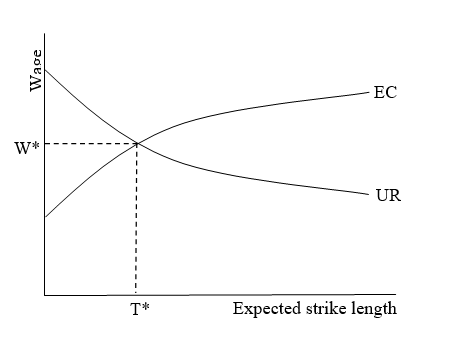 -The more elastic the demand for labor,the:
 (Multiple Choice)
4.9/5 (77)
(77) According to models of asymmetric information,strikes are more likely when:
(Multiple Choice)
4.8/5 (84)
(84) refer to the following graph, in which Wc is the competitive wage and Ic is the union’s utility level at the competitive wage and employment level.
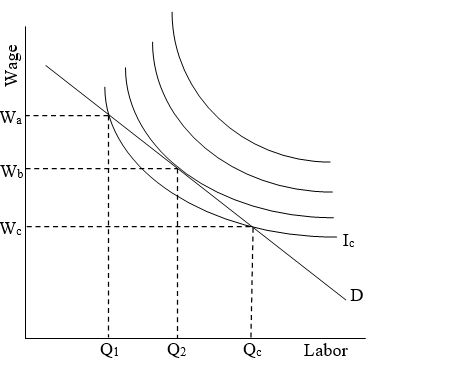 -The wage/employment combination given by Wb/Q2 is:
 (Multiple Choice)
4.9/5 (75)
(75) Compared to the 1950s,current union membership as a percent of the labor force in the U.S.is:
(Multiple Choice)
4.9/5 (89)
(89) The level of union organization that is most likely to lobby congress for legislation that prohibits the hiring of permanent strikebreakers is the:
(Multiple Choice)
4.7/5 (84)
(84) Which one of the following hypotheses is not generally given as an explanation of the change in relative union membership?
(Multiple Choice)
4.8/5 (76)
(76) The level of union organization that is most likely to "organize the unorganized" is the:
(Multiple Choice)
4.9/5 (72)
(72) A union will most likely attempt to restrict the growth of labor supply if:
(Multiple Choice)
4.8/5 (82)
(82) 
Filters
- Essay(0)
- Multiple Choice(0)
- Short Answer(0)
- True False(0)
- Matching(0)