



 Chat with AI
Exam 14: The Expansion of Space

Exam 1: Our Place in the Universe71 Questions
Exam 2: Patterns in the Skymotions of Earth92 Questions
Exam 3: Laws of Motion70 Questions
Exam 4: Light and Telescopes71 Questions
Exam 5: The Formation of Stars and Planets79 Questions
Exam 6: Terrestrial Worlds in the Inner Solar System91 Questions
Exam 7: Atmospheres of Venus, Earth, and Mars69 Questions
Exam 8: The Giant Planets79 Questions
Exam 9: Small Bodies of the Solar System75 Questions
Exam 10: Measuring the Stars75 Questions
Exam 11: Our Star: The Sun71 Questions
Exam 12: Evolution of Low-Mass Stars73 Questions
Exam 13: Evolution of High-Mass Stars71 Questions
Exam 14: The Expansion of Space71 Questions
Exam 15: The Realm of the Galaxies71 Questions
Exam 16: Our Galaxy: The Milky Way80 Questions
Exam 17: Modern Cosmology and the Origin of Structure100 Questions
Exam 18: Life in the Universe41 Questions
Select questions type


The only chemical elements that formed as the universe cooled down after the Big Bang were hydrogen,deuterium,and helium.
(True/False)
5.0/5  (85)
(85) Assuming the Hubble constant is equal to 22 km/s/Mly,estimate the age of the universe (or Hubble time).Note that 1 Mly = 9.5 × 10¹⁸ km and 1 year = 3.17 × 10⁷ s.
(Essay)
4.7/5 (78)
(78) How did Edwin Hubble definitively prove that "spiral nebulae" were individual galaxies that were separate from the Milky Way?
(Essay)
4.7/5 (73)
(73) After the Big Bang,as the universe cooled and protons and electrons combined so that the universe became neutral,what important consequence happened?
(Multiple Choice)
4.9/5 (84)
(84) Examine the figure below.Describe why the distance ladder is so important to the field of cosmology.
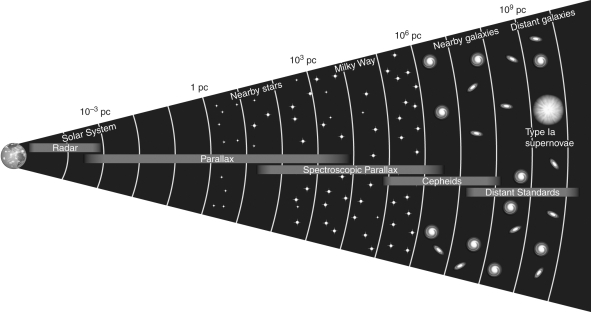
(Essay)
4.9/5 (83)
(83) Why is it NOT possible to look all the way back to the Big Bang itself?
(Multiple Choice)
4.8/5 (84)
(84) If we lived on a galaxy one billion light-years from our own,what would we see?
(Multiple Choice)
4.8/5 (72)
(72) As the universe expands,the sizes of galaxies expand a measurable amount as well.
(True/False)
4.9/5 (79)
(79) The Cosmological Principle says that physical laws that are true in one part of the universe must be true in every part of the universe.
(True/False)
4.8/5 (75)
(75) Which of the following is NOT a prediction of the standard Big Bang theory that has been successfully verified by observations?
(Multiple Choice)
4.8/5 (88)
(88) If the density of normal matter,such as protons and electrons,were higher in the early universe,would there have been more or less 4He made in the Big Bang?
(Essay)
4.9/5 (84)
(84) If the spectrum of a distant galaxy is observed to have a calcium K absorption line that occurs at a wavelength of 500.4 nm,what is this galaxy's distance if the rest wavelength of this absorption line is 393.4 nm?
(Multiple Choice)
4.8/5 (71)
(71) Why are some galaxies' spectra blueshifted rather than redshifted?
(Multiple Choice)
4.9/5 (73)
(73) The cosmic microwave background radiation contains photons left over from the epoch in the universe's history when electrons recombined with nuclei.
(True/False)
4.9/5 (66)
(66) Describe the two assumptions regarding the universe that the cosmological principle makes.
(Essay)
4.9/5 (78)
(78) The standard Big Bang theory successfully predicts that the fraction of helium by mass in the primordial universe was 2 percent.
(True/False)
4.9/5 (73)
(73) The spectrum of a galaxy is observed to have a hydrogen emission line,normally found at 656.3 nm,with a measured wavelength of 928.7 nm.What is its redshift?
(Essay)
4.8/5 (88)
(88) In the Great Debate of 1920,Curtis argued that spiral nebulae were individual galaxies,while Shapley argued spiral nebulae must be part of the Milky Way because the Milky Way was very large in size.
(True/False)
4.9/5 (75)
(75) If you found a galaxy with a hydrogen emission line,normally found at 656.3 nm,with a measured wavelength of 756.3 nm,what would the galaxy's recessional velocity be if the Hubble constant is 22 km/s/Mly?
(Multiple Choice)
4.8/5 (78)
(78) 
Filters
- Essay(0)
- Multiple Choice(0)
- Short Answer(0)
- True False(0)
- Matching(0)