



 Chat with AI
Exam 13: Evolution of High-Mass Stars

Exam 1: Our Place in the Universe71 Questions
Exam 2: Patterns in the Skymotions of Earth92 Questions
Exam 3: Laws of Motion70 Questions
Exam 4: Light and Telescopes71 Questions
Exam 5: The Formation of Stars and Planets79 Questions
Exam 6: Terrestrial Worlds in the Inner Solar System91 Questions
Exam 7: Atmospheres of Venus, Earth, and Mars69 Questions
Exam 8: The Giant Planets79 Questions
Exam 9: Small Bodies of the Solar System75 Questions
Exam 10: Measuring the Stars75 Questions
Exam 11: Our Star: The Sun71 Questions
Exam 12: Evolution of Low-Mass Stars73 Questions
Exam 13: Evolution of High-Mass Stars71 Questions
Exam 14: The Expansion of Space71 Questions
Exam 15: The Realm of the Galaxies71 Questions
Exam 16: Our Galaxy: The Milky Way80 Questions
Exam 17: Modern Cosmology and the Origin of Structure100 Questions
Exam 18: Life in the Universe41 Questions
Select questions type


All evolutionary differences between high- and low-mass stars can be attributed to differences in the amount of gravity each star possesses.
(True/False)
4.9/5  (87)
(87) Examine the figure below.Hydrogen burns through the CNO cycle only in high-mass main-sequence stars because of the greater __________ in their cores. 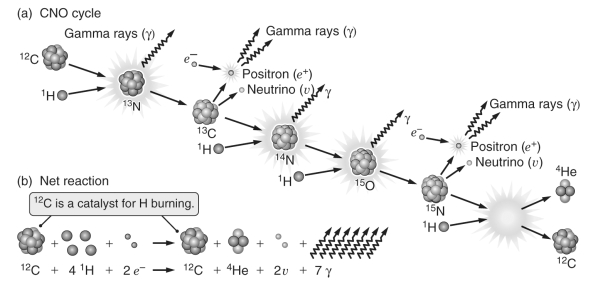
(Multiple Choice)
4.8/5 (82)
(82) Black holes have an infinitely small radius,but a finite event horizon.
(True/False)
5.0/5 (85)
(85) While traveling the galaxy in a spacecraft,you and a colleague set out to investigate the 106 M black hole at the center of our galaxy.Your colleague hops aboard an escape pod and drops into a circular orbit around the black hole,maintaining a distance of 1 AU,while you remain much farther away in the spacecraft but from which you can easily monitor your colleague.After doing some experiments to measure the strength of gravity,your colleague signals his/her results back to you using a green laser.What would you see?
(Multiple Choice)
4.8/5 (96)
(96) What would happen if mass were continually added to a 2 M neutron star?
(Multiple Choice)
4.9/5 (88)
(88) Essentially all the elements heavier than iron in our galaxy were formed:
(Multiple Choice)
4.8/5 (86)
(86) Most of the uranium (U; atomic mass = 238)found on the Earth was formed in Type II supernovae explosions.
(True/False)
4.8/5 (75)
(75) Gravitational lensing occurs when __________ distorts the fabric of spacetime.
(Multiple Choice)
4.9/5 (80)
(80) Which of the following is a consequence of Einstein's special theory of relativity?
(Multiple Choice)
4.9/5 (80)
(80) What is the difference between the singularity and the event horizon of a black hole?
(Essay)
4.9/5 (84)
(84) As a high-mass main-sequence star evolves off the main sequence,it follows a __________ on the H-R diagram.
(Multiple Choice)
4.8/5 (78)
(78) While traveling the galaxy in a spacecraft,you and a colleague set out to investigate a 1 M black hole.Your colleague hops aboard an escape pod and drops into a circular orbit around the black hole maintaining a distance of 10 km from it,while you remain much farther away inside the spacecraft.After doing some experiments to measure the strength of gravity,your colleague signals the results back to you using a green laser.What would you see,and why?
(Essay)
4.9/5 (88)
(88) Photons have no mass,and Einstein's theory of general relativity says:
(Multiple Choice)
4.9/5 (72)
(72) Explain why Einstein's theory of general relativity predicts the existence of gravitational lensing.
(Essay)
4.8/5 (86)
(86) Type Ia and Type II supernovae are approximately equal in luminosity.
(True/False)
4.8/5 (91)
(91) Black holes that are stellar remnants can be found by searching for:
(Multiple Choice)
4.8/5 (72)
(72) Why does the luminosity of a high-mass star remain nearly constant as the star burns heavy elements in its core,even though it is producing millions of times more energy per second than it did on the main sequence?
(Multiple Choice)
4.7/5 (85)
(85) Assume that a group of explorers traveled to the Orion Nebula,the nearest star-forming cloud at a distance of 1,300 light-years,using revolutionary technology that allowed them to travel at a speed very close to the speed of light.Observers back on Earth would say it took them __________ to get there,but the travelers would say it took them __________ to get there.
(Multiple Choice)
4.8/5 (84)
(84) 
Filters
- Essay(0)
- Multiple Choice(0)
- Short Answer(0)
- True False(0)
- Matching(0)