



 Chat with AI
Exam 5: Externalities

Exam 1: Introduction31 Questions
Exam 2: Tools of Positive Analysis35 Questions
Exam 3: Tools of Normative Analysis32 Questions
Exam 4: Public Goods34 Questions
Exam 5: Externalities37 Questions
Exam 6: Political Economy37 Questions
Exam 7: Education30 Questions
Exam 8: Cost-Benefit Analysis35 Questions
Exam 9: The Health Care Market30 Questions
Exam 10: Government and the Market for Health Care31 Questions
Exam 11: Social Security30 Questions
Exam 12: Income Redistribution: Conceptual Issues32 Questions
Exam 13: Expenditure Programs for the Poor35 Questions
Exam 14: Taxation and Income Distribution34 Questions
Exam 15: Taxation and Efficiency34 Questions
Exam 16: Efficient and Equitable Taxation34 Questions
Exam 17: The Personal Income Tax33 Questions
Exam 18: Personal Taxation and Behavior31 Questions
Exam 19: The Corporation Tax35 Questions
Exam 20: Deficit Finance32 Questions
Exam 21: Fundamental Tax Reform: Taxes on Consumption and Wealth37 Questions
Exam 22: Public Finance in a Federal System36 Questions
Select questions type


Reducing output from the privately optimal level to the socially optimal level will
(Multiple Choice)
4.8/5  (78)
(78) Incentive-based regulations provide polluters no incentive to reduce pollution and are thus not used often.
(True/False)
4.8/5 (86)
(86) Consider the case of two farmers,Tony and Hakim,depicted in the following figure.Both use DDT (a chemical pesticide)for their crops.The use of DDT causes an externality for swimmers down river from the farms.
(a)Show the amount of pesticides used if each uses the privately optimal level of pesticides.
(b)Show the amount of pesticides used if they are socially concerned.
(c)Why is a reduction back to XH = HT not socially desired? 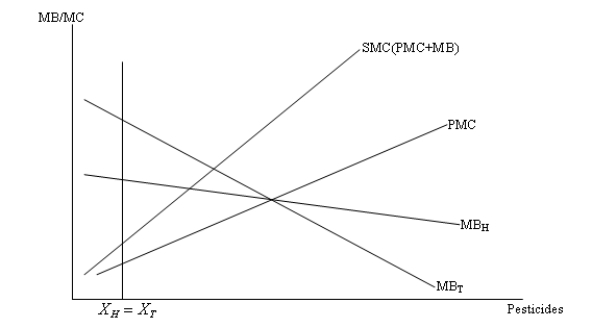
(Essay)
4.9/5 (78)
(78) 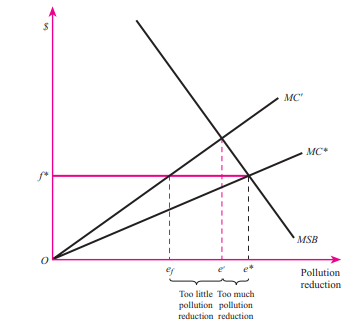 Figure 5.11
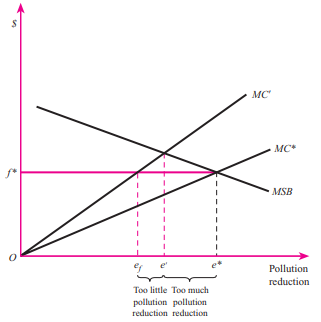 Figure 5.12
-Refer to Figure 5.11 and Figure 5.12 of to answer this question:
A) In case of an inelastic marginal social benefit curve,what type of pollution reduction system should the government employ? Why?
B)If the social benefit curve is elastic,do you answer change?
C)What are advantages and disadvantages of Cap-and-Trade systems over Emission Fee systems when the inflation and change in marginal costs are considered?
Figure 5.11
Figure 5.12
-Refer to Figure 5.11 and Figure 5.12 of to answer this question:
A) In case of an inelastic marginal social benefit curve,what type of pollution reduction system should the government employ? Why?
B)If the social benefit curve is elastic,do you answer change?
C)What are advantages and disadvantages of Cap-and-Trade systems over Emission Fee systems when the inflation and change in marginal costs are considered? (Essay)
4.8/5 (81)
(81) An emissions fee is preferable to a cap-and-trade when MSB are elastic and costs are uncertain.
(True/False)
4.9/5 (97)
(97) Which policy is more effective when handling externalities: Cap-and-trade or emissions fee?
(Essay)
4.7/5 (86)
(86) Why are command- and -control regulations less flexible than incentive based systems?
(Essay)
4.8/5 (77)
(77) Externalities can be produced by ____________,as well as ____________.
(Multiple Choice)
4.8/5 (90)
(90) List and discuss three problems that might arise when using the Coase theorem.
(Essay)
4.8/5 (76)
(76) A subsidy for pollution not produced can induce producers to pollute at the efficient level.
(True/False)
4.7/5 (84)
(84) 
Filters
- Essay(0)
- Multiple Choice(0)
- Short Answer(0)
- True False(0)
- Matching(0)