



 Chat with AI
Exam 7: Education

Exam 1: Introduction31 Questions
Exam 2: Tools of Positive Analysis35 Questions
Exam 3: Tools of Normative Analysis32 Questions
Exam 4: Public Goods34 Questions
Exam 5: Externalities37 Questions
Exam 6: Political Economy37 Questions
Exam 7: Education30 Questions
Exam 8: Cost-Benefit Analysis35 Questions
Exam 9: The Health Care Market30 Questions
Exam 10: Government and the Market for Health Care31 Questions
Exam 11: Social Security30 Questions
Exam 12: Income Redistribution: Conceptual Issues32 Questions
Exam 13: Expenditure Programs for the Poor35 Questions
Exam 14: Taxation and Income Distribution34 Questions
Exam 15: Taxation and Efficiency34 Questions
Exam 16: Efficient and Equitable Taxation34 Questions
Exam 17: The Personal Income Tax33 Questions
Exam 18: Personal Taxation and Behavior31 Questions
Exam 19: The Corporation Tax35 Questions
Exam 20: Deficit Finance32 Questions
Exam 21: Fundamental Tax Reform: Taxes on Consumption and Wealth37 Questions
Exam 22: Public Finance in a Federal System36 Questions
Select questions type


Publicly provided education is generally considered

Free
(Multiple Choice)
5.0/5  (86)
(86) Correct Answer: Verified
C
The presence of positive externalities _____ justify the current structure of government programs for higher education.
Free
(Multiple Choice)
4.8/5 (79)
(79) Correct Answer:Verified
VerifiedD
Merit pay for teachers has a _________ on test student test scores.
Free
(Multiple Choice)
4.9/5 (86)
(86) Correct Answer:Verified
VerifiedC
Crowding out occurs when public provision of a good substitutes for private provision.
(True/False)
4.9/5 (84)
(84) Some critics have argued that moving children to private schools might reduce the _________ of education.
(Multiple Choice)
4.7/5 (63)
(63) Increasing the amount of annual per pupil expenditures has helped in increasing student performance.What could make that improvement better?
(Essay)
4.9/5 (70)
(70) Assume that the budget constraint in Figure 7.1 panel A is: PEE +PAA = I,where I is total income and PE is the price of education and PA is the price of all other goods.If U(E,A)= A+E,PE = 2,PA = 1,and I = 10 what is the quantity of education and all other goods consumed?
-If the price of education drops to 1,how much of the two goods are consumed now?
(Essay)
4.9/5 (75)
(75) In 2007 ___________ had the highest annual expenditures on public and private schools per student.
(Multiple Choice)
4.7/5 (71)
(71) Does increasing reliance on student loans distort students career choices?
(Essay)
4.8/5 (85)
(85) Education is one of the few areas of study in your text that do not require the use of public finance.
(True/False)
5.0/5 (82)
(82) Between 2003 and 2004 real annual expenditure per pupil in public elementary and secondary schools
(Multiple Choice)
4.8/5 (80)
(80) Do you believe that class size reductions will help student performance?
(Essay)
4.9/5 (99)
(99) 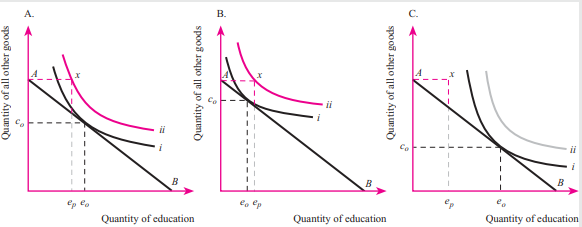 Figure 7.1
-In Figure 7.1,Panel B shows free public schooling leading to less education.
Figure 7.1
-In Figure 7.1,Panel B shows free public schooling leading to less education. (True/False)
4.8/5 (82)
(82) A criticism of market-oriented schemes say that consumers may not be well informed.
(True/False)
4.8/5 (93)
(93) Standardized tests do not receive universal acceptance as being helpful in making schools more accountable.Discuss why.
(Essay)
4.9/5 (81)
(81) Standardized tests are used in efforts to make schools more accountable.
(True/False)
4.8/5 (64)
(64) Commodity egalitarianism suggests that some goods be available to everyone.
(True/False)
4.7/5 (88)
(88) 
Filters
- Essay(0)
- Multiple Choice(0)
- Short Answer(0)
- True False(0)
- Matching(0)