



 Chat with AI
Exam 9: The Health Care Market

Exam 1: Introduction31 Questions
Exam 2: Tools of Positive Analysis35 Questions
Exam 3: Tools of Normative Analysis32 Questions
Exam 4: Public Goods34 Questions
Exam 5: Externalities37 Questions
Exam 6: Political Economy37 Questions
Exam 7: Education30 Questions
Exam 8: Cost-Benefit Analysis35 Questions
Exam 9: The Health Care Market30 Questions
Exam 10: Government and the Market for Health Care31 Questions
Exam 11: Social Security30 Questions
Exam 12: Income Redistribution: Conceptual Issues32 Questions
Exam 13: Expenditure Programs for the Poor35 Questions
Exam 14: Taxation and Income Distribution34 Questions
Exam 15: Taxation and Efficiency34 Questions
Exam 16: Efficient and Equitable Taxation34 Questions
Exam 17: The Personal Income Tax33 Questions
Exam 18: Personal Taxation and Behavior31 Questions
Exam 19: The Corporation Tax35 Questions
Exam 20: Deficit Finance32 Questions
Exam 21: Fundamental Tax Reform: Taxes on Consumption and Wealth37 Questions
Exam 22: Public Finance in a Federal System36 Questions
Select questions type


Which one of these conditions is not a part of asymmetric information?

Free
(Multiple Choice)
4.8/5  (75)
(75) Correct Answer: Verified
C
Which country had the highest per capita expenditures on health care in 2004?
Free
(Multiple Choice)
4.8/5 (77)
(77) Correct Answer:Verified
VerifiedD
What effect would a "price cap" have on medical services?
Free
(Essay)
4.8/5 (66)
(66) Correct Answer:Verified
VerifiedAs we learned in previous chapters,a price cap would have the effect of creating shortages in that the supply of medical services would not meet the demand.
Paying money in order to guarantee a certain level of compensation should an adverse event occur is
(Multiple Choice)
4.9/5 (70)
(70) Suppose that the demand for medical services can be characterized by the equation X = 500 - P/3.Suppose further that the supply of health services can be characterized by the equation X = P - 100.
(a)What is the equilibrium quantity and price in the market for health services?
(b)In an effort to make health services more affordable,the government restricts the price of health services to be no greater than $250.What will happen to the quantity of health services in the market?
(Essay)
4.8/5 (78)
(78) President Obama has suggested some form or universal health coverage for all Americans.How do you feel about this?
(Essay)
4.7/5 (83)
(83) 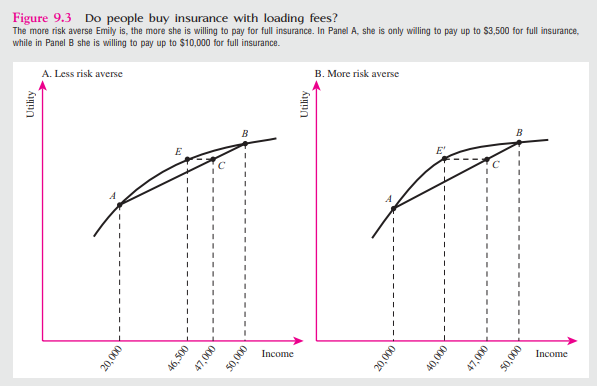 -In Figure 9.3,Panel B,$40,000 for certain is as desirable as $47,000 with risk.
 (True/False)
4.9/5 (69)
(69) 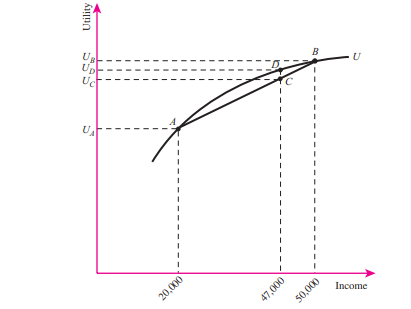 -In Figure 9.2,the value of insurance is $7,000.
We have read in this chapter that people with insurance may be more likely to engage in risky behavior because they are insured.Does it make sense then that there should be an "insurance tax" on people that engage in these types of activities?
(Essay)
4.9/5 (85)
(85) In 2007,the percentage of health care expenditures paid out-of-pocket was
(Multiple Choice)
4.8/5 (93)
(93) Pooling individuals allow insurance companies to _______ risk from a societal point of view.
(Multiple Choice)
4.9/5 (80)
(80) 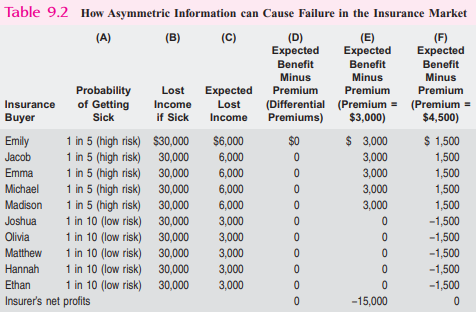 -In Table 9.2,Emily will loose no income if she becomes sick.
When people behave in ways that involve increased risk because they have insurance,this is known as
(Multiple Choice)
4.7/5 (81)
(81) We have read that the uninsured and the insured behave differently in regard to medical services.Suppose that the insured have a demand curve that can be written as Q = 100 - P,where Q is the quantity of medical services and P is the price.Suppose further that the uninsured have a demand curve that can be written as Q = 100 - 2P.
(a)At a price of $10 of medical services,how much will each demand?
(b)At a quantity of 50 units,how much will the price be for the insured and uninsured?
(Essay)
5.0/5 (80)
(80) Most private medical insurance is provided through employers as a benefit to their employees.
(True/False)
4.9/5 (84)
(84) 
Filters
- Essay(0)
- Multiple Choice(0)
- Short Answer(0)
- True False(0)
- Matching(0)