



 Chat with AI
Exam 3: Forecasting

Exam 1: Introduction to Operations Management70 Questions
Exam 2: Competitiveness, Strategy, and Productivity73 Questions
Exam 3: Forecasting164 Questions
Exam 4: Product and Service Design77 Questions
Exam 5: Strategic Capacity Planning for Products and Services103 Questions
Exam 6: Process Selection and Facility Layout151 Questions
Exam 7: Work Design and Measurement151 Questions
Exam 8: Location Planning and Analysis80 Questions
Exam 9: Management of Quality102 Questions
Exam 10: Quality Control141 Questions
Exam 11: Aggregate Planning and Master Scheduling81 Questions
Exam 12: MRP and ERP89 Questions
Exam 13: Inventory Management162 Questions
Exam 14: Jit and Lean Operations88 Questions
Exam 15: Supply Chain Management89 Questions
Exam 16: Scheduling134 Questions
Exam 17: Project Management137 Questions
Exam 18: Management of Waiting Lines81 Questions
Exam 19: Linear Programming105 Questions
Exam 20: Extension 4: Reliability10 Questions
Exam 21: Extension 5: Decision Theory126 Questions
Exam 22: Extension 7: Learning Curves68 Questions
Exam 23: Extension 8: The Transportation Model20 Questions
Exam 24: Extension 10: Acceptance Sampling65 Questions
Exam 25: Extension 14: Maintenance38 Questions
Select questions type


What is the forecast for this year using trend adjusted (double) smoothing with alpha = 0.3 and beta = 0.2, if the forecast for last year was 310, the forecast for two years ago was 430, and the trend estimate for last year's forecast was -150?
(Multiple Choice)
4.9/5  (75)
(75) Forecasts for groups of items tend to be less accurate than forecasts for individual items because forecasts for individual items don't include as many influencing factors.
(True/False)
4.9/5 (93)
(93) What is this week's forecast using a three-week simple moving average?
(Multiple Choice)
4.8/5 (84)
(84) The two most important factors in choosing a forecasting technique are:
(Multiple Choice)
4.9/5 (80)
(80) Which of the following changes would tend to shorten the time frame for short term forecasting?
(Multiple Choice)
4.8/5 (79)
(79) The shorter the forecast period, the more accurately the forecasts tend to track what actually happens.
(True/False)
5.0/5 (74)
(74) Forecasting techniques such as moving averages, exponential smoothing, and the naive approach all represent smoothed (averaged) values of time series data.
(True/False)
4.7/5 (84)
(84) A seasonal relative (or seasonal indexes) is expressed as a percentage of average or trend.
(True/False)
4.9/5 (90)
(90) A proactive approach to forecasting views forecasts as probable descriptions of future demand, and requires action to be taken to meet that demand.
(True/False)
4.9/5 (90)
(90) Forecasts help managers plan both the system itself and provide valuable information for using the system.
(True/False)
4.9/5 (93)
(93) Current information on _________ can have a significant impact on forecast accuracy:
(Multiple Choice)
4.9/5 (76)
(76) Forecasts based on an average tend to exhibit less variability than the original data.
(True/False)
4.9/5 (85)
(85) What is this year's forecast using a four-year simple moving average?
(Short Answer)
4.8/5 (75)
(75) What is the forecast for this year using the naive approach?
(Multiple Choice)
4.8/5 (87)
(87) For the data given below, what would the naive forecast be for the next period (period #5)? 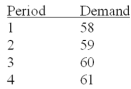
(Multiple Choice)
4.8/5 (92)
(92) Seasonal relatives can be used to de-seasonalize data or incorporate seasonality in a forecast.
(True/False)
4.8/5 (70)
(70) 
Filters
- Essay(0)
- Multiple Choice(0)
- Short Answer(0)
- True False(0)
- Matching(0)