



 Chat with AI
Exam 3: Forecasting

Exam 1: Introduction to Operations Management70 Questions
Exam 2: Competitiveness, Strategy, and Productivity73 Questions
Exam 3: Forecasting164 Questions
Exam 4: Product and Service Design77 Questions
Exam 5: Strategic Capacity Planning for Products and Services103 Questions
Exam 6: Process Selection and Facility Layout151 Questions
Exam 7: Work Design and Measurement151 Questions
Exam 8: Location Planning and Analysis80 Questions
Exam 9: Management of Quality102 Questions
Exam 10: Quality Control141 Questions
Exam 11: Aggregate Planning and Master Scheduling81 Questions
Exam 12: MRP and ERP89 Questions
Exam 13: Inventory Management162 Questions
Exam 14: Jit and Lean Operations88 Questions
Exam 15: Supply Chain Management89 Questions
Exam 16: Scheduling134 Questions
Exam 17: Project Management137 Questions
Exam 18: Management of Waiting Lines81 Questions
Exam 19: Linear Programming105 Questions
Exam 20: Extension 4: Reliability10 Questions
Exam 21: Extension 5: Decision Theory126 Questions
Exam 22: Extension 7: Learning Curves68 Questions
Exam 23: Extension 8: The Transportation Model20 Questions
Exam 24: Extension 10: Acceptance Sampling65 Questions
Exam 25: Extension 14: Maintenance38 Questions
Select questions type


A smoothing constant of .1 will cause an exponential smoothing forecast to react more quickly to a sudden change than a smoothing constant value of .3.
(True/False)
4.8/5  (85)
(85) For new products in a strong growth mode, a low alpha will minimize forecast errors when using exponential smoothing techniques.
(True/False)
4.9/5 (83)
(83) Bias exists when forecasts tend to be greater or less than the actual values of time series.
(True/False)
4.9/5 (79)
(79) What is this year's forecast using exponential smoothing with alpha = .25, if last year's smoothed forecast was 45?
(Short Answer)
4.8/5 (71)
(71) Forecasts of future demand are used by operations people to plan capacity.
(True/False)
4.8/5 (65)
(65) A manager uses the following equation to predict monthly receipts: Yt = 40,000 + 150t.What is the forecast for July if t = 0 in April of this year?
(Multiple Choice)
4.7/5 (77)
(77) The naive forecast can serve as a quick and easy standard of comparison against which to judge the cost and accuracy of other techniques.
(True/False)
4.9/5 (70)
(70) Using the latest observation in a sequence of data to forecast the next period is:
(Multiple Choice)
4.8/5 (86)
(86) What is this year's seasonally adjusted forecast for each season?
(Short Answer)
4.8/5 (83)
(83) What is the forecast for this year using trend adjusted (double) smoothing with alpha = .05 and beta = 0.3, if the forecast for last year was 21,000, the forecast for two years ago was 19,000, and the trend estimate for last year's forecast was 1,500?
(Multiple Choice)
4.7/5 (81)
(81) Consider the data below:
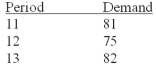 Using exponential smoothing with alpha = .2, and assuming the forecast for period 11 was 80, what would the forecast for period 14 be?
 (Essay)
4.8/5 (64)
(64) Once accepted by managers, forecasts should be held firm regardless of new input since many plans have been made using the original forecast.
(True/False)
4.9/5 (83)
(83) Given the following historical data and weights of .5, .3, and .2, what is the three-period moving average forecast for period 5? 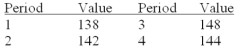
(Multiple Choice)
4.7/5 (82)
(82) Exponential smoothing adds a percentage (called alpha) of last period's forecast to estimate next period's demand.
(True/False)
4.9/5 (95)
(95) A persistent tendency for forecasts to be greater than or less than the actual values is called:
(Multiple Choice)
4.8/5 (75)
(75) 
Filters
- Essay(0)
- Multiple Choice(0)
- Short Answer(0)
- True False(0)
- Matching(0)