



 Chat with AI
Exam 8: Firms in Perfectly Competitive Markets

Exam 1: Economics: Foundations and Models159 Questions
Exam 2: Choices and Trade-Offs in the Market192 Questions
Exam 3: Where Prices Come From: The Interaction of Demand and Supply202 Questions
Exam 4: Elasticity: The Responsiveness of Demand and Supply224 Questions
Exam 5: Economic Efficiency, Government Price Setting and Taxes187 Questions
Exam 6: Consumer Choice and Behavioural Economics254 Questions
Exam 7: Technology Production and Costs301 Questions
Exam 8: Firms in Perfectly Competitive Markets269 Questions
Exam 9: Monopoly Markets281 Questions
Exam 10: Monopolistic Competition: The Competitive Model in a More Realistic255 Questions
Exam 11: Oligopoly: Markets With Few Competitors186 Questions
Exam 12: The Markets for Labour and Other Factors of Production250 Questions
Exam 13: Comparative Advantage and the Gains From International Trade131 Questions
Exam 14: Government Intervention in the Market113 Questions
Exam 15: Externalities, Environmental Policy and Public Goods212 Questions
Exam 16: The Distribution of Income and Social Policy121 Questions
Select questions type


Ethan Nicholas, who developed the iShoot application for the iPhone 3G, found that to maintain sales in a profitable competitive market, the price of a product
(Multiple Choice)
4.9/5  (74)
(74) Figure 8.7  Figure 8.7 shows cost and demand curves facing a profit-maximising, perfectly competitive firm.
-Refer to Figure 8.7.Identify the short-run shut down point for the firm.
Figure 8.7 shows cost and demand curves facing a profit-maximising, perfectly competitive firm.
-Refer to Figure 8.7.Identify the short-run shut down point for the firm. (Multiple Choice)
4.8/5 (85)
(85) Figure 8.11 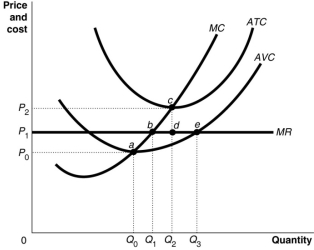 -Refer to Figure 8.11.Suppose the prevailing price is P1 and the firm is currently producing its loss-minimising quantity.If the firm represented in the diagram continues to stay in business, in the long-run equilibrium
 (Multiple Choice)
4.7/5 (82)
(82) If, for a given output level, a perfectly competitive firm's price is less than its average variable cost, the firm
(Multiple Choice)
4.8/5 (94)
(94) Which of the following is true of firms that are price takers?
(Multiple Choice)
4.8/5 (87)
(87) Explain two different ways to determine the profit-maximising level of output for a firm in a perfectly competitive market.
__________________________________________________________________________________________________________________________________________________________________________________________
(Essay)
4.8/5 (86)
(86) What are the two options for a firm that is operating at a loss in the short run?
(Multiple Choice)
4.9/5 (80)
(80) Assuming a market price of $4, fill in the columns in the following table.What is the profit-maximising level of production? What are the two ways to determine the profit-maximising level of production? 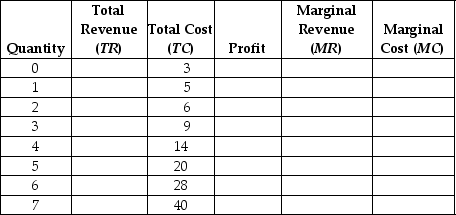 __________________________________________________________________________________________________________________________________________________________________________________________
 (Essay)
4.8/5 (72)
(72) Ted's Pancake Kitchen suffers a short-run loss.Ted should decide to shut down rather than continue to produce
(Multiple Choice)
4.8/5 (83)
(83) After an increase in demand in a constant-cost industry, firms will find themselves with higher average cost curves.
(True/False)
4.7/5 (77)
(77) Assume that price is greater than average variable cost.If a perfectly competitive seller is producing at an output where price is $11 and the marginal cost is $14.54, then to maximise profits the firm should
(Multiple Choice)
4.8/5 (86)
(86) The demand curve for an individual seller's product in perfect competition is
(Multiple Choice)
4.9/5 (90)
(90) Suppose Veronica sells teapots in the perfectly competitive teapot market.Her output per day and her costs are as follows: 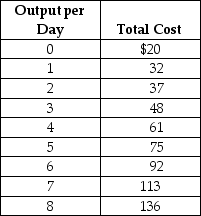 Suppose the current equilibrium price in the teapot market is $10.To maximise profit, how many teapots will Veronica produce, what price will she charge, and how much profit (or loss)will she make? Draw a graph to illustrate your answer.Your graph should include Veronica's demand, ATC, AVC, MC, and MR curves, the price she is charging, the quantity she is producing, and the area representing her profit (or loss).
__________________________________________________________________________________________________________________________________________________________________________________________
Suppose the current equilibrium price in the teapot market is $10.To maximise profit, how many teapots will Veronica produce, what price will she charge, and how much profit (or loss)will she make? Draw a graph to illustrate your answer.Your graph should include Veronica's demand, ATC, AVC, MC, and MR curves, the price she is charging, the quantity she is producing, and the area representing her profit (or loss).
__________________________________________________________________________________________________________________________________________________________________________________________ (Essay)
4.8/5 (87)
(87) For a perfectly competitive firm, at the profit-maximising output, average revenue equals marginal cost.
(True/False)
4.9/5 (72)
(72) What assumptions are necessary for a market to be perfectly competitive? Explain why each of these assumptions is important.
__________________________________________________________________________________________________________________________________________________________________________________________
(Essay)
4.9/5 (84)
(84) Figure 8.16 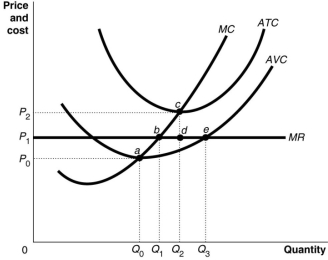 -Refer to Figure 8.16.If the market price is P1, the allocatively efficient output level is
 (Multiple Choice)
4.7/5 (69)
(69) Table 8.3  Arnie sells basketballs in a perfectly competitive market.Table 8.3 summarises Arnie's output per day (Q), total cost (TC), average total cost (ATC)and marginal cost (MC).
-Refer to Table 8.3.What will Arnie's output be and how much profit will he earn if the market price of basketballs is $5.00?
Arnie sells basketballs in a perfectly competitive market.Table 8.3 summarises Arnie's output per day (Q), total cost (TC), average total cost (ATC)and marginal cost (MC).
-Refer to Table 8.3.What will Arnie's output be and how much profit will he earn if the market price of basketballs is $5.00? (Multiple Choice)
4.8/5 (73)
(73) Suppose Veronica sells teapots in the perfectly competitive teapot market.Her output per day and her costs are as follows: 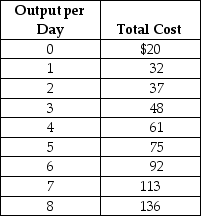 Suppose the current equilibrium price in the teapot market is $20.To maximise profit, how many teapots will Veronica produce, what price will she charge, and how much profit (or loss)will she make? Draw a graph to illustrate your answer.Your graph should include Veronica's demand, ATC, AVC, MC, and MR curves, the price she is charging, the quantity she is producing, and the area representing her profit (or loss).
__________________________________________________________________________________________________________________________________________________________________________________________
Suppose the current equilibrium price in the teapot market is $20.To maximise profit, how many teapots will Veronica produce, what price will she charge, and how much profit (or loss)will she make? Draw a graph to illustrate your answer.Your graph should include Veronica's demand, ATC, AVC, MC, and MR curves, the price she is charging, the quantity she is producing, and the area representing her profit (or loss).
__________________________________________________________________________________________________________________________________________________________________________________________ (Essay)
4.8/5 (80)
(80) Letters are used to represent the terms used to answer this question: price (P), quantity of output (Q), total cost (TC)and average total cost (ATC).Which of the following equations is equal to a firm's profit?
(Multiple Choice)
4.9/5 (87)
(87) Which of the following describes a situation in which a good or service is produced at the lowest possible cost?
(Multiple Choice)
4.8/5 (74)
(74) 
Filters
- Essay(0)
- Multiple Choice(0)
- Short Answer(0)
- True False(0)
- Matching(0)