



 Chat with AI
Exam 22: Industry Supply

Exam 1: Budget Constraint58 Questions
Exam 1: A: Budget Constraint30 Questions
Exam 2: Preferences49 Questions
Exam 2: A: Preferences30 Questions
Exam 3: Utility57 Questions
Exam 3: A: Utility29 Questions
Exam 4: Choice63 Questions
Exam 4: A: Choice31 Questions
Exam 5: Demand79 Questions
Exam 5: A: Demand22 Questions
Exam 6: Revealed Preference58 Questions
Exam 6: A: Revealed Preference26 Questions
Exam 7: Slutsky Equation51 Questions
Exam 7: A: Slutsky Equation30 Questions
Exam 8: Buying and Selling75 Questions
Exam 8: A: Buying and Selling30 Questions
Exam 9: Intertemporal Choice61 Questions
Exam 9: A: Intertemporal Choice30 Questions
Exam 10: Asset Markets46 Questions
Exam 10: A: Asset Markets30 Questions
Exam 11: Uncertainty39 Questions
Exam 11: A: Uncertainty25 Questions
Exam 12: Risky Assets16 Questions
Exam 12: A: Risky Assets10 Questions
Exam 13: Consumers Surplus42 Questions
Exam 13: A: Consumers Surplus30 Questions
Exam 14: Market Demand101 Questions
Exam 14: A: Market Demand25 Questions
Exam 15: Equilibrium48 Questions
Exam 15: A: Equilibrium20 Questions
Exam 16: Auctions36 Questions
Exam 16: A: Auctions25 Questions
Exam 17: Technology52 Questions
Exam 17: A: Technology30 Questions
Exam 18: Profit Maximization52 Questions
Exam 18: A: Profit Maximization21 Questions
Exam 19: Cost Minimization77 Questions
Exam 19: A: Cost Minimization26 Questions
Exam 20: Cost Curves51 Questions
Exam 20: A: Cost Curves20 Questions
Exam 21: Firm Supply41 Questions
Exam 21: A: Firm Supply15 Questions
Exam 22: Industry Supply49 Questions
Exam 22: A: Industry Supply33 Questions
Exam 23: Monopoly76 Questions
Exam 23: A: Monopoly30 Questions
Exam 24: Monopoly Behavior34 Questions
Exam 24: A: Monopoly Behavior20 Questions
Exam 25: Factor Markets24 Questions
Exam 25: A: Factor Markets20 Questions
Exam 26: Oligopoly56 Questions
Exam 26: A: Oligopoly30 Questions
Exam 27: Game Theory34 Questions
Exam 27: A: Game Theory25 Questions
Exam 28: Game Applications28 Questions
Exam 28: A: Game Applications25 Questions
Exam 29: Behavioral Economics34 Questions
Exam 30: Exchange68 Questions
Exam 30: A: Exchange30 Questions
Exam 31: Production35 Questions
Exam 31: A: Production25 Questions
Exam 32: Welfare27 Questions
Exam 32: A: Welfare25 Questions
Exam 33: Externalities42 Questions
Exam 33: A: Externalities25 Questions
Exam 34: Information Technology24 Questions
Exam 34: A: Information Technology15 Questions
Exam 35: Public Goods26 Questions
Exam 35: A: Public Goods20 Questions
Exam 36: Asymmetric Information31 Questions
Exam 36: A: Asymmetric Information20 Questions
Select questions type


If there are constant returns to scale in a competitive industry, then the long-run industry supply curve for that industry is horizontal.
(True/False)
4.9/5  (80)
(80) It is possible to have an industry in which all firms make zero economic profits in long-run equilibrium.
(True/False)
4.8/5 (75)
(75) On a tropical island there are 100 potential boat builders, numbered 1 through 100. Each can build up to8 boats a year, but anyone who goes into the boatbuilding business has to pay a fixed cost of $7. Marginal costs differ from person to person. Where y denotes the number of boats built per year, boat builder 1 has a total cost function c(y) = 7 + y. Boat builder 2 has a total cost function c(y) = 7 + 2y, and more generally, for each i, from 1 to 100, boat builder i has a cost function c(y) = 7 + iy. If the price of boats is 15, how many boats will be built per year?
(Multiple Choice)
4.7/5 (96)
(96) In the problem discussed in your workbook, the cost of capturing a cockatoo and transporting him to the United States is about $40 per bird. Cockatoos are drugged and smuggled in suitcases to the United States. Half of the smuggled cockatoos die in transit. Each smuggled cockatoo has a 10% probability of being discovered, in which case the smuggler is fined. If the fine imposed for each smuggled cockatoo is increased to $1,200, then the equilibrium price of cockatoos in the United States will be
(Multiple Choice)
4.7/5 (82)
(82) In the absence of government interference, there is a constant marginal cost of $4 per ounce for growing marijuana and delivering it to buyers. Suppose that government authorities seize shipments whenever they find them and resell the marijuana that they seize on the open market. The probability that any shipment of marijuana is seized is .50. If a shipment is seized, there is no other punishment besides loss of the marijuana that is seized. The effect of the government action is to
(Multiple Choice)
4.8/5 (79)
(79) In the absence of government interference, there is a constant marginal cost of $5 per ounce for growing marijuana and delivering it to buyers. If the probability that any shipment of marijuana is seized is .10 and the fine if a shipper is caught is $45 per ounce, then the equilibrium price of marijuana per ounce is
(Multiple Choice)
4.9/5 (80)
(80) The price elasticity of gasoline in the United States has been estimated to be 0.15. If this is so, should profit-maximizing gasoline stations raise their prices? (Explain why or why not.)
(Essay)
4.8/5 (80)
(80) In a certain industry, the supply curve of any firm is Si(p) =  . If a firm produces 6 units of output, what are its total variable costs?
 (Multiple Choice)
4.8/5 (83)
(83) The market for a good is in equilibrium when the government unexpectedly imposes a quantity tax of $2 per unit. In the short run, the price will rise by $2 per unit so that firms can regain their lost revenue and continue to produce.
(True/False)
4.8/5 (78)
(78) The cheese business in Lake Fon-du-lac, Wisconsin, is a competitive industry. All cheese manufacturers have the cost function C = Q2 + 4, while demand for cheese in the town is given by Qd = 120 - P. The long-run equilibrium number of firms in this industry is
(Multiple Choice)
5.0/5 (86)
(86) The cost per bushel of growing corn on a given acre of land depends partly on how intensely the land is farmed and partly on the quality of the soil, the amount of rainfall, and the length of the growing season. Suppose that the last three factors are summarized by a single index f for fertility. Suppose that the long-run total cost of producing y hundred bushels of corn on an acre of land of fertility f is c(y, f), where c(y, f) =  for y > 0 and c(0, f) = 0.
a. Write down a formula for the long-run average cost function per hundred bushels of corn from an acre of land of quality
b. At what level of output is long-run average cost minimized on an acre of land of quality f?
c. What is the lowest price per hundred bushels at which an acre of land of quality f will be used to produce corn?
f.
for y > 0 and c(0, f) = 0.
a. Write down a formula for the long-run average cost function per hundred bushels of corn from an acre of land of quality
b. At what level of output is long-run average cost minimized on an acre of land of quality f?
c. What is the lowest price per hundred bushels at which an acre of land of quality f will be used to produce corn?
f. (Essay)
4.9/5 (69)
(69) In Baggs, Wyoming, cattle can be produced according to the following process: C =  +
 , where C is the number of cattle, G are bushels of grain, and P are acres of pasture. If grain costs $5 per bushel and pasture costs $4 per acre, how many cattle can Rancher Roy produce with a budget of $3,000?
+ , where C is the number of cattle, G are bushels of grain, and P are acres of pasture. If grain costs $5 per bushel and pasture costs $4 per acre, how many cattle can Rancher Roy produce with a budget of $3,000? (Multiple Choice)
4.8/5 (82)
(82) Consider a competitive industry with several firms all of which have the same cost function, c(y) = y2 + 4 for y > 0 and c(0) = 0. The demand curve for this industry is D(p) = 50 2 p, where p is the price. The long-run equilibrium number of firms in this industry is
(Multiple Choice)
5.0/5 (66)
(66) The bicycle industry y is made up of 100 firms with the long-run cost curve c(y) = 2 + (  ) and 60 firms with the long-run cost curve c(y) =
 . No new firms can enter the industry. What is the long-run industry supply curve at prices greater than $2?
) and 60 firms with the long-run cost curve c(y) = . No new firms can enter the industry. What is the long-run industry supply curve at prices greater than $2? (Multiple Choice)
4.9/5 (73)
(73) An industry has 1,000 firms, each with the production function f(x1, x2) =  . The price of factor 1 is $1 and the price of factor 2 is $1. In the long run, both factors are variable, but in the short run, each firm is stuck with using 100 units of factor 2. The long-run industry supply curve is
 (Multiple Choice)
4.8/5 (81)
(81) The possibility of more firms entering an industry in the long run tends to make long-run industry supply more price elastic than short-run industry supply.
(True/False)
4.7/5 (75)
(75) An industry has 100 firms. These firms have identical production functions. In the short run, each firm has fixed costs of $200. There are two variable factors in the short run and output is given by y = 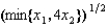 . The cost of factor 1 is $5 per unit and the cost of factor 2 is $5 per unit. In the short run, the industry supply curve is given by
 (Multiple Choice)
4.9/5 (85)
(85) An industry has 100 firms. These firms have identical production functions. In the short run, each firm has fixed costs of $200. There are two variable factors in the short run and output is given by y = 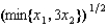 . The cost of factor 1 is $5 per unit and the cost of factor 2 is $4 per unit. In the short run, the industry supply curve is given by
 (Multiple Choice)
4.9/5 (77)
(77) In the problem discussed in your workbook, the cost of capturing a cockatoo and transporting him to the United States is about $40 per bird. Cockatoos are drugged and smuggled in suitcases to the United States. Half of the smuggled cockatoos die in transit. Each smuggled cockatoo has a 10% probability of being discovered, in which case the smuggler is fined. If the fine imposed for each smuggled cockatoo is increased to $1,100, then the equilibrium price of cockatoos in the United States will be
(Multiple Choice)
4.9/5 (93)
(93) Suppose that all firms in a given industry have the same supply curve given by Si(p) = 2p when p is greater than or equal to $2 and Si(p) = 0 when p is less than $2. Suppose that market demand is given by D(p) = 12 - p. If firms continue to enter the industry so long as they can do so profitably, the equilibrium price must be closest to
(Multiple Choice)
4.9/5 (91)
(91) 
Filters
- Essay(0)
- Multiple Choice(0)
- Short Answer(0)
- True False(0)
- Matching(0)