



 Chat with AI
Exam 21: Firm Supply

Exam 1: Budget Constraint58 Questions
Exam 1: A: Budget Constraint30 Questions
Exam 2: Preferences49 Questions
Exam 2: A: Preferences30 Questions
Exam 3: Utility57 Questions
Exam 3: A: Utility29 Questions
Exam 4: Choice63 Questions
Exam 4: A: Choice31 Questions
Exam 5: Demand79 Questions
Exam 5: A: Demand22 Questions
Exam 6: Revealed Preference58 Questions
Exam 6: A: Revealed Preference26 Questions
Exam 7: Slutsky Equation51 Questions
Exam 7: A: Slutsky Equation30 Questions
Exam 8: Buying and Selling75 Questions
Exam 8: A: Buying and Selling30 Questions
Exam 9: Intertemporal Choice61 Questions
Exam 9: A: Intertemporal Choice30 Questions
Exam 10: Asset Markets46 Questions
Exam 10: A: Asset Markets30 Questions
Exam 11: Uncertainty39 Questions
Exam 11: A: Uncertainty25 Questions
Exam 12: Risky Assets16 Questions
Exam 12: A: Risky Assets10 Questions
Exam 13: Consumers Surplus42 Questions
Exam 13: A: Consumers Surplus30 Questions
Exam 14: Market Demand101 Questions
Exam 14: A: Market Demand25 Questions
Exam 15: Equilibrium48 Questions
Exam 15: A: Equilibrium20 Questions
Exam 16: Auctions36 Questions
Exam 16: A: Auctions25 Questions
Exam 17: Technology52 Questions
Exam 17: A: Technology30 Questions
Exam 18: Profit Maximization52 Questions
Exam 18: A: Profit Maximization21 Questions
Exam 19: Cost Minimization77 Questions
Exam 19: A: Cost Minimization26 Questions
Exam 20: Cost Curves51 Questions
Exam 20: A: Cost Curves20 Questions
Exam 21: Firm Supply41 Questions
Exam 21: A: Firm Supply15 Questions
Exam 22: Industry Supply49 Questions
Exam 22: A: Industry Supply33 Questions
Exam 23: Monopoly76 Questions
Exam 23: A: Monopoly30 Questions
Exam 24: Monopoly Behavior34 Questions
Exam 24: A: Monopoly Behavior20 Questions
Exam 25: Factor Markets24 Questions
Exam 25: A: Factor Markets20 Questions
Exam 26: Oligopoly56 Questions
Exam 26: A: Oligopoly30 Questions
Exam 27: Game Theory34 Questions
Exam 27: A: Game Theory25 Questions
Exam 28: Game Applications28 Questions
Exam 28: A: Game Applications25 Questions
Exam 29: Behavioral Economics34 Questions
Exam 30: Exchange68 Questions
Exam 30: A: Exchange30 Questions
Exam 31: Production35 Questions
Exam 31: A: Production25 Questions
Exam 32: Welfare27 Questions
Exam 32: A: Welfare25 Questions
Exam 33: Externalities42 Questions
Exam 33: A: Externalities25 Questions
Exam 34: Information Technology24 Questions
Exam 34: A: Information Technology15 Questions
Exam 35: Public Goods26 Questions
Exam 35: A: Public Goods20 Questions
Exam 36: Asymmetric Information31 Questions
Exam 36: A: Asymmetric Information20 Questions
Select questions type


Mr. O. Carr has the cost function c(y) = y2 + 144 if his output, y, is positive and c(0) = 0. If the price of output is 18, Mr. Carr's profit-maximizing output is zero.
(True/False)
4.9/5  (93)
(93) The Lost Mountains of northern Iowa are inhabited by the rare Marshallian deer. Patches of grass are far apart in this rugged land. If a deer finds a fresh patch of grass and spends h hours grazing it, it gets the square root of h units of grass. The deer compete for grass. When there are n deer, it takes a deer n 2 minutes to find a fresh patch. A deer can survive if it gets 1 unit of grass every 200 minutes.
a. Find the average cost in time of a unit of grass if a deer gets y units of grass from each patch.
b. How much time will an efficient deer spend in each patch when there are n deer? (Hint: Minimize aver-age cost.)
c. Since there is free entry into the deer business, the equilibrium population is the maximum number of efficient deer who can survive. How many is this?
(Essay)
4.7/5 (78)
(78) A competitive firm uses two variable factors to produce its output, with a production function q = min{x1, x2}.The price of factor 1 is $4 and the price of factor 2 is $1. Due to a lack of warehouse space, the company cannot use more than 15 units of x1. The firm must pay a fixed cost of $90 if it produces any positive amount but doesn't have to pay this cost if it produces no output. What is the smallest integer price that would make a firm willing to produce a positive amount?
(Multiple Choice)
4.7/5 (92)
(92) Suppose that Dent Carr's long-run total cost of repairing s cars per week is c(s) = 3s2 + 75. If the price he receives for repairing a car is $18, then in the long run, how many cars will he fix per week if he maximizes profits?
(Multiple Choice)
4.9/5 (78)
(78) A firm with the cost function c(y) = 20y2 + 500 has a U-shaped cost curve.
(True/False)
4.7/5 (86)
(86) A competitive firm has a long-run total cost function c(y) = 5y2 + 1,125 for y > 0 and c(0) = 0. Its long-run supply function is described as
(Multiple Choice)
4.7/5 (85)
(85) A competitive firm produces its output according to the production function y = min{  , 10}. Let w be the price of the factor x, and let the price of output be $1.The demand for factor x, when the factor price is w, is
 (Multiple Choice)
4.9/5 (69)
(69) A competitive firm has a single factory with the cost function c(y) = 4y2 + 89 and produces 28 units in order to maximize profits. Although the price of output does not change, the firm decides to build a second factory with the cost function c(y) = 8y2 + 39. To maximize its profits, how many units should it produce in the second factory?
(Multiple Choice)
4.9/5 (66)
(66) A firm's production function is f(x1, x2) = 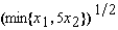 . If the price of factor 1 is w1 = $5 per unit and the price of factor 2 is w2 = $25 per unit, then its supply function is given by the equation S(p) =
 (Multiple Choice)
4.9/5 (76)
(76) A competitive firm uses two variable factors to produce its output, with a production function q = min{x1, x2}.The price of factor 1 is $8 and the price of factor 2 is $5. Due to a lack of warehouse space, the company cannot use more than 10 units of x1. The firm must pay a fixed cost of $80 if it produces any positive amount but doesn't have to pay this cost if it produces no output. What is the smallest integer price that would make a firm willing to produce a positive amount?
(Multiple Choice)
4.7/5 (71)
(71) A competitive firm has a long-run total cost function c(y) = 2y2 + 288 for y > 0 and c(0) = 0. Its long-run supply function is described as
(Multiple Choice)
4.8/5 (82)
(82) The area under the marginal cost curve measures total variable costs.
(True/False)
5.0/5 (82)
(82) A competitive firm has a continuous marginal cost curve. It finds that as output increases, its marginal cost curve first rises, then falls, then rises again. If it wants to maximize profits, the firm should never produce at a positive output where price equals marginal cost and marginal cost decreases as output increases.
(True/False)
4.8/5 (80)
(80) A competitive firm is choosing an output level to maximize its profits in the short run. Which of the following is not necessarily true? (Assume that marginal cost is not constant and is well defined at all levels of output.)
(Multiple Choice)
4.9/5 (65)
(65) A competitive firm uses two variable factors to produce its output, with a production function q = min{x1, x2}.The price of factor 1 is $4 and the price of factor 2 is $5. Due to a lack of warehouse space, the company cannot use more than 17 units of x1. The firm must pay a fixed cost of $136 if it produces any positive amount but doesn't have to pay this cost if it produces no output. What is the smallest integer price that would make a firm willing to produce a positive amount?
(Multiple Choice)
5.0/5 (86)
(86) In a perfectly competitive industry, the demand curve for the total output of the industry may be downward sloping.
(True/False)
4.9/5 (68)
(68) A profit-maximizing firm continues to operate even though it is losing money. It sells its product at a price of $100.
(Multiple Choice)
4.9/5 (85)
(85) Mr. O. Carr has the cost function c(y) = y2 + 64 if his output, y, is positive and c(0) = 0. If the price of output is 12, Mr. Carr's profit-maximizing output is zero.
(True/False)
4.9/5 (80)
(80) A competitive firm produces its output according to the production function y = min{x3, 1000}. Let p be the price of output, and let the price of input x be $1. The profit maximizing output for this firm is
(Multiple Choice)
4.8/5 (80)
(80) Irma's production function is f(x1, x2) = 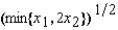 . If the price of factor 1 is w1 = $3 and the price of factor 2 is w2 = $4, then her supply function is given by the equation
 (Multiple Choice)
4.8/5 (68)
(68) 
Filters
- Essay(0)
- Multiple Choice(0)
- Short Answer(0)
- True False(0)
- Matching(0)