



 Chat with AI
Exam 7: Slutsky Equation

Exam 1: Budget Constraint58 Questions
Exam 1: A: Budget Constraint30 Questions
Exam 2: Preferences49 Questions
Exam 2: A: Preferences30 Questions
Exam 3: Utility57 Questions
Exam 3: A: Utility29 Questions
Exam 4: Choice63 Questions
Exam 4: A: Choice31 Questions
Exam 5: Demand79 Questions
Exam 5: A: Demand22 Questions
Exam 6: Revealed Preference58 Questions
Exam 6: A: Revealed Preference26 Questions
Exam 7: Slutsky Equation51 Questions
Exam 7: A: Slutsky Equation30 Questions
Exam 8: Buying and Selling75 Questions
Exam 8: A: Buying and Selling30 Questions
Exam 9: Intertemporal Choice61 Questions
Exam 9: A: Intertemporal Choice30 Questions
Exam 10: Asset Markets46 Questions
Exam 10: A: Asset Markets30 Questions
Exam 11: Uncertainty39 Questions
Exam 11: A: Uncertainty25 Questions
Exam 12: Risky Assets16 Questions
Exam 12: A: Risky Assets10 Questions
Exam 13: Consumers Surplus42 Questions
Exam 13: A: Consumers Surplus30 Questions
Exam 14: Market Demand101 Questions
Exam 14: A: Market Demand25 Questions
Exam 15: Equilibrium48 Questions
Exam 15: A: Equilibrium20 Questions
Exam 16: Auctions36 Questions
Exam 16: A: Auctions25 Questions
Exam 17: Technology52 Questions
Exam 17: A: Technology30 Questions
Exam 18: Profit Maximization52 Questions
Exam 18: A: Profit Maximization21 Questions
Exam 19: Cost Minimization77 Questions
Exam 19: A: Cost Minimization26 Questions
Exam 20: Cost Curves51 Questions
Exam 20: A: Cost Curves20 Questions
Exam 21: Firm Supply41 Questions
Exam 21: A: Firm Supply15 Questions
Exam 22: Industry Supply49 Questions
Exam 22: A: Industry Supply33 Questions
Exam 23: Monopoly76 Questions
Exam 23: A: Monopoly30 Questions
Exam 24: Monopoly Behavior34 Questions
Exam 24: A: Monopoly Behavior20 Questions
Exam 25: Factor Markets24 Questions
Exam 25: A: Factor Markets20 Questions
Exam 26: Oligopoly56 Questions
Exam 26: A: Oligopoly30 Questions
Exam 27: Game Theory34 Questions
Exam 27: A: Game Theory25 Questions
Exam 28: Game Applications28 Questions
Exam 28: A: Game Applications25 Questions
Exam 29: Behavioral Economics34 Questions
Exam 30: Exchange68 Questions
Exam 30: A: Exchange30 Questions
Exam 31: Production35 Questions
Exam 31: A: Production25 Questions
Exam 32: Welfare27 Questions
Exam 32: A: Welfare25 Questions
Exam 33: Externalities42 Questions
Exam 33: A: Externalities25 Questions
Exam 34: Information Technology24 Questions
Exam 34: A: Information Technology15 Questions
Exam 35: Public Goods26 Questions
Exam 35: A: Public Goods20 Questions
Exam 36: Asymmetric Information31 Questions
Exam 36: A: Asymmetric Information20 Questions
Select questions type


If a good is an inferior good, then an increase in its price will increase the demand for it.
(True/False)
4.9/5  (85)
(85) In the case of homothetic preferences, the entire change in demand from a price change is due to the substitution effect.
(True/False)
4.8/5 (79)
(79) An increase in the price of a Giffen good makes the people who consume that good better off.
(True/False)
4.9/5 (73)
(73) When the price of x rises, Marvin responds by changing his demand for x. The substitution effect is the part of this change that represents his change in demand
(Multiple Choice)
4.9/5 (77)
(77) Cindy consumes goods x and y. Her demand for x is given by x(px, m) = 0.05m -5.15px. Now her income is $419, the price of x is $3, and the price of y is $1. If the price of x rises to $4 and if we denote the income effect on her demand for x by DI and the substitution effect on her demand for x by DS, then
(Multiple Choice)
4.8/5 (83)
(83) The Slutsky substitution effect measures the movement between two points on the same indifference curve.
(True/False)
4.8/5 (77)
(77) Maude thinks delphiniums and hollyhocks are perfect substitutes, one for one. If delphiniums currently cost $5 per unit and hollyhocks cost $6 per unit and if the price of delphiniums rises to $8 per unit,
(Multiple Choice)
4.9/5 (76)
(76) Ivan spends his entire income on two goods. One of them is a Giffen good. If the price of the Giffen good rises, demand for the other good must fall.
(True/False)
4.8/5 (71)
(71) Neville from your workbook has a friend named Cedric. Cedric has the same demand function for claret as Neville, namely q = .02m - 2p, where m is income and p is price. Cedric's income is $6,000 and he initially had to pay a price of $40 per bottle of claret. The price of claret rose to $60. The substitution effect of the price change
(Multiple Choice)
4.9/5 (65)
(65) A consumer has the utility function 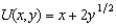 . The price of good x is 2 and the price of good y is 1. The consumer's income is 20. If the price of good y rises to 2, then entire change in demand for y is due to the substitution effect.
 (True/False)
4.8/5 (78)
(78) Gladys loves music and spends her money only on tapes and compact discs. She is always willing to trade 2 tapes for 1 compact discs. Originally, music stores sold compact disc for $9 each and tapes for $5 each. Then the price of compact discs fell to $8 each. The change in her consumption of compact discs that resulted was
(Multiple Choice)
4.8/5 (100)
(100) Suppose that bananas are a normal good and Woody is currently consuming 100 bananas at a price of 10 cents each.
(Multiple Choice)
4.9/5 (84)
(84) Ben consumes two goods and his utility function is U(x1, x2) = x21x42. The price of good 2 does not change and his income does not change, but the price of good 1 decreases.
(Multiple Choice)
4.9/5 (80)
(80) Carlos consumes only two goods, apples and bananas. His utility function is given by U(x, y) = min{x, 2y}. He is endowed with wa apples and wb bananas. Unaware that prices are about to change, Carlos buys the quantities of apples and bananas that maximize his utility subject to his budget constraint. After he has made his purchases but before he has eaten them, the relative prices change. Carlos is then free to make further trades at the new relative prices if he wishes.
(Multiple Choice)
4.8/5 (75)
(75) If the Engel curve slopes up, then the demand curve slopes down.
(True/False)
4.9/5 (83)
(83) Polly consumes crackers and fruit. The price of fruit rose and the price of crackers stayed constant. The income effect on Polly's demand is
(Multiple Choice)
4.9/5 (83)
(83) Herbie consumes two goods and his utility function is U(x1, x2) = x31x42. The price of good 2 does not change and his income does not change, but the price of good 1 decreases.
(Multiple Choice)
4.9/5 (63)
(63) Charlie's utility function is xAxB. The price of apples used to be $1, the price of bananas used to be $2, and his income used to be $40. If the price of apples increased to $5 and the price of bananas stayed constant, the substitution effect on Charlie's apple consumption would reduce his consumption by
(Multiple Choice)
4.9/5 (75)
(75) If two goods x and y are perfect complements, then if the price of x falls, the entire change in the demand for x is due to the income effect.
(True/False)
4.8/5 (87)
(87) 
Filters
- Essay(0)
- Multiple Choice(0)
- Short Answer(0)
- True False(0)
- Matching(0)