



 Chat with AI
Exam 4: Choice

Exam 1: Budget Constraint58 Questions
Exam 1: A: Budget Constraint30 Questions
Exam 2: Preferences49 Questions
Exam 2: A: Preferences30 Questions
Exam 3: Utility57 Questions
Exam 3: A: Utility29 Questions
Exam 4: Choice63 Questions
Exam 4: A: Choice31 Questions
Exam 5: Demand79 Questions
Exam 5: A: Demand22 Questions
Exam 6: Revealed Preference58 Questions
Exam 6: A: Revealed Preference26 Questions
Exam 7: Slutsky Equation51 Questions
Exam 7: A: Slutsky Equation30 Questions
Exam 8: Buying and Selling75 Questions
Exam 8: A: Buying and Selling30 Questions
Exam 9: Intertemporal Choice61 Questions
Exam 9: A: Intertemporal Choice30 Questions
Exam 10: Asset Markets46 Questions
Exam 10: A: Asset Markets30 Questions
Exam 11: Uncertainty39 Questions
Exam 11: A: Uncertainty25 Questions
Exam 12: Risky Assets16 Questions
Exam 12: A: Risky Assets10 Questions
Exam 13: Consumers Surplus42 Questions
Exam 13: A: Consumers Surplus30 Questions
Exam 14: Market Demand101 Questions
Exam 14: A: Market Demand25 Questions
Exam 15: Equilibrium48 Questions
Exam 15: A: Equilibrium20 Questions
Exam 16: Auctions36 Questions
Exam 16: A: Auctions25 Questions
Exam 17: Technology52 Questions
Exam 17: A: Technology30 Questions
Exam 18: Profit Maximization52 Questions
Exam 18: A: Profit Maximization21 Questions
Exam 19: Cost Minimization77 Questions
Exam 19: A: Cost Minimization26 Questions
Exam 20: Cost Curves51 Questions
Exam 20: A: Cost Curves20 Questions
Exam 21: Firm Supply41 Questions
Exam 21: A: Firm Supply15 Questions
Exam 22: Industry Supply49 Questions
Exam 22: A: Industry Supply33 Questions
Exam 23: Monopoly76 Questions
Exam 23: A: Monopoly30 Questions
Exam 24: Monopoly Behavior34 Questions
Exam 24: A: Monopoly Behavior20 Questions
Exam 25: Factor Markets24 Questions
Exam 25: A: Factor Markets20 Questions
Exam 26: Oligopoly56 Questions
Exam 26: A: Oligopoly30 Questions
Exam 27: Game Theory34 Questions
Exam 27: A: Game Theory25 Questions
Exam 28: Game Applications28 Questions
Exam 28: A: Game Applications25 Questions
Exam 29: Behavioral Economics34 Questions
Exam 30: Exchange68 Questions
Exam 30: A: Exchange30 Questions
Exam 31: Production35 Questions
Exam 31: A: Production25 Questions
Exam 32: Welfare27 Questions
Exam 32: A: Welfare25 Questions
Exam 33: Externalities42 Questions
Exam 33: A: Externalities25 Questions
Exam 34: Information Technology24 Questions
Exam 34: A: Information Technology15 Questions
Exam 35: Public Goods26 Questions
Exam 35: A: Public Goods20 Questions
Exam 36: Asymmetric Information31 Questions
Exam 36: A: Asymmetric Information20 Questions
Select questions type


Charlie's utility function is U(xA, xB) = xAxB. If Charlie's income is $40, the price of apples is $4, and the price of bananas is $2, how many apples are there in the best bundle that Charlie can afford?
(Multiple Choice)
4.8/5  (91)
(91) Ambrose's utility function is U(x1, x2) =  . If the price of nuts (good 1) is $1, the price of berries (good 2) is $5, and his income is $145, how many units of nuts will Ambrose choose?
 (Multiple Choice)
4.8/5 (86)
(86) If a consumer maximizes her preferences subject to her budget by choosing a consumption bundle where the ratio of her marginal utilities of shelter and food,  , is greater than the ratio of the prices of shelter and food,
 , then she must
, is greater than the ratio of the prices of shelter and food, , then she must (Multiple Choice)
4.8/5 (83)
(83) Max Gross has the utility function U(x, y) = max{x, y}. If the price of x is the same as the price of y, Max will buy equal amounts of x and y.
(True/False)
4.9/5 (85)
(85) Charlie has a utility function U(xA, xB) = xAxB, the price of apples is $1, and the price of bananas is $2. If Charlie's income were $120, how many units of bananas would he consume if he chose the bundle that maximized his utility subject to his budget constraint?
(Multiple Choice)
4.9/5 (85)
(85) Ambrose's utility function is 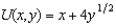 . The price of x is $1 and the price of y is $2. If his income rises from $100 to $150, his consumption of y increases by more than 10% but less than 50%.
 (True/False)
4.8/5 (83)
(83) Charlie's utility function is U(xA, xB) = xAxB. If Charlie's income is $40, the price of apples is $4, and the price of bananas is $2, how many apples are there in the best bundle that Charlie can afford?
(Multiple Choice)
4.8/5 (90)
(90) Mary Granola's utility function is U(x, y) = min{x + 2y, y + 2x}. Mary maximizes her utility subject to a budget constraint. If she chooses the bundle (5, 6), then the price of x must be exactly twice the price of y.
(True/False)
4.9/5 (84)
(84) Coke and Pepsi are perfect substitutes for Mr. Drinker and the slope of his indifference curves is - 1. One day he bought 2 cans of Coke and 20 cans of Pepsi. (The cans of both drinks are the same size.)
(Multiple Choice)
4.8/5 (82)
(82) Peter consumes no commodities other than Miller Lite and Bud Light. His annual budget for these two commodities is described by the equation 5x + 30y = 300, where x is sixpacks of Miller Lite and y is cases of Bud Light. Peter considers 2 cases of Bud Light to be perfect substitutes for 6 sixpacks of Miller Lite.
(Multiple Choice)
4.7/5 (72)
(72) Harold's utility function is U(x, y) = (x + 3)(y + 2). The price of x is $1. The price of y is $2. At all incomes for which Harold consumes positive amounts of both goods, he will consume
(Multiple Choice)
4.8/5 (75)
(75) Jane's utility function is U(x, y) = x + 2y, where x is her consumption of good X and y is her consumption of good Y. Her income is $2. The price of Y is $2. The cost per unit of X depends on how many units she buys. The total cost of x units of X is the square root of x.
(Multiple Choice)
4.9/5 (62)
(62) At a boundary optimum, a consumer's indifference curve must be tangent to her budget line.
(True/False)
4.7/5 (80)
(80) Charlie has a utility function U(xA, xB) = xAxB, the price of apples is $1, and the price of bananas is $2. If Charlie's income were $200, how many units of bananas would he consume if he chose the bundle that maximized his utility subject to his budget constraint?
(Multiple Choice)
4.9/5 (92)
(92) Casper consumes cocoa and cheese. Cocoa is sold in an unusual way. There is only one supplier, and the more cocoa you buy from him, the higher the price you have to pay per unit. In fact y units of cocoa will cost Casper y2 dollars. Cheese is sold in the usual way at a price of 2 dollars per unit. Casper's income is 20 dollars and his utility function is U(x, y) = x + 2y, where x is his consumption of cheese and y is his consumption of cocoa.
a. Sketch Casper's budget set and shade it in.
b. Sketch some of his indifference curves and label the point that he chooses.
c. Calculate the amount of cheese and the amount of cocoa that Casper demands at these prices and this income.
(Essay)
4.9/5 (85)
(85) Roger consumes no commodities other than Miller Lite and Bud Light. His annual budget for these two commodities is described by the equation 5x + 25y = 300, where x is sixpacks of Miller Lite and y is cases of Bud Light. Roger considers 2 cases of Bud Light to be perfect substitutes for 6 sixpacks of Miller Lite.
(Multiple Choice)
4.8/5 (74)
(74) Charlie has a utility function U(x, y) = (x + 3)(y + 4). The price of x is $1 and the price of y is $1. When he maximizes his utility subject to his budget constraint, he consumes positive amounts of both goods. Charlie consumes
(Multiple Choice)
4.8/5 (80)
(80) Millie's utility function is U(x, y) = min{x, y}. She maximizes her utility subject to a budget constraint. The price of x is the same as the price of y. If the price of x rises and the price of y and her income remain constant, then her consumption of y will certainly decrease.
(True/False)
5.0/5 (77)
(77) Clara's utility function is U(x, y) = (x + 2)(y + 1). If her marginal rate of substitution is -4 and she is consuming 14 units of good x, how many units of good y must she be consuming?
(Multiple Choice)
5.0/5 (85)
(85) Hans has $27 which he decides to spend on x and y. Commodity x costs $16 per unit and commodity y costs $10 per unit. He has the utility function U(x, y) = 5x2 + 2y2 and he can purchase fractional units of x and y. Hans will choose
(Multiple Choice)
4.7/5 (76)
(76) 
Filters
- Essay(0)
- Multiple Choice(0)
- Short Answer(0)
- True False(0)
- Matching(0)