



 Chat with AI
Exam 26: Saving, investment, and the Financial System

Exam 1: Ten Principles of Economics281 Questions
Exam 2: Thinking Like an Economist451 Questions
Exam 3: Interdependence and the Gains From Trade353 Questions
Exam 4: The Market Forces of Supply and Demand467 Questions
Exam 5: Elasticity and Its Application409 Questions
Exam 6: Supply, Demand, and Government Policies459 Questions
Exam 7: Consumers, Producers, and the Efficiency of Markets363 Questions
Exam 8: Application: The Costs of Taxation353 Questions
Exam 9: Application: International Trade333 Questions
Exam 10: Externalities352 Questions
Exam 11: Public Goods and Common Resources270 Questions
Exam 12: The Design of the Tax System397 Questions
Exam 13: The Costs of Production434 Questions
Exam 14: Firms in Competitive Markets381 Questions
Exam 15: Monopoly427 Questions
Exam 16: Monopolistic Competition416 Questions
Exam 17: Oligopoly325 Questions
Exam 18: The Markets for the Factors of Production361 Questions
Exam 19: Earnings and Discrimination335 Questions
Exam 20: Income Inequality and Poverty312 Questions
Exam 21: The Theory of Consumer Choice354 Questions
Exam 22: Frontiers of Microeconomics262 Questions
Exam 23: Measuring a Nations Income343 Questions
Exam 24: Measuring the Cost of Living358 Questions
Exam 25: Production and Growth335 Questions
Exam 26: Saving, investment, and the Financial System381 Questions
Exam 27: The Basic Tools of Finance336 Questions
Exam 28: Unemployment533 Questions
Exam 29: The Monetary System366 Questions
Exam 30: Money Growth and Inflation312 Questions
Exam 31: Open-Economy Macroeconomics: Basic Concepts346 Questions
Exam 32: A Macroeconomic Theory of the Open Economy300 Questions
Exam 33: Aggregate Demand and Aggregate Supply386 Questions
Exam 34: The Influence of Monetary and Fiscal Policy on Aggregate Demand334 Questions
Exam 35: The Short-Run Trade-Off Between Inflation and Unemployment306 Questions
Exam 36: Five Debates Over Macroeconomic Policy179 Questions
Select questions type


Figure 26-2.The figure depicts a supply-of-loanable-funds curve and two
demand-for-loanable-funds curves. 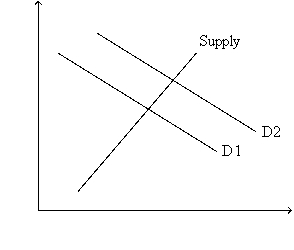 -Refer to Figure 26-2.Which of the following events would shift the demand curve from D1 to D2?
 (Multiple Choice)
4.8/5  (77)
(77) In a closed economy,what remains after paying for consumption and government purchases is
(Multiple Choice)
4.9/5 (71)
(71) Which of the following people purchased the correct asset to meet his or her objective?
(Multiple Choice)
4.8/5 (83)
(83) Suppose Congress institutes an investment tax credit.What would happen in the market for loanable funds?
(Multiple Choice)
4.8/5 (74)
(74) People who buy newly issued stock in a corporation such as Crate and Barrel provide
(Multiple Choice)
4.7/5 (91)
(91) Figure 26-3.The figure shows two demand-for-loanable-funds curves and two supply-of-loanable-funds curves.  -Refer to Figure 26-3.Which of the following movements would be consistent with the government budget going from deficit to surplus and the simultaneous enactment of an investment tax credit?
 (Multiple Choice)
4.7/5 (88)
(88) It is claimed that mutual funds have two advantages.The first is that mutual funds allow people with small amounts of money to diversify.The second is that mutual funds provide the skills of professional money managers who buy stocks they believe will be the most profitable and thereby increase the return that mutual fund depositors earn on their savings.
(Multiple Choice)
4.8/5 (91)
(91) The term loanable funds refers to all income that is not used for consumption or government expenditures.
(True/False)
4.9/5 (87)
(87) If we were to change the interpretation of the term "loanable funds" in such a way that government budget deficits would affect the demand for loanable funds,rather than the supply of loanable funds,then
(Multiple Choice)
4.9/5 (76)
(76) 
Filters
- Essay(0)
- Multiple Choice(0)
- Short Answer(0)
- True False(0)
- Matching(0)