



 Chat with AI
Exam 26: Saving, investment, and the Financial System

Exam 1: Ten Principles of Economics281 Questions
Exam 2: Thinking Like an Economist451 Questions
Exam 3: Interdependence and the Gains From Trade353 Questions
Exam 4: The Market Forces of Supply and Demand467 Questions
Exam 5: Elasticity and Its Application409 Questions
Exam 6: Supply, Demand, and Government Policies459 Questions
Exam 7: Consumers, Producers, and the Efficiency of Markets363 Questions
Exam 8: Application: The Costs of Taxation353 Questions
Exam 9: Application: International Trade333 Questions
Exam 10: Externalities352 Questions
Exam 11: Public Goods and Common Resources270 Questions
Exam 12: The Design of the Tax System397 Questions
Exam 13: The Costs of Production434 Questions
Exam 14: Firms in Competitive Markets381 Questions
Exam 15: Monopoly427 Questions
Exam 16: Monopolistic Competition416 Questions
Exam 17: Oligopoly325 Questions
Exam 18: The Markets for the Factors of Production361 Questions
Exam 19: Earnings and Discrimination335 Questions
Exam 20: Income Inequality and Poverty312 Questions
Exam 21: The Theory of Consumer Choice354 Questions
Exam 22: Frontiers of Microeconomics262 Questions
Exam 23: Measuring a Nations Income343 Questions
Exam 24: Measuring the Cost of Living358 Questions
Exam 25: Production and Growth335 Questions
Exam 26: Saving, investment, and the Financial System381 Questions
Exam 27: The Basic Tools of Finance336 Questions
Exam 28: Unemployment533 Questions
Exam 29: The Monetary System366 Questions
Exam 30: Money Growth and Inflation312 Questions
Exam 31: Open-Economy Macroeconomics: Basic Concepts346 Questions
Exam 32: A Macroeconomic Theory of the Open Economy300 Questions
Exam 33: Aggregate Demand and Aggregate Supply386 Questions
Exam 34: The Influence of Monetary and Fiscal Policy on Aggregate Demand334 Questions
Exam 35: The Short-Run Trade-Off Between Inflation and Unemployment306 Questions
Exam 36: Five Debates Over Macroeconomic Policy179 Questions
Select questions type


Suppose the U.S.offered a tax credit for firms that built new factories in the U.S..Then
(Multiple Choice)
4.9/5  (71)
(71) Scenario 26-1.Assume the following information for an imaginary,closed economy.
GDP = $110,000;consumption = $70,000;private saving = $8,000;national
saving = $12,000.
-Refer to Scenario 26-1.For this economy,government purchases amount to
(Multiple Choice)
4.9/5 (71)
(71) Fran buys 1,000 shares of stock issued by Miller Brewing.In turn,Miller uses the funds to buy new machinery for one of its breweries.
(Multiple Choice)
4.8/5 (87)
(87) Suppose the market for loanable funds is in equilibrium.Given the numbers below,determine the quantity of loanable funds demanded.
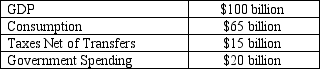
(Multiple Choice)
4.7/5 (83)
(83) The Dow Jones Industrial Average is now based on the prices of the stocks of
(Multiple Choice)
4.9/5 (81)
(81) Other things being constant,when a firm sells new shares of stock,the
(Multiple Choice)
5.0/5 (79)
(79) The prices of stock traded on exchanges are determined by
(Multiple Choice)
4.8/5 (101)
(101) As an alternative to selling shares of stock as a means of raising funds,a large company could,instead,
(Multiple Choice)
4.7/5 (80)
(80) We would expect the interest rate on Bond A to be higher than the interest rate on Bond B if the two bonds have identical characteristics except that
(Multiple Choice)
4.7/5 (69)
(69) Bolivia had a smaller budget deficit in 2003 than in 2002.Other things the same,we would expect this reduction in the budget deficit to have
(Multiple Choice)
4.8/5 (82)
(82) What would happen in the market for loanable funds if the government were to increase the tax on interest income?
(Multiple Choice)
4.8/5 (70)
(70) The ratio of debt to GDP in the United States tended to fall
(Multiple Choice)
4.9/5 (74)
(74) The model of the market for loanable funds shows that an investment tax credit will cause interest rates to rise and investment to rise.Yet we also suppose that higher interest rates lead to lower investment.How can these two conclusions be reconciled?
(Essay)
4.8/5 (95)
(95) The financial system coordinates investment and saving,which are important determinants of long-run real GDP.
(True/False)
4.9/5 (80)
(80) What would happen in the market for loanable funds if the government were to decrease the tax rate on interest income?
(Multiple Choice)
4.9/5 (82)
(82) 
Filters
- Essay(0)
- Multiple Choice(0)
- Short Answer(0)
- True False(0)
- Matching(0)