



 Chat with AI
Exam 26: Saving, investment, and the Financial System

Exam 1: Ten Principles of Economics281 Questions
Exam 2: Thinking Like an Economist451 Questions
Exam 3: Interdependence and the Gains From Trade353 Questions
Exam 4: The Market Forces of Supply and Demand467 Questions
Exam 5: Elasticity and Its Application409 Questions
Exam 6: Supply, Demand, and Government Policies459 Questions
Exam 7: Consumers, Producers, and the Efficiency of Markets363 Questions
Exam 8: Application: The Costs of Taxation353 Questions
Exam 9: Application: International Trade333 Questions
Exam 10: Externalities352 Questions
Exam 11: Public Goods and Common Resources270 Questions
Exam 12: The Design of the Tax System397 Questions
Exam 13: The Costs of Production434 Questions
Exam 14: Firms in Competitive Markets381 Questions
Exam 15: Monopoly427 Questions
Exam 16: Monopolistic Competition416 Questions
Exam 17: Oligopoly325 Questions
Exam 18: The Markets for the Factors of Production361 Questions
Exam 19: Earnings and Discrimination335 Questions
Exam 20: Income Inequality and Poverty312 Questions
Exam 21: The Theory of Consumer Choice354 Questions
Exam 22: Frontiers of Microeconomics262 Questions
Exam 23: Measuring a Nations Income343 Questions
Exam 24: Measuring the Cost of Living358 Questions
Exam 25: Production and Growth335 Questions
Exam 26: Saving, investment, and the Financial System381 Questions
Exam 27: The Basic Tools of Finance336 Questions
Exam 28: Unemployment533 Questions
Exam 29: The Monetary System366 Questions
Exam 30: Money Growth and Inflation312 Questions
Exam 31: Open-Economy Macroeconomics: Basic Concepts346 Questions
Exam 32: A Macroeconomic Theory of the Open Economy300 Questions
Exam 33: Aggregate Demand and Aggregate Supply386 Questions
Exam 34: The Influence of Monetary and Fiscal Policy on Aggregate Demand334 Questions
Exam 35: The Short-Run Trade-Off Between Inflation and Unemployment306 Questions
Exam 36: Five Debates Over Macroeconomic Policy179 Questions
Select questions type


Which of the following events could explain a decrease in interest rates together with an increase in investment?
(Multiple Choice)
4.9/5  (65)
(65) In the small closed economy of San Lucretia,the currency is the denar.Statistics for last year show that private saving was 60 billion denars,taxes were 70 billion denars,government purchases of goods and services were 80 billion denars,there were no transfer payments by the government,and GDP was 400 billion denars.What were consumption and investment in San Lucretia?
(Multiple Choice)
4.8/5 (90)
(90) Other things the same,a higher interest rate induces people to
(Multiple Choice)
5.0/5 (86)
(86) Corporations receive no proceeds from the resale of their stock.
(True/False)
4.9/5 (78)
(78) The term loanable funds refers to all income that is not used for consumption.
(True/False)
4.9/5 (78)
(78) The sale of either stocks or bonds to raise money is known as equity finance.
(True/False)
4.7/5 (85)
(85) Stock in Creole Cuisine Restaurants is selling at $25 per share.Creole Cuisine had earnings of $5 a share and a dividend yield of 5 percent.The dividend is
(Multiple Choice)
4.7/5 (78)
(78) Which of the following counts as part of the supply of loanable funds?
(Multiple Choice)
4.9/5 (81)
(81) To state that public saving is equal to investment,for a closed economy,is to state an accounting identity.
(True/False)
4.8/5 (66)
(66) Scenario 26-1.Assume the following information for an imaginary,closed economy.
GDP = $110,000;consumption = $70,000;private saving = $8,000;national
saving = $12,000.
-Refer to Scenario 26-1.For this economy,taxes amount to
(Multiple Choice)
4.8/5 (79)
(79) Suppose a country has a consumption tax that is similar to a state sales tax.If its government were to eliminate the consumption tax and replace it with an income tax that includes an income tax on interest from savings,what would happen?
(Multiple Choice)
5.0/5 (76)
(76) Jerry has the choice of two bonds,one that pays 3 percent interest and one that pays 6 percent interest.Which of the following is most likely?
(Multiple Choice)
4.8/5 (85)
(85) The single most important piece of information about a stock is its
(Multiple Choice)
4.8/5 (74)
(74) Table 26-2
 -Refer to Table 26-2.For which company's stock is the P/E ratio closest to what is historically typical?
 (Multiple Choice)
4.8/5 (85)
(85) Figure 26-1.The figure depicts a demand-for-loanable-funds curve and two
supply-of-loanable-funds curves. 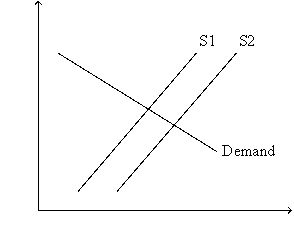 -Refer to Figure 26-1.Which of the following events would shift the supply curve from S1 to S2?
 (Multiple Choice)
4.8/5 (75)
(75) Interest rates fall and investment falls.Which of the following could explain these changes?
(Multiple Choice)
4.9/5 (83)
(83) If the quantity of loanable funds demanded exceeds the quantity of loanable funds supplied,
(Multiple Choice)
4.8/5 (88)
(88) 
Filters
- Essay(0)
- Multiple Choice(0)
- Short Answer(0)
- True False(0)
- Matching(0)