



 Chat with AI
Exam 19: Earnings and Discrimination

Exam 1: Ten Principles of Economics281 Questions
Exam 2: Thinking Like an Economist451 Questions
Exam 3: Interdependence and the Gains From Trade353 Questions
Exam 4: The Market Forces of Supply and Demand467 Questions
Exam 5: Elasticity and Its Application409 Questions
Exam 6: Supply, Demand, and Government Policies459 Questions
Exam 7: Consumers, Producers, and the Efficiency of Markets363 Questions
Exam 8: Application: The Costs of Taxation353 Questions
Exam 9: Application: International Trade333 Questions
Exam 10: Externalities352 Questions
Exam 11: Public Goods and Common Resources270 Questions
Exam 12: The Design of the Tax System397 Questions
Exam 13: The Costs of Production434 Questions
Exam 14: Firms in Competitive Markets381 Questions
Exam 15: Monopoly427 Questions
Exam 16: Monopolistic Competition416 Questions
Exam 17: Oligopoly325 Questions
Exam 18: The Markets for the Factors of Production361 Questions
Exam 19: Earnings and Discrimination335 Questions
Exam 20: Income Inequality and Poverty312 Questions
Exam 21: The Theory of Consumer Choice354 Questions
Exam 22: Frontiers of Microeconomics262 Questions
Exam 23: Measuring a Nations Income343 Questions
Exam 24: Measuring the Cost of Living358 Questions
Exam 25: Production and Growth335 Questions
Exam 26: Saving, investment, and the Financial System381 Questions
Exam 27: The Basic Tools of Finance336 Questions
Exam 28: Unemployment533 Questions
Exam 29: The Monetary System366 Questions
Exam 30: Money Growth and Inflation312 Questions
Exam 31: Open-Economy Macroeconomics: Basic Concepts346 Questions
Exam 32: A Macroeconomic Theory of the Open Economy300 Questions
Exam 33: Aggregate Demand and Aggregate Supply386 Questions
Exam 34: The Influence of Monetary and Fiscal Policy on Aggregate Demand334 Questions
Exam 35: The Short-Run Trade-Off Between Inflation and Unemployment306 Questions
Exam 36: Five Debates Over Macroeconomic Policy179 Questions
Select questions type


When comparing average wages for male and female workers in the United States,wages paid to females have been about 40 percent less than those paid to male workers.
(True/False)
4.8/5  (64)
(64) Which of the following statements does not accurately describe the market for labor?
(Multiple Choice)
4.7/5 (85)
(85) John is an Asian 23-year-old male,and Ken is an Asian 43-year-old male.Both John and Ken are economics majors,and they graduated from the same college with the same GPA - John in 2006 and Ken in 1986.John and Ken both are both financial advisers at the same brokerage firm.John earns $52,000 a year,and Ken earns $88,000 a year.Select the best explanation for this wage difference.
(Multiple Choice)
4.9/5 (78)
(78) Which of the following is not an explanation for why better educated workers earn more,on average,than less educated workers?
(Multiple Choice)
4.8/5 (77)
(77) Figure 19-1 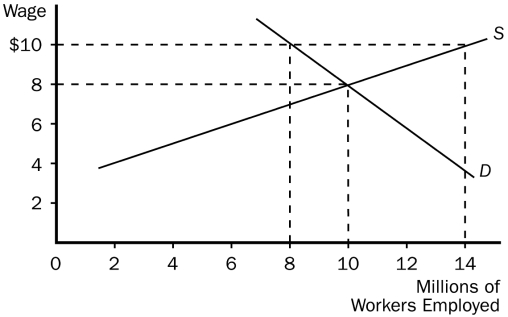 -Refer to Figure 19-1.Some policymakers have argued that the government should establish a "living wage." A living wage would provide workers a reasonable standard of living in their city or region.If a living wage of $10 per hour is established in the market pictured here,we would expect
 (Multiple Choice)
4.7/5 (87)
(87) The organized withdrawal of labor from a firm by a union is called
(Multiple Choice)
4.8/5 (84)
(84) Firms that operate in competitive product markets and choose to practice discrimination in hiring workers
(Multiple Choice)
4.9/5 (81)
(81) The "superstar" phenomenon can apply to which of these jobs?
(Multiple Choice)
4.9/5 (78)
(78) The National Collegiate Athletic Association (NCAA)has long argued that nationally-prominent college athletes are compensated with an investment in human capital that far exceeds the monetary reward of playing professional sports.Examine this argument in light of your knowledge of human capital theory and the economic theory of labor markets.
(Essay)
4.9/5 (78)
(78) Efficiency wages will raise the quantity of labor supplied to the market.
(True/False)
4.9/5 (88)
(88) Scenario 19-2
Travis,a student at a community college,is considering what he should do for summer employment.Two recruiters show up at his school in search of summer workers.Recruiter A is looking for workers to help a disaster relief agency distribute food aid in Africa.Recruiter B is looking for custodial help to clean motel rooms in a motel located near the entrance to a famous national park.
-Refer to Scenario 19-2.Travis is carefully considering the options that each recruiter presents.On the basis of knowledge obtained in his economics class,Travis concludes that
(Multiple Choice)
4.9/5 (84)
(84) A compensating differential refers to a difference in wages that arises from nonmonetary characteristics.
(True/False)
4.8/5 (82)
(82) One explanation for the loss in manufacturing jobs is that new technologies have replaced the need for some workers.
(True/False)
5.0/5 (79)
(79) Which of the following statements represents the idea behind signaling in education?
(Multiple Choice)
4.7/5 (77)
(77) Consumers are often a primary source of discrimination in labor markets.
(True/False)
5.0/5 (99)
(99) Given that the median male is better paid than the median female,which of the following is a valid explanation for wage differences?
(Multiple Choice)
4.8/5 (77)
(77) 
Filters
- Essay(0)
- Multiple Choice(0)
- Short Answer(0)
- True False(0)
- Matching(0)