



 Chat with AI
Exam 19: Earnings and Discrimination

Exam 1: Ten Principles of Economics281 Questions
Exam 2: Thinking Like an Economist451 Questions
Exam 3: Interdependence and the Gains From Trade353 Questions
Exam 4: The Market Forces of Supply and Demand467 Questions
Exam 5: Elasticity and Its Application409 Questions
Exam 6: Supply, Demand, and Government Policies459 Questions
Exam 7: Consumers, Producers, and the Efficiency of Markets363 Questions
Exam 8: Application: The Costs of Taxation353 Questions
Exam 9: Application: International Trade333 Questions
Exam 10: Externalities352 Questions
Exam 11: Public Goods and Common Resources270 Questions
Exam 12: The Design of the Tax System397 Questions
Exam 13: The Costs of Production434 Questions
Exam 14: Firms in Competitive Markets381 Questions
Exam 15: Monopoly427 Questions
Exam 16: Monopolistic Competition416 Questions
Exam 17: Oligopoly325 Questions
Exam 18: The Markets for the Factors of Production361 Questions
Exam 19: Earnings and Discrimination335 Questions
Exam 20: Income Inequality and Poverty312 Questions
Exam 21: The Theory of Consumer Choice354 Questions
Exam 22: Frontiers of Microeconomics262 Questions
Exam 23: Measuring a Nations Income343 Questions
Exam 24: Measuring the Cost of Living358 Questions
Exam 25: Production and Growth335 Questions
Exam 26: Saving, investment, and the Financial System381 Questions
Exam 27: The Basic Tools of Finance336 Questions
Exam 28: Unemployment533 Questions
Exam 29: The Monetary System366 Questions
Exam 30: Money Growth and Inflation312 Questions
Exam 31: Open-Economy Macroeconomics: Basic Concepts346 Questions
Exam 32: A Macroeconomic Theory of the Open Economy300 Questions
Exam 33: Aggregate Demand and Aggregate Supply386 Questions
Exam 34: The Influence of Monetary and Fiscal Policy on Aggregate Demand334 Questions
Exam 35: The Short-Run Trade-Off Between Inflation and Unemployment306 Questions
Exam 36: Five Debates Over Macroeconomic Policy179 Questions
Select questions type


The statement that "night shift workers make a higher wage than day shift workers" is likely to reflect the fact that
(Multiple Choice)
4.9/5  (77)
(77) Which of the following does not explain the "beauty premium" differences in wages?
(Multiple Choice)
4.9/5 (80)
(80) The human capital theory explanation for why people invest in education has been challenged by a theory that suggests
(Multiple Choice)
4.9/5 (82)
(82) Economic theory of labor markets suggests that wages are governed by labor supply and labor demand.
(True/False)
4.8/5 (84)
(84) Studies of professional sports teams suggest that,in sports,racial discrimination is
(Multiple Choice)
4.9/5 (71)
(71) Why do major-league baseball players get paid more than minor-league players?
(Multiple Choice)
4.9/5 (95)
(95) Which of the following statements does not accurately describe the market for labor?
(Multiple Choice)
4.8/5 (76)
(76) One reason why better-looking workers may have higher earnings is that physical attractiveness may enhance a worker's productivity for certain jobs,especially for those workers who deal with the public.
(True/False)
4.9/5 (79)
(79) Discrimination by a manager in the hiring process may be consistent with the decision to maximize profits if
(Multiple Choice)
4.7/5 (71)
(71) If an employer's behavior is supportive of the theory of efficiency wages,the employer would
(Multiple Choice)
4.9/5 (65)
(65) If,as some economists believe,changes in technology over recent decades have brought about changes in labor markets,then those changes likely have resulted in
(Multiple Choice)
4.8/5 (83)
(83) Which of the following represents an example of labor-market discrimination?
(Multiple Choice)
4.8/5 (84)
(84) The very high pay earned by the best actors and actresses is partially explained by the fact that
(Multiple Choice)
4.8/5 (73)
(73) Discrimination may persist even in competitive markets when the source of the discrimination is
(Multiple Choice)
4.8/5 (74)
(74) Which of the following theories would suggest that attending school does not improve productivity but that high-ability people are more likely to stay in school?
(Multiple Choice)
4.9/5 (86)
(86) Figure 19-3
The manufacturing labor market. 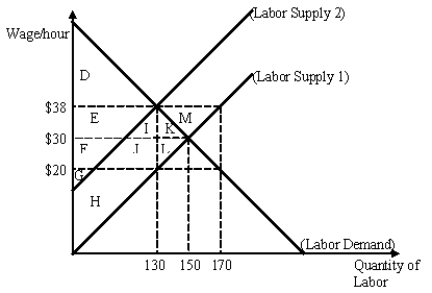 -Refer to Figure 19-3.Suppose the manufacturing labor market,which is non-unionized,is in equilibrium at a wage equal to $30.Suppose now that the AFL-CIO (a labor organization)organizes the workers in the manufacturing market and negotiates a wage of $38 per hour.Because of the union,
 (Multiple Choice)
4.8/5 (67)
(67) As a result of their experiment economists Muriel Niederle and Lise Vesterlund found that
(Multiple Choice)
4.8/5 (79)
(79) 
Filters
- Essay(0)
- Multiple Choice(0)
- Short Answer(0)
- True False(0)
- Matching(0)