



 Chat with AI
Exam 19: Earnings and Discrimination

Exam 1: Ten Principles of Economics281 Questions
Exam 2: Thinking Like an Economist451 Questions
Exam 3: Interdependence and the Gains From Trade353 Questions
Exam 4: The Market Forces of Supply and Demand467 Questions
Exam 5: Elasticity and Its Application409 Questions
Exam 6: Supply, Demand, and Government Policies459 Questions
Exam 7: Consumers, Producers, and the Efficiency of Markets363 Questions
Exam 8: Application: The Costs of Taxation353 Questions
Exam 9: Application: International Trade333 Questions
Exam 10: Externalities352 Questions
Exam 11: Public Goods and Common Resources270 Questions
Exam 12: The Design of the Tax System397 Questions
Exam 13: The Costs of Production434 Questions
Exam 14: Firms in Competitive Markets381 Questions
Exam 15: Monopoly427 Questions
Exam 16: Monopolistic Competition416 Questions
Exam 17: Oligopoly325 Questions
Exam 18: The Markets for the Factors of Production361 Questions
Exam 19: Earnings and Discrimination335 Questions
Exam 20: Income Inequality and Poverty312 Questions
Exam 21: The Theory of Consumer Choice354 Questions
Exam 22: Frontiers of Microeconomics262 Questions
Exam 23: Measuring a Nations Income343 Questions
Exam 24: Measuring the Cost of Living358 Questions
Exam 25: Production and Growth335 Questions
Exam 26: Saving, investment, and the Financial System381 Questions
Exam 27: The Basic Tools of Finance336 Questions
Exam 28: Unemployment533 Questions
Exam 29: The Monetary System366 Questions
Exam 30: Money Growth and Inflation312 Questions
Exam 31: Open-Economy Macroeconomics: Basic Concepts346 Questions
Exam 32: A Macroeconomic Theory of the Open Economy300 Questions
Exam 33: Aggregate Demand and Aggregate Supply386 Questions
Exam 34: The Influence of Monetary and Fiscal Policy on Aggregate Demand334 Questions
Exam 35: The Short-Run Trade-Off Between Inflation and Unemployment306 Questions
Exam 36: Five Debates Over Macroeconomic Policy179 Questions
Select questions type


Scenario 19-1
Ferris B. ,a student at a community college,is considering what he should do for summer employment.Two recruiters show up at his school in search of summer workers.Recruiter A is looking for lifeguards to patrol the beach at an exclusive island resort in the Caribbean.Recruiter B is looking for workers to staff positions at a summer youth camp.
-Refer to Scenario 19-1.Ferris is carefully considering the options that each recruiter presents.On the basis of knowledge obtained in his economics class,Ferris concludes that
(Multiple Choice)
4.9/5  (73)
(73) In the United States,the earnings gap between workers with college degrees and workers with high school degrees
(Multiple Choice)
4.8/5 (76)
(76) Karen is a black 21-year-old female,and Jessica is a black 41-year-old female.Both Karen and Jessica are accounting majors,and they graduated from the same college with the same GPA - Karen in 2008 and Jessica in 1988.Karen and Jessica are both financial advisers at the same mutual fund firm.Karen earns $45,000 a year,and Jessica earns $90,000 a year.Select the best explanation for this wage difference.
(Multiple Choice)
4.8/5 (84)
(84) In recent years,the amount of international trade in which the United States engages has increased.Which of the following accurately describes the effect(s)on labor demanded by firms in the United States?
(Multiple Choice)
4.7/5 (87)
(87) The signaling theory of education maintains that workers who complete specific levels of education enhance their productivity through education.
(True/False)
4.7/5 (62)
(62) If there is systematic discrimination against a group of workers,then the wage paid to those workers likely will be
(Multiple Choice)
4.8/5 (89)
(89) The belief that education makes a person more productive and thereby raises his or her wage is referred to as the
(Multiple Choice)
4.8/5 (88)
(88) Figure 19-1 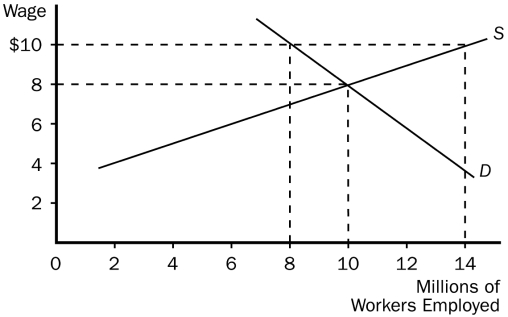 -Refer to Figure 19-1.What is the loss associated with wages moving from $8 to $10?
 (Multiple Choice)
4.8/5 (76)
(76) Studies of discrimination in baseball suggest that black players
(Multiple Choice)
4.9/5 (61)
(61) Most wage differences can be understood while maintaining the assumption of equilibrium in the labor market.We deviate from that assumption,however,when we consider
(Multiple Choice)
4.9/5 (73)
(73) The fact that movie star Julia Roberts' salary is much higher than the salary earned by a Nobel prize winning economics professor can best be explained by the
(Multiple Choice)
4.7/5 (68)
(68) Which of the following is not a consequence of above-equilibrium wages in a labor market?
(Multiple Choice)
4.8/5 (70)
(70) The Asian Development Bank has been investing in education and training programs in the developing economies of Asia over the last five years.As a result of this investment,economists who adhere to the human capital view of education would predict
(Multiple Choice)
4.9/5 (70)
(70) When differences in human capital among workers lead to discrimination,the differences are typically a result of social or political processes rather than economic processes.
(True/False)
4.9/5 (80)
(80) One reason why better-looking workers may have higher earnings is that physical attractiveness is correlated with intelligence.
(True/False)
4.8/5 (68)
(68) Jane and John are twins who attended grammar school through college together.Jane and John both got jobs at a brokerage firm after graduating from college with the same major.They both work equally hard.Jane earns $43,000 a year,and John earns $69,000 a year.Select the best explanation for this wage difference.
(Multiple Choice)
4.9/5 (87)
(87) 
Filters
- Essay(0)
- Multiple Choice(0)
- Short Answer(0)
- True False(0)
- Matching(0)