



 Chat with AI
Exam 15: Monopoly

Exam 1: Ten Principles of Economics281 Questions
Exam 2: Thinking Like an Economist451 Questions
Exam 3: Interdependence and the Gains From Trade353 Questions
Exam 4: The Market Forces of Supply and Demand467 Questions
Exam 5: Elasticity and Its Application409 Questions
Exam 6: Supply, Demand, and Government Policies459 Questions
Exam 7: Consumers, Producers, and the Efficiency of Markets363 Questions
Exam 8: Application: The Costs of Taxation353 Questions
Exam 9: Application: International Trade333 Questions
Exam 10: Externalities352 Questions
Exam 11: Public Goods and Common Resources270 Questions
Exam 12: The Design of the Tax System397 Questions
Exam 13: The Costs of Production434 Questions
Exam 14: Firms in Competitive Markets381 Questions
Exam 15: Monopoly427 Questions
Exam 16: Monopolistic Competition416 Questions
Exam 17: Oligopoly325 Questions
Exam 18: The Markets for the Factors of Production361 Questions
Exam 19: Earnings and Discrimination335 Questions
Exam 20: Income Inequality and Poverty312 Questions
Exam 21: The Theory of Consumer Choice354 Questions
Exam 22: Frontiers of Microeconomics262 Questions
Exam 23: Measuring a Nations Income343 Questions
Exam 24: Measuring the Cost of Living358 Questions
Exam 25: Production and Growth335 Questions
Exam 26: Saving, investment, and the Financial System381 Questions
Exam 27: The Basic Tools of Finance336 Questions
Exam 28: Unemployment533 Questions
Exam 29: The Monetary System366 Questions
Exam 30: Money Growth and Inflation312 Questions
Exam 31: Open-Economy Macroeconomics: Basic Concepts346 Questions
Exam 32: A Macroeconomic Theory of the Open Economy300 Questions
Exam 33: Aggregate Demand and Aggregate Supply386 Questions
Exam 34: The Influence of Monetary and Fiscal Policy on Aggregate Demand334 Questions
Exam 35: The Short-Run Trade-Off Between Inflation and Unemployment306 Questions
Exam 36: Five Debates Over Macroeconomic Policy179 Questions
Select questions type


When a certain monopoly sets its price at $8 it sells 64 units.When the monopoly sets its price at $10 it sells 60 units.The marginal revenue for the firm over this range is
(Multiple Choice)
4.9/5  (74)
(74) Table 15-6
Dreher's Designer Shirt Company,a monopolist,has the following cost and revenue information.Assume that Dreher's is able to engage in perfect price discrimination.
 -Refer to Table 15-6.If the monopolist can engage in perfect price discrimination,what is the quantity that maximizes economic profit?
 (Multiple Choice)
4.9/5 (64)
(64) The following table gives information on the price,quantity,and total cost of production for a monopolist.How much profit will the firm earn at the profit-maximizing price?
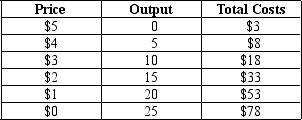
(Multiple Choice)
4.9/5 (79)
(79) The De Beers Diamond company is not worried about differentiating its product from all other gemstones.
(True/False)
4.7/5 (83)
(83) Drug companies are allowed to be monopolists in the drugs they discover in order to
(Multiple Choice)
5.0/5 (82)
(82) The deadweight loss that arises from a monopoly is a consequence of the fact that the monopoly
(Multiple Choice)
4.8/5 (73)
(73) A monopoly firm can sell 150 units of output for $10 per unit.Alternatively,it can sell 151 units of output for $9.95 per unit.The marginal revenue of the 151st unit of output is
(Multiple Choice)
4.9/5 (81)
(81) Figure 15-2 


 -Refer to Figure 15-2.Which of the following statements is correct?
 (Multiple Choice)
4.9/5 (89)
(89) Competitive firms differ from monopolies in which of the following ways?

(Multiple Choice)
4.9/5 (84)
(84) Figure 15-12  -Refer to Figure 15-12.If there are no fixed costs of production,monopoly profit with perfect price discrimination equals
 (Multiple Choice)
4.8/5 (73)
(73) Graphically depict the deadweight loss caused by a monopoly.How is this similar to the deadweight loss from taxation?
(Essay)
4.8/5 (75)
(75) Price discrimination adds to social welfare in the form of
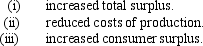
(Multiple Choice)
4.8/5 (92)
(92) A monopolist faces the following demand curve:
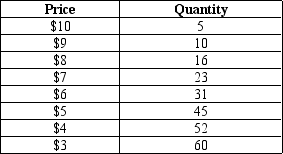 The monopolist has total fixed costs of $40 and a constant marginal cost of $5.At the profit-maximizing level of output,the monopolist's average total cost is
 (Multiple Choice)
4.8/5 (71)
(71) Figure 15-1  -Refer to Figure 15-1.The shape of the average total cost curve in the figure suggests an opportunity for a profit-maximizing monopolist to take advantage of
 (Multiple Choice)
4.8/5 (61)
(61) Which type of public policy toward monopolies is much more common in Europe than in the United States?
(Multiple Choice)
4.9/5 (78)
(78) For a monopolist,when does marginal revenue exceed average revenue?
(Multiple Choice)
4.7/5 (83)
(83) Which of the following is not an example of a barrier to entry?
(Multiple Choice)
4.9/5 (73)
(73) 
Filters
- Essay(0)
- Multiple Choice(0)
- Short Answer(0)
- True False(0)
- Matching(0)