



 Chat with AI
Exam 15: Monopoly

Exam 1: Ten Principles of Economics281 Questions
Exam 2: Thinking Like an Economist451 Questions
Exam 3: Interdependence and the Gains From Trade353 Questions
Exam 4: The Market Forces of Supply and Demand467 Questions
Exam 5: Elasticity and Its Application409 Questions
Exam 6: Supply, Demand, and Government Policies459 Questions
Exam 7: Consumers, Producers, and the Efficiency of Markets363 Questions
Exam 8: Application: The Costs of Taxation353 Questions
Exam 9: Application: International Trade333 Questions
Exam 10: Externalities352 Questions
Exam 11: Public Goods and Common Resources270 Questions
Exam 12: The Design of the Tax System397 Questions
Exam 13: The Costs of Production434 Questions
Exam 14: Firms in Competitive Markets381 Questions
Exam 15: Monopoly427 Questions
Exam 16: Monopolistic Competition416 Questions
Exam 17: Oligopoly325 Questions
Exam 18: The Markets for the Factors of Production361 Questions
Exam 19: Earnings and Discrimination335 Questions
Exam 20: Income Inequality and Poverty312 Questions
Exam 21: The Theory of Consumer Choice354 Questions
Exam 22: Frontiers of Microeconomics262 Questions
Exam 23: Measuring a Nations Income343 Questions
Exam 24: Measuring the Cost of Living358 Questions
Exam 25: Production and Growth335 Questions
Exam 26: Saving, investment, and the Financial System381 Questions
Exam 27: The Basic Tools of Finance336 Questions
Exam 28: Unemployment533 Questions
Exam 29: The Monetary System366 Questions
Exam 30: Money Growth and Inflation312 Questions
Exam 31: Open-Economy Macroeconomics: Basic Concepts346 Questions
Exam 32: A Macroeconomic Theory of the Open Economy300 Questions
Exam 33: Aggregate Demand and Aggregate Supply386 Questions
Exam 34: The Influence of Monetary and Fiscal Policy on Aggregate Demand334 Questions
Exam 35: The Short-Run Trade-Off Between Inflation and Unemployment306 Questions
Exam 36: Five Debates Over Macroeconomic Policy179 Questions
Select questions type


Policymakers are discussing various proposals regarding how to deal with natural monopolies.Senator Huff wants to regulate natural monopolies by equating price with average total cost.Huff contends that such a policy will ensure that monopolies make every effort to reduce costs.Senator Puff wants the government to own natural monopolies.Puff argues that government-owned monopolies usually do a better job of holding down costs than privately owned monopolies.Which senator's argument is correct?
(Multiple Choice)
4.8/5  (68)
(68) Table 15-1
 -Refer to Table 15-1.When 4 units of output are produced and sold,what is average revenue?
 (Multiple Choice)
4.8/5 (87)
(87) The collection of statutes aimed at curbing monopoly power is called
(Multiple Choice)
4.7/5 (93)
(93) Scenario 15-3
Suppose a monopolist has a demand curve that can be expressed as P=90-Q.The monopolist's marginal revenue curve can be expressed as MR=90-2Q.The monopolist has constant marginal costs and average total costs of $10.
-Refer to Scenario 15-3.The profit-maximizing monopolist will earn profits of
(Multiple Choice)
4.8/5 (77)
(77) A monopolist faces the following demand curve:
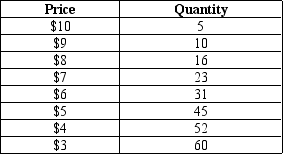 The monopolist has total fixed costs of $40 and a constant marginal cost of $5.At the profit-maximizing level of output,the monopolist's profit is
 (Multiple Choice)
4.7/5 (84)
(84) Even with market power,monopolists cannot achieve any level of profit they desire because they will sell lower quantities at higher prices.
(True/False)
4.7/5 (80)
(80) Table 15-2
Dreher's Designer Shirt Company,a monopolist,has the following cost and revenue information.
 -Refer to Table 15-2.Which of the following quantities will achieve the maximum profit?
 (Multiple Choice)
4.8/5 (74)
(74) The deadweight loss for a monopolist equals one-half of its profits for any given level of output.
(True/False)
4.8/5 (78)
(78) Figure 15-4  -Refer to Figure 15-4.If the monopoly firm is currently producing Q3 units of output,then a decrease in output will necessarily cause profit to
 (Multiple Choice)
4.8/5 (71)
(71) Figure 15-5  -Refer to Figure 15-5.A profit-maximizing monopoly's total revenue is equal to
 (Multiple Choice)
4.8/5 (66)
(66) By selling hardcover books to die-hard fans and paperback books to less enthusiastic readers,the publisher is able to price discriminate and raise its profits.
(True/False)
4.8/5 (83)
(83) Table 15-2
Dreher's Designer Shirt Company,a monopolist,has the following cost and revenue information.
-Refer to Table 15-2.What is the average revenue when 7 shirts are sold?
-Refer to Table 15-2.What is the average revenue when 7 shirts are sold? (Multiple Choice)
4.9/5 (80)
(80) When regulators use a marginal-cost pricing strategy to regulate a natural monopoly,the regulated monopoly
(Multiple Choice)
5.0/5 (81)
(81) A monopolist produces an output level where marginal revenue equals marginal cost and charges a price where marginal cost equals average total cost.
(True/False)
4.7/5 (89)
(89) A monopolist faces the following demand curve:
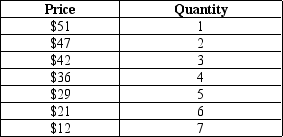 The monopolist has total fixed costs of $60 and has a constant marginal cost of $15.What is the profit-maximizing price?
 (Multiple Choice)
4.8/5 (87)
(87) If a profit-maximizing monopolist faces a downward-sloping market demand curve,its
(Multiple Choice)
4.8/5 (82)
(82) Which of the following is an example of a barrier to entry?
(Multiple Choice)
4.9/5 (80)
(80) 
Filters
- Essay(0)
- Multiple Choice(0)
- Short Answer(0)
- True False(0)
- Matching(0)