



 Chat with AI
Exam 15: Monopoly

Exam 1: Ten Principles of Economics281 Questions
Exam 2: Thinking Like an Economist451 Questions
Exam 3: Interdependence and the Gains From Trade353 Questions
Exam 4: The Market Forces of Supply and Demand467 Questions
Exam 5: Elasticity and Its Application409 Questions
Exam 6: Supply, Demand, and Government Policies459 Questions
Exam 7: Consumers, Producers, and the Efficiency of Markets363 Questions
Exam 8: Application: The Costs of Taxation353 Questions
Exam 9: Application: International Trade333 Questions
Exam 10: Externalities352 Questions
Exam 11: Public Goods and Common Resources270 Questions
Exam 12: The Design of the Tax System397 Questions
Exam 13: The Costs of Production434 Questions
Exam 14: Firms in Competitive Markets381 Questions
Exam 15: Monopoly427 Questions
Exam 16: Monopolistic Competition416 Questions
Exam 17: Oligopoly325 Questions
Exam 18: The Markets for the Factors of Production361 Questions
Exam 19: Earnings and Discrimination335 Questions
Exam 20: Income Inequality and Poverty312 Questions
Exam 21: The Theory of Consumer Choice354 Questions
Exam 22: Frontiers of Microeconomics262 Questions
Exam 23: Measuring a Nations Income343 Questions
Exam 24: Measuring the Cost of Living358 Questions
Exam 25: Production and Growth335 Questions
Exam 26: Saving, investment, and the Financial System381 Questions
Exam 27: The Basic Tools of Finance336 Questions
Exam 28: Unemployment533 Questions
Exam 29: The Monetary System366 Questions
Exam 30: Money Growth and Inflation312 Questions
Exam 31: Open-Economy Macroeconomics: Basic Concepts346 Questions
Exam 32: A Macroeconomic Theory of the Open Economy300 Questions
Exam 33: Aggregate Demand and Aggregate Supply386 Questions
Exam 34: The Influence of Monetary and Fiscal Policy on Aggregate Demand334 Questions
Exam 35: The Short-Run Trade-Off Between Inflation and Unemployment306 Questions
Exam 36: Five Debates Over Macroeconomic Policy179 Questions
Select questions type


Which of the following statements comparing monopoly with competition is correct?
(Multiple Choice)
5.0/5  (85)
(85) Authors are allowed to be monopolists in the sale of their books in order to
(Multiple Choice)
4.9/5 (69)
(69) A profit-maximizing monopolist charges a price of $14.The intersection of the marginal revenue curve and the marginal cost curve occurs where output is 15 units and marginal cost is $7.What is the monopolist's profit?
(Multiple Choice)
4.8/5 (76)
(76) When a monopolist increases the amount of output that it produces and sells,average revenue
(Multiple Choice)
4.8/5 (84)
(84) Table 15-5
 -Refer to Table 15-5.If the monopolist faces a constant marginal cost of $3,how much output should the firm produce?
 (Multiple Choice)
4.9/5 (86)
(86) Splitting up a monopoly is often justified on the grounds that
(Multiple Choice)
4.9/5 (88)
(88) One solution to the problems of marginal-cost pricing of a regulated natural monopolist is average cost pricing.In this model,the monopolist is allowed to price its production at average total cost.How does average-cost pricing differ from marginal-cost pricing? Does this solution maximize social well-being?
(Essay)
4.9/5 (76)
(76) During the holiday season,high-end retailers frequently place a high price on merchandise on weekends and discount the price during the week.They do this because they believe that two groups of customers exist: shoppers with little free time and bargain hunters.Bargain hunters have time to shop around and frequently shop during the week.What do economists call this price strategy used by high-end retailers?
(Multiple Choice)
4.9/5 (85)
(85) What are the four ways that government policymakers can respond to the problem of monopoly?
(Essay)
4.9/5 (78)
(78) Because a monopolist is the sole producer in its market,it can necessarily alter the price of its good

(Multiple Choice)
4.7/5 (73)
(73) The following table shows quantity,price,and marginal cost information for a monopoly.What price should the firm charge to maximize its profit?
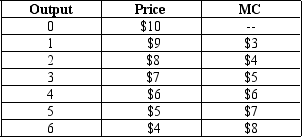
(Multiple Choice)
4.9/5 (88)
(88) Figure 15-10 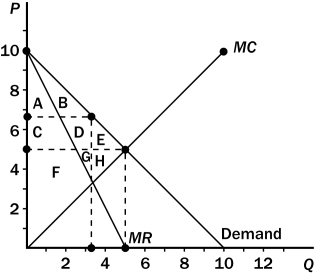 -Refer to Figure 15-10.Which area represents the deadweight loss from monopoly?
 (Multiple Choice)
4.9/5 (76)
(76) In order for antitrust laws to raise social welfare,the government must
(Multiple Choice)
4.9/5 (95)
(95) The monopolist's profit-maximizing quantity of output is determined by the intersection of which of the following two curves?
(Multiple Choice)
4.7/5 (86)
(86) Table 15-5
-Refer to Table 15-5.If the monopolist faces a constant marginal cost of $1,how much output should the firm produce?
-Refer to Table 15-5.If the monopolist faces a constant marginal cost of $1,how much output should the firm produce? (Multiple Choice)
4.9/5 (76)
(76) 
Suppose a profit-maximizing monopolist faces a constant marginal cost of $10,produces an output level of 100 units,and charges a price of $50.The socially efficient level of output is 200 units.Assume that the demand curve and marginal revenue curve are the typical downward-sloping straight lines.The monopoly deadweight loss equals $4,000.
(True/False)
4.8/5 (87)
(87) Figure 15-9 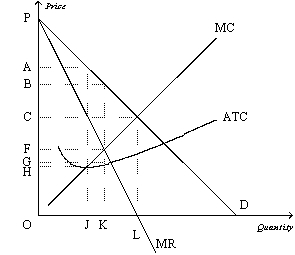 -Refer to Figure 15-9.What area measures the deadweight loss?
 (Multiple Choice)
4.7/5 (66)
(66) University financial aid can be viewed as a type of price discrimination.
(True/False)
4.9/5 (79)
(79) Price discrimination is a rational strategy for a profit-maximizing monopolist when
(Multiple Choice)
4.8/5 (90)
(90) 
Filters
- Essay(0)
- Multiple Choice(0)
- Short Answer(0)
- True False(0)
- Matching(0)