



 Chat with AI
Exam 7: Consumers, Producers, and the Efficiency of Markets

Exam 1: Ten Principles of Economics281 Questions
Exam 2: Thinking Like an Economist451 Questions
Exam 3: Interdependence and the Gains From Trade353 Questions
Exam 4: The Market Forces of Supply and Demand467 Questions
Exam 5: Elasticity and Its Application409 Questions
Exam 6: Supply, Demand, and Government Policies459 Questions
Exam 7: Consumers, Producers, and the Efficiency of Markets363 Questions
Exam 8: Application: The Costs of Taxation353 Questions
Exam 9: Application: International Trade333 Questions
Exam 10: Externalities352 Questions
Exam 11: Public Goods and Common Resources270 Questions
Exam 12: The Design of the Tax System397 Questions
Exam 13: The Costs of Production434 Questions
Exam 14: Firms in Competitive Markets381 Questions
Exam 15: Monopoly427 Questions
Exam 16: Monopolistic Competition416 Questions
Exam 17: Oligopoly325 Questions
Exam 18: The Markets for the Factors of Production361 Questions
Exam 19: Earnings and Discrimination335 Questions
Exam 20: Income Inequality and Poverty312 Questions
Exam 21: The Theory of Consumer Choice354 Questions
Exam 22: Frontiers of Microeconomics262 Questions
Exam 23: Measuring a Nations Income343 Questions
Exam 24: Measuring the Cost of Living358 Questions
Exam 25: Production and Growth335 Questions
Exam 26: Saving, investment, and the Financial System381 Questions
Exam 27: The Basic Tools of Finance336 Questions
Exam 28: Unemployment533 Questions
Exam 29: The Monetary System366 Questions
Exam 30: Money Growth and Inflation312 Questions
Exam 31: Open-Economy Macroeconomics: Basic Concepts346 Questions
Exam 32: A Macroeconomic Theory of the Open Economy300 Questions
Exam 33: Aggregate Demand and Aggregate Supply386 Questions
Exam 34: The Influence of Monetary and Fiscal Policy on Aggregate Demand334 Questions
Exam 35: The Short-Run Trade-Off Between Inflation and Unemployment306 Questions
Exam 36: Five Debates Over Macroeconomic Policy179 Questions
Select questions type


Figure 7-3 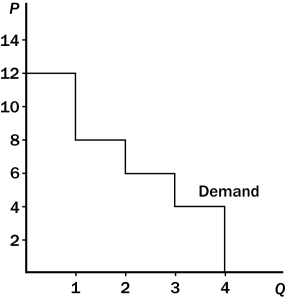 -Refer to Figure 7-3.If the price of the good is $6,then consumer surplus is
 (Multiple Choice)
4.9/5  (72)
(72) Figure 7-13  -Refer to Figure 7-13.For quantities less than M,the value to the marginal buyer is
 (Multiple Choice)
4.8/5 (71)
(71) According to many economists,government restrictions on ticket scalping do all of the following except
(Multiple Choice)
4.8/5 (84)
(84) Figure 7-11  -Refer to Figure 7-11.When the price falls from P2 to P1,producer surplus
 (Multiple Choice)
4.9/5 (76)
(76) Figure 7-9  -Refer to Figure 7-9.If the equilibrium price is $50,what is the producer surplus?
 (Multiple Choice)
4.8/5 (81)
(81) All else equal,what happens to consumer surplus if the price of a good decreases?
(Multiple Choice)
4.9/5 (86)
(86) Figure 7-17  -Refer to Figure 7-17.At equilibrium,producer surplus is
 (Multiple Choice)
4.9/5 (78)
(78) Producing a soccer ball costs Jake $5.He sells it to Darby for $35.Darby values the soccer ball at $50.For this transaction,the total surplus in the market is $40.
(True/False)
4.9/5 (68)
(68) Figure 7-13
-Refer to Figure 7-13.Total surplus can be measured as the area
-Refer to Figure 7-13.Total surplus can be measured as the area (Multiple Choice)
4.8/5 (75)
(75) Figure 7-8  -Refer to Figure 7-8.If the supply curve is S,the demand curve is D,and the equilibrium price is $100,what is the producer surplus?
 (Multiple Choice)
4.8/5 (78)
(78) Figure 7-11
-Refer to Figure 7-11.When the price is P2,producer surplus is
-Refer to Figure 7-11.When the price is P2,producer surplus is (Multiple Choice)
4.8/5 (75)
(75) Figure 7-17
-Refer to Figure 7-17.If 4 units of the good are produced and sold,then
-Refer to Figure 7-17.If 4 units of the good are produced and sold,then (Multiple Choice)
4.8/5 (67)
(67) 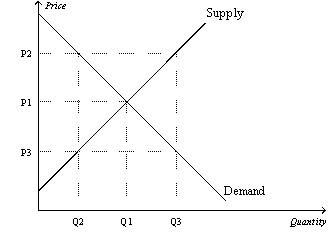 -Refer to Figure 7-19.At the quantity Q3,
A buyer is willing to buy a product at a price greater than or equal to his willingness to pay,but would refuse to buy a product at a price less than his willingness to pay.
(True/False)
4.8/5 (69)
(69) Figure 7-2  -Refer to Figure 7-2.When the price falls from P1 to P2,which area represents the increase in consumer surplus to new buyers entering the market?
 (Multiple Choice)
4.9/5 (73)
(73) 
Filters
- Essay(0)
- Multiple Choice(0)
- Short Answer(0)
- True False(0)
- Matching(0)