



 Chat with AI
Exam 7: Consumers, Producers, and the Efficiency of Markets

Exam 1: Ten Principles of Economics281 Questions
Exam 2: Thinking Like an Economist451 Questions
Exam 3: Interdependence and the Gains From Trade353 Questions
Exam 4: The Market Forces of Supply and Demand467 Questions
Exam 5: Elasticity and Its Application409 Questions
Exam 6: Supply, Demand, and Government Policies459 Questions
Exam 7: Consumers, Producers, and the Efficiency of Markets363 Questions
Exam 8: Application: The Costs of Taxation353 Questions
Exam 9: Application: International Trade333 Questions
Exam 10: Externalities352 Questions
Exam 11: Public Goods and Common Resources270 Questions
Exam 12: The Design of the Tax System397 Questions
Exam 13: The Costs of Production434 Questions
Exam 14: Firms in Competitive Markets381 Questions
Exam 15: Monopoly427 Questions
Exam 16: Monopolistic Competition416 Questions
Exam 17: Oligopoly325 Questions
Exam 18: The Markets for the Factors of Production361 Questions
Exam 19: Earnings and Discrimination335 Questions
Exam 20: Income Inequality and Poverty312 Questions
Exam 21: The Theory of Consumer Choice354 Questions
Exam 22: Frontiers of Microeconomics262 Questions
Exam 23: Measuring a Nations Income343 Questions
Exam 24: Measuring the Cost of Living358 Questions
Exam 25: Production and Growth335 Questions
Exam 26: Saving, investment, and the Financial System381 Questions
Exam 27: The Basic Tools of Finance336 Questions
Exam 28: Unemployment533 Questions
Exam 29: The Monetary System366 Questions
Exam 30: Money Growth and Inflation312 Questions
Exam 31: Open-Economy Macroeconomics: Basic Concepts346 Questions
Exam 32: A Macroeconomic Theory of the Open Economy300 Questions
Exam 33: Aggregate Demand and Aggregate Supply386 Questions
Exam 34: The Influence of Monetary and Fiscal Policy on Aggregate Demand334 Questions
Exam 35: The Short-Run Trade-Off Between Inflation and Unemployment306 Questions
Exam 36: Five Debates Over Macroeconomic Policy179 Questions
Select questions type


When markets fail,public policy can potentially remedy the problem and increase economic efficiency.
(True/False)
4.8/5  (80)
(80) Unless markets are perfectly competitive,they may fail to maximize the total benefits to buyers and sellers.
(True/False)
4.8/5 (73)
(73) Table 7-9
 -Refer to Table 7-9.Both the demand curve and the supply curve are straight lines.At equilibrium,producer surplus is
 (Multiple Choice)
4.7/5 (73)
(73) Figure 7-1  -Refer to Figure 7-1.When the price is P2,consumer surplus is
 (Multiple Choice)
4.8/5 (76)
(76) Table 7-3
The only four consumers in a market have the following willingness to pay for a good:
 -Refer to Table 7-3.If the market price for the good is $30,who will purchase the good?
 (Multiple Choice)
4.8/5 (98)
(98) Suppose consumer income increases.If grass seed is a normal good,the equilibrium price of grass seed will
(Multiple Choice)
4.9/5 (68)
(68) The area below the price and above the supply curve measures the producer surplus in a market.
(True/False)
4.8/5 (92)
(92) Figure 7-17  -Refer to Figure 7-17.At equilibrium,consumer surplus is
 (Multiple Choice)
4.9/5 (90)
(90) Figure 7-15  -Refer to Figure 7-15.If 110 units of the good are being bought and sold,then
 (Multiple Choice)
4.8/5 (81)
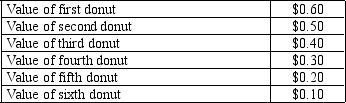
(81) Tammy loves donuts.The table shown reflects the value Tammy places on each donut she eats:
 a.
Use this information to construct Tammy's demand curve for donuts.
b.
If the price of donuts is $0.20,how many donuts will Tammy buy?
c.
Show Tammy's consumer surplus on your graph.How much consumer surplus would she have at a price of $0.20?
d.
If the price of donuts rose to $0.40,how many donuts would she purchase now? What would happen to Tammy's consumer surplus? Show this change on your graph.
a.
Use this information to construct Tammy's demand curve for donuts.
b.
If the price of donuts is $0.20,how many donuts will Tammy buy?
c.
Show Tammy's consumer surplus on your graph.How much consumer surplus would she have at a price of $0.20?
d.
If the price of donuts rose to $0.40,how many donuts would she purchase now? What would happen to Tammy's consumer surplus? Show this change on your graph. (Essay)
4.8/5 (94)
(94) Table 7-4
The numbers in Table 7-1 reveal the maximum willingness to pay for a ticket to a Chicago Cubs vs.St.Louis Cardinal's baseball game at Wrigley Field.
 -Refer to Table 7-4.If tickets sell for $20 each,then what is the total consumer surplus in the market?
 (Multiple Choice)
4.7/5 (76)
(76) Figure 7-9  -Refer to Figure 7-9.If the equilibrium price rises from $50 to $200,what is the producer surplus to new producers?
 (Multiple Choice)
4.7/5 (76)
(76) Figure 7-14  -Refer to Figure 7-14.Which area represents producer surplus when the price is P1?
 (Multiple Choice)
5.0/5 (86)
(86) Table 7-1
 -Refer to Table 7-1.If the price of the product is $15,then who would be willing to purchase the product?
 (Multiple Choice)
4.9/5 (86)
(86) Noah drinks Dr.Pepper.He can buy as many cans of Dr.Pepper as he wishes at a price of $0.50 per can.On a particular day,he is willing to pay $0.95 for the first can,$0.80 for the second can,$0.60 for the third can,and $0.40 for the fourth can.Assume Noah is rational in deciding how many cans to buy.His consumer surplus is
(Multiple Choice)
4.8/5 (88)
(88) Table 7-3
The only four consumers in a market have the following willingness to pay for a good:
-Refer to Table 7-3.If there is only one unit of the good and if the buyers bid against each other for the right to purchase it,then the consumer surplus will be
-Refer to Table 7-3.If there is only one unit of the good and if the buyers bid against each other for the right to purchase it,then the consumer surplus will be (Multiple Choice)
5.0/5 (94)
(94) Table 7-1
-Refer to Table 7-1.If the price of the product is $18,then the total consumer surplus is
-Refer to Table 7-1.If the price of the product is $18,then the total consumer surplus is (Multiple Choice)
4.8/5 (86)
(86) David tunes pianos in his spare time for extra income.Buyers of his service are willing to pay $150 per tuning.One particular week,David is willing to tune the first piano for $115,the second piano for $125,the third piano for $140,and the fourth piano for $175.Assume David is rational in deciding how many pianos to tune.His producer surplus is
(Multiple Choice)
5.0/5 (75)
(75) 
Filters
- Essay(0)
- Multiple Choice(0)
- Short Answer(0)
- True False(0)
- Matching(0)