



 Chat with AI
Exam 7: Consumers, Producers, and the Efficiency of Markets

Exam 1: Ten Principles of Economics281 Questions
Exam 2: Thinking Like an Economist451 Questions
Exam 3: Interdependence and the Gains From Trade353 Questions
Exam 4: The Market Forces of Supply and Demand467 Questions
Exam 5: Elasticity and Its Application409 Questions
Exam 6: Supply, Demand, and Government Policies459 Questions
Exam 7: Consumers, Producers, and the Efficiency of Markets363 Questions
Exam 8: Application: The Costs of Taxation353 Questions
Exam 9: Application: International Trade333 Questions
Exam 10: Externalities352 Questions
Exam 11: Public Goods and Common Resources270 Questions
Exam 12: The Design of the Tax System397 Questions
Exam 13: The Costs of Production434 Questions
Exam 14: Firms in Competitive Markets381 Questions
Exam 15: Monopoly427 Questions
Exam 16: Monopolistic Competition416 Questions
Exam 17: Oligopoly325 Questions
Exam 18: The Markets for the Factors of Production361 Questions
Exam 19: Earnings and Discrimination335 Questions
Exam 20: Income Inequality and Poverty312 Questions
Exam 21: The Theory of Consumer Choice354 Questions
Exam 22: Frontiers of Microeconomics262 Questions
Exam 23: Measuring a Nations Income343 Questions
Exam 24: Measuring the Cost of Living358 Questions
Exam 25: Production and Growth335 Questions
Exam 26: Saving, investment, and the Financial System381 Questions
Exam 27: The Basic Tools of Finance336 Questions
Exam 28: Unemployment533 Questions
Exam 29: The Monetary System366 Questions
Exam 30: Money Growth and Inflation312 Questions
Exam 31: Open-Economy Macroeconomics: Basic Concepts346 Questions
Exam 32: A Macroeconomic Theory of the Open Economy300 Questions
Exam 33: Aggregate Demand and Aggregate Supply386 Questions
Exam 34: The Influence of Monetary and Fiscal Policy on Aggregate Demand334 Questions
Exam 35: The Short-Run Trade-Off Between Inflation and Unemployment306 Questions
Exam 36: Five Debates Over Macroeconomic Policy179 Questions
Select questions type


The area below the demand curve and above the supply curve measures the producer surplus in a market.
(True/False)
4.9/5  (70)
(70) Consumer surplus is the amount a buyer actually has to pay for a good minus the amount the buyer is willing to pay for it.
(True/False)
4.8/5 (86)
(86) Economists generally believe that,although there may be advantages to society from ticket-scalping,the costs to society of this activity outweigh the benefits.
(True/False)
4.8/5 (83)
(83) Figure 7-8  -Refer to Figure 7-8.If the supply curve is S and the demand curve shifts from D to D',what is the increase in producer surplus to existing producers?
 (Multiple Choice)
4.8/5 (74)
(74) Janine would be willing to pay $50 to see Les Misérables,but she buys a ticket for only $30.Janine values the performance at
(Multiple Choice)
4.8/5 (76)
(76) Table 7-8
The numbers reveal the opportunity costs of providing 10 piano lessons of equal quality.
 -Refer to Table 7-8.The equilibrium market price for 10 piano lessons is $300.What is the total producer surplus in the market?
 (Multiple Choice)
4.8/5 (80)
(80) If a consumer places a value of $20 on a particular good and if the price of the good is $25,then the
(Multiple Choice)
4.9/5 (81)
(81) At present,the maximum legal price for a human kidney is $0.The price of $0 maximizes
(Multiple Choice)
4.8/5 (89)
(89) Table 7-5
For each of three potential buyers of oranges,the table displays the willingness to pay for the first three oranges of the day.Assume Alex,Barb,and Carlos are the only three buyers of oranges,and only three oranges can be supplied per day.
 -Refer to Table 7-5.If the market price of an orange is $1.20,the market quantity of oranges demanded per day is
 (Multiple Choice)
4.9/5 (69)
(69) If producing a soccer ball costs Jake $5,and he sells it for $40,his producer surplus is $45.
(True/False)
5.0/5 (76)
(76) If the United States legally allowed for a market in transplant organs,it is estimated that one kidney would sell for at least $100,000.
(True/False)
4.9/5 (83)
(83)  -Refer to Figure 7-15.The efficient price is
Efficiency refers to whether a market outcome is fair,while equality refers to whether the maximum amount of output was produced from a given number of inputs.
(True/False)
4.9/5 (73)
(73) Figure 7-11  -Refer to Figure 7-11.When the price rises from P1 to P2,which area represents the increase in producer surplus to existing producers?
 (Multiple Choice)
4.7/5 (90)
(90) Denise values a stainless steel dishwasher for her new house at $500,but she succeeds in buying one for $350.Denise's consumer surplus is
(Multiple Choice)
4.8/5 (82)
(82) Figure 7-4 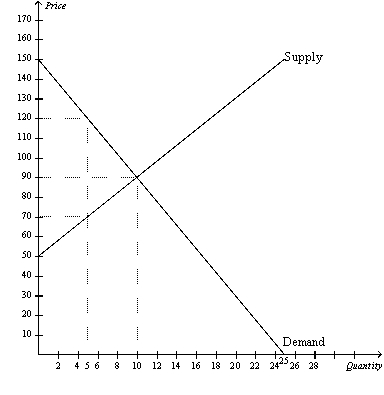 -Refer to Figure 7-4.If the government imposes a price floor of $120 in this market,then consumer surplus will decrease by
 (Multiple Choice)
4.8/5 (86)
(86) 
Filters
- Essay(0)
- Multiple Choice(0)
- Short Answer(0)
- True False(0)
- Matching(0)