



 Chat with AI
Exam 35: The Short-Run Trade-Off Between Inflation and Unemployment

Exam 1: Ten Lessons From Economics149 Questions
Exam 2: Thinking Like an Economist147 Questions
Exam 3: Interdependence and the Gains From Trade153 Questions
Exam 4: The Market Forces of Supply and Demand222 Questions
Exam 5: Elasticity and Its Application181 Questions
Exam 6: Supply, Demand and Government Policies148 Questions
Exam 7: Consumers, Producers and the Efficiency of Markets177 Questions
Exam 8: Application: The Costs of Taxation141 Questions
Exam 9: Application: International Trade161 Questions
Exam 10: Externalities199 Questions
Exam 11: Public Goods and Common Resources182 Questions
Exam 12: The Design of the Tax System154 Questions
Exam 13: The Costs of Production191 Questions
Exam 14: Firms in Competitive Markets200 Questions
Exam 15: Monopoly214 Questions
Exam 16: Business Strategy184 Questions
Exam 17: Competition Policy104 Questions
Exam 18: Monopolistic Competition214 Questions
Exam 19: The Markets for the Factors of Production215 Questions
Exam 20: Earnings, Unions and Discrimination206 Questions
Exam 21: Income Inequity and Poverty111 Questions
Exam 22: The Theory of Consumer Choice161 Questions
Exam 23: Frontiers of Microeconomics120 Questions
Exam 24: Measuring a Nations Income51 Questions
Exam 25: Measuring the Cost of Living52 Questions
Exam 26: Production and Growth62 Questions
Exam 27: Saving, Investment and the Financial System62 Questions
Exam 28: The Natural Rate of Unemployment59 Questions
Exam 29: The Monetary System66 Questions
Exam 30: Inflation: Its Causes and Costs74 Questions
Exam 31: Open-Economy Macroeconomics: Basic Concepts68 Questions
Exam 32: A Macroeconomic Theory of the Open Economy64 Questions
Exam 33: Aggregate Demand and Aggregate Supply82 Questions
Exam 34: The Influence of Monetary and Fiscal Policy on Aggregate Demand73 Questions
Exam 35: The Short-Run Trade-Off Between Inflation and Unemployment58 Questions
Exam 36: Five Debates Over Macroeconomic Policy38 Questions
Select questions type


Rational expectations theory is based on the assumption that people optimally allocate their incomes - that is, they decide how much they consume and how much they save.
(True/False)
4.8/5  (77)
(77) A group of economists offer the theory that the economy will reduce inflation without the cost of _____ if people are rational.
(Multiple Choice)
4.9/5 (88)
(88) The natural rate of unemployment is:The natural rate of unemployment is:
(Multiple Choice)
4.9/5 (72)
(72) Economists have various theories of how expectations may be formed. The textbook discusses the theory of rational expectations. Another possibility is that people have adaptive expectations, which means they form their expectations based on recent history. (For example, people might guess that the inflation rate next year will be the same as it was this year.) Would it be easier to eliminate inflation when people have rational expectations or when they have adaptive expectations?
(Essay)
4.8/5 (75)
(75) According to the theory of rational expectations, an announced policy of reducing the rate of growth of the money supply will result in people:
(Multiple Choice)
5.0/5 (79)
(79) See the graph below. In the short run, a decrease in the rate of growth of the money supply will move the economy from point K to point ____. 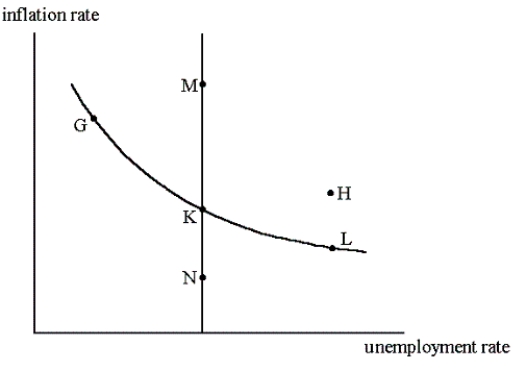
(Multiple Choice)
4.9/5 (63)
(63) Most macroeconomic variables - for example, GDP or inflation or unemployment - can be easily measured. Expectations, however, are difficult - perhaps impossible - to measure accurately. Why do macroeconomists give such prominence in their theory to such an elusive variable?
(Essay)
4.9/5 (88)
(88) Explain how policymakers could use monetary and fiscal policies to move the economy along the Phillips curve in the direction of higher inflation and lower unemployment.
(Essay)
4.8/5 (80)
(80) If the sacrifice ratio is 5 per cent, reducing the inflation rate from 10 per cent to 5 per cent would require sacrificing _____ per cent of annual output.
(Multiple Choice)
4.9/5 (73)
(73) Friedman and Phelps concluded that policymakers face a _____ trade-off between inflation and unemployment.
(Multiple Choice)
4.9/5 (78)
(78) If the long-run Phillips curve shifts to the left, the economy will experience a(n) ____ short-run trade-off between inflation and unemployment.
(Multiple Choice)
4.8/5 (76)
(76) Proponents of rational expectations theory argue that when government policies change, people adjust their expectations accordingly, and that failure to include that fact once led to estimates of the sacrifice ratio that were unreliable guides to policy.
(True/False)
4.7/5 (92)
(92) The equation by Friedman and Phelps of a relationship between the unemployment rate and its natural rate can be summarised as:
(Multiple Choice)
5.0/5 (73)
(73) When the money supply changes, the aggregate-demand curve shifts and the economy moves along a given short-run aggregate-supply curve, causing unexpected changes in output, prices, unemployment and inflation. These changes cause people to adjust their expectations of inflation, leading to shifts in the short-run aggregate-supply curve.
(True/False)
4.9/5 (84)
(84) The Phillips Curve is a short-run positive relationship between inflation and unemployment.
(True/False)
4.7/5 (82)
(82) 
Filters
- Essay(0)
- Multiple Choice(0)
- Short Answer(0)
- True False(0)
- Matching(0)