



 Chat with AI
Exam 30: Inflation: Its Causes and Costs

Exam 1: Ten Lessons From Economics149 Questions
Exam 2: Thinking Like an Economist147 Questions
Exam 3: Interdependence and the Gains From Trade153 Questions
Exam 4: The Market Forces of Supply and Demand222 Questions
Exam 5: Elasticity and Its Application181 Questions
Exam 6: Supply, Demand and Government Policies148 Questions
Exam 7: Consumers, Producers and the Efficiency of Markets177 Questions
Exam 8: Application: The Costs of Taxation141 Questions
Exam 9: Application: International Trade161 Questions
Exam 10: Externalities199 Questions
Exam 11: Public Goods and Common Resources182 Questions
Exam 12: The Design of the Tax System154 Questions
Exam 13: The Costs of Production191 Questions
Exam 14: Firms in Competitive Markets200 Questions
Exam 15: Monopoly214 Questions
Exam 16: Business Strategy184 Questions
Exam 17: Competition Policy104 Questions
Exam 18: Monopolistic Competition214 Questions
Exam 19: The Markets for the Factors of Production215 Questions
Exam 20: Earnings, Unions and Discrimination206 Questions
Exam 21: Income Inequity and Poverty111 Questions
Exam 22: The Theory of Consumer Choice161 Questions
Exam 23: Frontiers of Microeconomics120 Questions
Exam 24: Measuring a Nations Income51 Questions
Exam 25: Measuring the Cost of Living52 Questions
Exam 26: Production and Growth62 Questions
Exam 27: Saving, Investment and the Financial System62 Questions
Exam 28: The Natural Rate of Unemployment59 Questions
Exam 29: The Monetary System66 Questions
Exam 30: Inflation: Its Causes and Costs74 Questions
Exam 31: Open-Economy Macroeconomics: Basic Concepts68 Questions
Exam 32: A Macroeconomic Theory of the Open Economy64 Questions
Exam 33: Aggregate Demand and Aggregate Supply82 Questions
Exam 34: The Influence of Monetary and Fiscal Policy on Aggregate Demand73 Questions
Exam 35: The Short-Run Trade-Off Between Inflation and Unemployment58 Questions
Exam 36: Five Debates Over Macroeconomic Policy38 Questions
Select questions type


What is the real interest rate under each of the following scenarios?
a. The nominal interest rate is 4 per cent and the inflation rate is 3 per cent
b. The nominal interest rate is 6 per cent and the inflation rate is -1 per cent
c. The nominal interest rate is 5 per cent and the inflation rate is 7 per cent
(Essay)
4.8/5  (58)
(58) Given that petrol is key to the transport sector and all other sectors in Australia, why does the constant changing of price petrol not create menu costs?
(Essay)
4.8/5 (87)
(87) If P represents the price of goods and services measured in money, then 1/P is the value of money measured in terms of goods and services. Hence when the overall price level rises, the value of money falls.
(True/False)
4.9/5 (84)
(84) Why has Germany had much lower inflation than the US has over the past 50 years?
(Multiple Choice)
4.9/5 (84)
(84) If between when you purchase an asset and sell it, the general price level and the price of the asset both double, then you have realised a:
(Multiple Choice)
4.8/5 (77)
(77) The irrelevance of monetary changes for nominal variables is called monetary neutrality.
(True/False)
4.9/5 (92)
(92) Graph 30-1
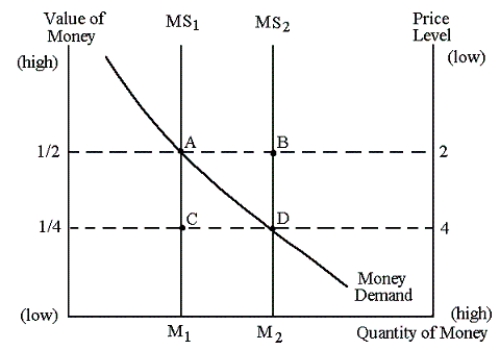 -At point B in Graph 30-1: At point B in Graph 30-1:
 (Multiple Choice)
4.9/5 (84)
(84) Consider a simple economy that produces only chocolates. The economy produces 100 bars of chocolates in a year, and a chocolate bar costs $5. If the quantity of money supplied in the economy is $25, then the velocity of money is:
(Multiple Choice)
4.9/5 (77)
(77) The most important variable affecting the demand for money in the long run is the:
(Multiple Choice)
4.8/5 (80)
(80) 
Filters
- Essay(0)
- Multiple Choice(0)
- Short Answer(0)
- True False(0)
- Matching(0)