



 Chat with AI
Exam 28: The Natural Rate of Unemployment

Exam 1: Ten Lessons From Economics149 Questions
Exam 2: Thinking Like an Economist147 Questions
Exam 3: Interdependence and the Gains From Trade153 Questions
Exam 4: The Market Forces of Supply and Demand222 Questions
Exam 5: Elasticity and Its Application181 Questions
Exam 6: Supply, Demand and Government Policies148 Questions
Exam 7: Consumers, Producers and the Efficiency of Markets177 Questions
Exam 8: Application: The Costs of Taxation141 Questions
Exam 9: Application: International Trade161 Questions
Exam 10: Externalities199 Questions
Exam 11: Public Goods and Common Resources182 Questions
Exam 12: The Design of the Tax System154 Questions
Exam 13: The Costs of Production191 Questions
Exam 14: Firms in Competitive Markets200 Questions
Exam 15: Monopoly214 Questions
Exam 16: Business Strategy184 Questions
Exam 17: Competition Policy104 Questions
Exam 18: Monopolistic Competition214 Questions
Exam 19: The Markets for the Factors of Production215 Questions
Exam 20: Earnings, Unions and Discrimination206 Questions
Exam 21: Income Inequity and Poverty111 Questions
Exam 22: The Theory of Consumer Choice161 Questions
Exam 23: Frontiers of Microeconomics120 Questions
Exam 24: Measuring a Nations Income51 Questions
Exam 25: Measuring the Cost of Living52 Questions
Exam 26: Production and Growth62 Questions
Exam 27: Saving, Investment and the Financial System62 Questions
Exam 28: The Natural Rate of Unemployment59 Questions
Exam 29: The Monetary System66 Questions
Exam 30: Inflation: Its Causes and Costs74 Questions
Exam 31: Open-Economy Macroeconomics: Basic Concepts68 Questions
Exam 32: A Macroeconomic Theory of the Open Economy64 Questions
Exam 33: Aggregate Demand and Aggregate Supply82 Questions
Exam 34: The Influence of Monetary and Fiscal Policy on Aggregate Demand73 Questions
Exam 35: The Short-Run Trade-Off Between Inflation and Unemployment58 Questions
Exam 36: Five Debates Over Macroeconomic Policy38 Questions
Select questions type


Discuss the 'unionisation' debate. What are the positive and negative effects when a union raises the wage above the equilibrium level?
(Essay)
4.9/5  (77)
(77) Which of the following statements about unemployment benefits is correct?
(Multiple Choice)
4.8/5 (81)
(81) Which of the following causes of unemployment is not associated with a wage rate above the equilibrium level?
(Multiple Choice)
5.0/5 (77)
(77) Economists and policymakers must equally consider the problems of short-term unemployment and long-term unemployment in the economy.
(True/False)
4.9/5 (83)
(83) Explain how a government policy encouraging a parent to stay at home with their young children would reduce unemployment.
(Essay)
4.9/5 (77)
(77) Mary has been out of the paid workforce in order to raise her children. Now she decides to do paid work and is looking for a job. Which of the following is the correct statement?
(Multiple Choice)
4.8/5 (75)
(75) 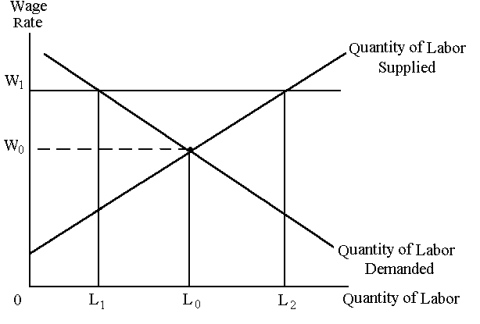 -Effective collective bargaining will:
Most of the economy's unemployment problem is attributable to the relatively few workers who are jobless for long periods of time.
(True/False)
4.9/5 (81)
(81) Which of the following statements about unemployment is incorrect?
(Multiple Choice)
4.8/5 (69)
(69) Firms may find it profitable to pay wages above the equilibrium level in order to give workers an incentive to avoid shirking their responsibilities.
(True/False)
4.8/5 (82)
(82) Janet loses her job and decides to sit around at home for a few weeks. Ceteris paribus:
(Multiple Choice)
4.8/5 (84)
(84) Explain the worker-effort variant of efficiency wage theory with moral hazard.
(Essay)
4.9/5 (68)
(68) When a union raises the wage above the equilibrium level, ceteris paribus:
(Multiple Choice)
4.9/5 (77)
(77) Efficiency-wage theory suggests that to improve workers performance, firms should:
(Multiple Choice)
4.9/5 (81)
(81) Which of the following statements is an example of moral hazard?
(Multiple Choice)
4.8/5 (83)
(83) 
Filters
- Essay(0)
- Multiple Choice(0)
- Short Answer(0)
- True False(0)
- Matching(0)