



 Chat with AI
Exam 18: Monopolistic Competition

Exam 1: Ten Lessons From Economics149 Questions
Exam 2: Thinking Like an Economist147 Questions
Exam 3: Interdependence and the Gains From Trade153 Questions
Exam 4: The Market Forces of Supply and Demand222 Questions
Exam 5: Elasticity and Its Application181 Questions
Exam 6: Supply, Demand and Government Policies148 Questions
Exam 7: Consumers, Producers and the Efficiency of Markets177 Questions
Exam 8: Application: The Costs of Taxation141 Questions
Exam 9: Application: International Trade161 Questions
Exam 10: Externalities199 Questions
Exam 11: Public Goods and Common Resources182 Questions
Exam 12: The Design of the Tax System154 Questions
Exam 13: The Costs of Production191 Questions
Exam 14: Firms in Competitive Markets200 Questions
Exam 15: Monopoly214 Questions
Exam 16: Business Strategy184 Questions
Exam 17: Competition Policy104 Questions
Exam 18: Monopolistic Competition214 Questions
Exam 19: The Markets for the Factors of Production215 Questions
Exam 20: Earnings, Unions and Discrimination206 Questions
Exam 21: Income Inequity and Poverty111 Questions
Exam 22: The Theory of Consumer Choice161 Questions
Exam 23: Frontiers of Microeconomics120 Questions
Exam 24: Measuring a Nations Income51 Questions
Exam 25: Measuring the Cost of Living52 Questions
Exam 26: Production and Growth62 Questions
Exam 27: Saving, Investment and the Financial System62 Questions
Exam 28: The Natural Rate of Unemployment59 Questions
Exam 29: The Monetary System66 Questions
Exam 30: Inflation: Its Causes and Costs74 Questions
Exam 31: Open-Economy Macroeconomics: Basic Concepts68 Questions
Exam 32: A Macroeconomic Theory of the Open Economy64 Questions
Exam 33: Aggregate Demand and Aggregate Supply82 Questions
Exam 34: The Influence of Monetary and Fiscal Policy on Aggregate Demand73 Questions
Exam 35: The Short-Run Trade-Off Between Inflation and Unemployment58 Questions
Exam 36: Five Debates Over Macroeconomic Policy38 Questions
Select questions type


The debate over whether society is wasting the resources it devotes to advertising has largely been resolved by which of the following groups? (i) economists who study the tastes and preferences of individuals
(ii) psychologists who evaluate the manipulative effects of advertising
(iii) sociologists who document the destructive social forces inherent in advertising
(Multiple Choice)
4.7/5  (65)
(65) Long-run economic profit in a monopolistically competitive market is mainly a function of which of the following? (i) free entry
(ii) free exit
(iii) strategic pricing among the sellers
(Multiple Choice)
4.8/5 (77)
(77) If firms in a monopolistically competitive market are incurring economic losses, which of the following scenarios would best reflect the change facing incumbent firms (who are able to stay in the market) as the market adjusts to its new equilibrium?
(Multiple Choice)
4.9/5 (86)
(86) An important criticism of advertising is that in some markets it may:
(Multiple Choice)
4.9/5 (71)
(71) Advertisements that appear to convey no information at all:
(Multiple Choice)
4.8/5 (86)
(86) Graph 17-2
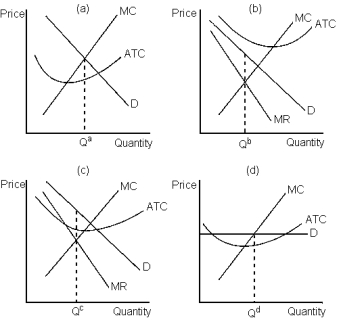 -Refer to Graph 17-2. Which of the graphs shown would be consistent with a firm in a monopolistically competitive market that is minimising its losses?
 (Multiple Choice)
4.8/5 (89)
(89) For which of the following reasons is the existence of business-stealing externalities and product-variety externalities unique to profit-maximising firms in a monopolistically competitive market? (i) there are few firms in the market, but each firm produces several different varieties of the product
(ii) there are many firms in the market, each with a different variety of the product
(iii) profit-maximising price exceeds marginal cost
(Multiple Choice)
4.8/5 (78)
(78) For many years, Google has had market dominance in many of its online activities. Recently, it has been trying to take on Facebook's dominance of social media.
Google has started to use its banner space on its website and the Tech media, as well as having 'invitees' to test the 'Beta'. What advertising theory does such an approach support? Explain.
(Essay)
4.9/5 (75)
(75) Since a firm in a monopolistically competitive market faces a:
(Multiple Choice)
4.9/5 (88)
(88) The 'competition' in monopolistically competitive markets is most likely a result of:
(Multiple Choice)
4.9/5 (65)
(65) The fact that firms in monopolistically competitive markets differentiate their product from other sellers means that the average revenue curve each seller faces is:
(Multiple Choice)
4.9/5 (79)
(79) Excess capacity occurs whenever a firm is operating at an output level below where average total cost is minimised.
(True/False)
5.0/5 (75)
(75) The product-variety externality associated with monopolistic competition arises because in monopolistically competitive markets firms try to differentiate their products.
(True/False)
4.8/5 (80)
(80) In a monopolistically competitive market structure, each firm sells a good that is:
(Multiple Choice)
4.9/5 (65)
(65) If advertising reduces a consumer's price sensitivity between identical goods, it is likely to:
(Multiple Choice)
4.9/5 (58)
(58) One way in which monopolistic competition differs from oligopoly is that:
(Multiple Choice)
4.8/5 (83)
(83) If firms in a monopolistically competitive market are not making accounting profits, this will discourage more firms to enter the market.
(True/False)
4.7/5 (87)
(87) Professional organisations and producer groups have an incentive to:
(Multiple Choice)
4.8/5 (77)
(77) When the loss from a business-stealing externality exceeds the gain from a product-variety externality:
(Multiple Choice)
4.8/5 (88)
(88) As developing countries make the transition to market-based economies, one of the first major capital investments is in 'Western-quality' hotels. Explain why the establishment of brand-name hotel accommodation is a critical step in attracting foreign investment.
(Essay)
4.8/5 (79)
(79) 
Filters
- Essay(0)
- Multiple Choice(0)
- Short Answer(0)
- True False(0)
- Matching(0)