



 Chat with AI
Exam 2: Thinking Like an Economist

Exam 1: Ten Principles of Economics347 Questions
Exam 2: Thinking Like an Economist535 Questions
Exam 3: Interdependence and the Gains From Trade442 Questions
Exam 4: The Market Forces of Supply and Demand569 Questions
Exam 5: Elasticity and Its Application503 Questions
Exam 6: Supply, Demand, and Government Policies556 Questions
Exam 7: Consumers, Producers, and the Efficiency of Markets460 Questions
Exam 8: Application: The Costs of Taxation422 Questions
Exam 9: Application: International Trade409 Questions
Exam 10: Measuring a Nations Income428 Questions
Exam 11: Measuring the Cost of Living436 Questions
Exam 12: Production and Growth417 Questions
Exam 13: Saving, Investment, and the Financial System473 Questions
Exam 14: The Basic Tools of Finance419 Questions
Exam 15: Unemployment571 Questions
Exam 16: The Monetary System423 Questions
Exam 17: Money Growth and Inflation388 Questions
Exam 18: Open-Economy Macroeconomic Models448 Questions
Exam 19: A Macroeconomic Theory of the Open Economy374 Questions
Exam 20: Aggregate Demand and Aggregate Supply471 Questions
Exam 21: The Influence of Monetary and Fiscal Policy on Aggregate Demand416 Questions
Exam 22: The Short-Run Trade-Off Between Inflation and Unemployment400 Questions
Exam 23: Six Debates Over Macroeconomic Policy235 Questions
Select questions type


Figure 2-8
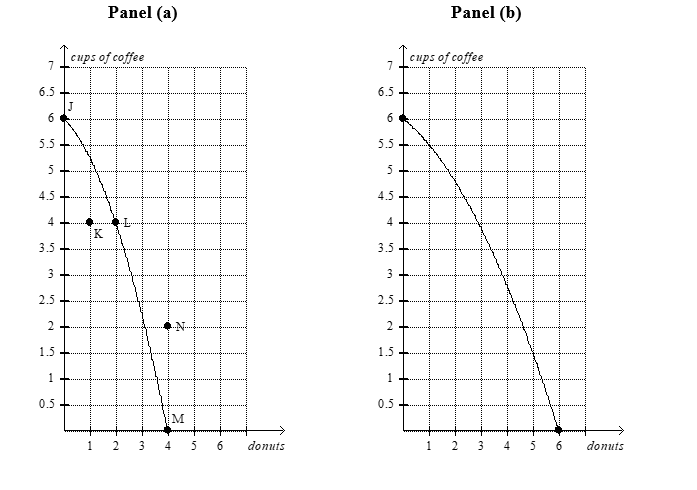 -Refer to Figure 2-8, Panel (a). In order to gain 2 donuts by moving from point L to point M, society must sacrifice
 (Multiple Choice)
4.8/5  (88)
(88) In the circular-flow diagram, another name for goods and services produced by firms is
(Multiple Choice)
4.8/5 (71)
(71) If a line passes through the points (20,5) and (10,10), then the slope of the line is -2.
(True/False)
4.8/5 (83)
(83) Changes in one variable on a graph might be caused by the other variable on the graph or by a third omitted variable.
(True/False)
4.8/5 (82)
(82) Figure 2-13 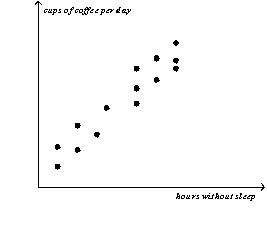 -Refer to Figure 2-13. Taking cause and effect into account, which of the following interpretations would be most reasonable regarding the relationship between coffee and hours without sleep?
 (Multiple Choice)
5.0/5 (80)
(80) Economists acting as scientists make positive statements, while economists acting as policy advisers make normative statements.
(True/False)
4.9/5 (88)
(88) Figure 2-6  -Refer to Figure 2-6. What is the opportunity cost of moving from point A to point B?
 (Multiple Choice)
4.8/5 (81)
(81) An outcome is said to be efficient if an economy is conserving the largest possible quantity of its scarce resources while still meeting the basic needs of society.
(True/False)
4.8/5 (77)
(77) "Other things equal, an increase in supply causes a decrease in price" is a normative statement, not a positive statement.
(True/False)
4.9/5 (88)
(88) When a production possibilities frontier is bowed outward, the opportunity cost of one good in terms of the other is constant.
(True/False)
4.9/5 (75)
(75) In the circular-flow diagram, factors of production include land, labor, and capital.
(True/False)
4.7/5 (75)
(75) Sometimes economists disagree because their values differ. Which of the following instances best reflects this source of disagreement?
(Multiple Choice)
4.8/5 (77)
(77) Which of the following is an example of a positive, as opposed to normative, statement?
(Multiple Choice)
4.7/5 (79)
(79) In the circular-flow diagram, one loop represents the flow of goods, services, and factors of production, and the other loop represents the corresponding flow of dollars.
(True/False)
4.8/5 (82)
(82) Microeconomics is the study of how households and firms make decisions and how they interact in specific markets.
(True/False)
4.8/5 (92)
(92) The inner loop of the circular-flow diagram represents the flows of inputs and outputs. Which of the following does not appear on the inner loop?
(Multiple Choice)
4.9/5 (81)
(81) Figure 2-14  -Refer to Figure 2-14. The opportunity cost of moving from point B to point A is zero.
 (True/False)
4.9/5 (78)
(78) 
Filters
- Essay(0)
- Multiple Choice(0)
- Short Answer(0)
- True False(0)
- Matching(0)