



 Chat with AI
Exam 2: Thinking Like an Economist

Exam 1: Ten Principles of Economics347 Questions
Exam 2: Thinking Like an Economist535 Questions
Exam 3: Interdependence and the Gains From Trade442 Questions
Exam 4: The Market Forces of Supply and Demand569 Questions
Exam 5: Elasticity and Its Application503 Questions
Exam 6: Supply, Demand, and Government Policies556 Questions
Exam 7: Consumers, Producers, and the Efficiency of Markets460 Questions
Exam 8: Application: The Costs of Taxation422 Questions
Exam 9: Application: International Trade409 Questions
Exam 10: Measuring a Nations Income428 Questions
Exam 11: Measuring the Cost of Living436 Questions
Exam 12: Production and Growth417 Questions
Exam 13: Saving, Investment, and the Financial System473 Questions
Exam 14: The Basic Tools of Finance419 Questions
Exam 15: Unemployment571 Questions
Exam 16: The Monetary System423 Questions
Exam 17: Money Growth and Inflation388 Questions
Exam 18: Open-Economy Macroeconomic Models448 Questions
Exam 19: A Macroeconomic Theory of the Open Economy374 Questions
Exam 20: Aggregate Demand and Aggregate Supply471 Questions
Exam 21: The Influence of Monetary and Fiscal Policy on Aggregate Demand416 Questions
Exam 22: The Short-Run Trade-Off Between Inflation and Unemployment400 Questions
Exam 23: Six Debates Over Macroeconomic Policy235 Questions
Select questions type


Figure 2-14 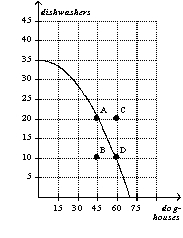 -Refer to Figure 2-14. It is possible for this economy to produce 30 doghouses and 20 dishwashers.
 (True/False)
4.8/5  (82)
(82) When a relevant variable that is not named on either axis changes,
(Multiple Choice)
4.8/5 (87)
(87) Any point on a country's production possibilities frontier represents a combination of two goods that an economy
(Multiple Choice)
4.9/5 (93)
(93) In the circular-flow diagram, which of the following items represents a payment for a factor of production?
(Multiple Choice)
4.7/5 (68)
(68) The most common data for testing economic theories come from
(Multiple Choice)
4.8/5 (80)
(80) Economists may disagree about the validity of alternative positive theories about how the world works.
(True/False)
4.8/5 (68)
(68) Economists try to address their subject with a scientist's objectivity.
(True/False)
4.9/5 (71)
(71) An example of a price that changes only infrequently is the price of
(Multiple Choice)
4.9/5 (65)
(65) A production possibilities frontier will be bowed outward if some of the economy's resources are better suited to producing one good than another.
(True/False)
4.8/5 (89)
(89) In the circular-flow diagram, firms produce goods and services using the factors of production.
(True/False)
4.8/5 (80)
(80) One way to characterize the difference between positive statements and normative statements is as follows:
(Multiple Choice)
5.0/5 (91)
(91) The slope of a line that passes through the points (10, 15) and (20, 7) is
(Multiple Choice)
5.0/5 (68)
(68) Figure 2-2  -Refer to Figure 2-2. Boxes A and B of this circular-flow diagram represent
 (Multiple Choice)
4.8/5 (96)
(96) Figure 2-2
-Refer to Figure 2-2. If households are buyers in the markets represented by Box C of this circular-flow diagram, then
-Refer to Figure 2-2. If households are buyers in the markets represented by Box C of this circular-flow diagram, then (Multiple Choice)
4.8/5 (89)
(89) The production possibilities frontier provides an illustration of the principle that
(Multiple Choice)
4.9/5 (85)
(85) 
Filters
- Essay(0)
- Multiple Choice(0)
- Short Answer(0)
- True False(0)
- Matching(0)