



 Chat with AI
Exam 2: Thinking Like an Economist

Exam 1: Ten Principles of Economics347 Questions
Exam 2: Thinking Like an Economist535 Questions
Exam 3: Interdependence and the Gains From Trade442 Questions
Exam 4: The Market Forces of Supply and Demand569 Questions
Exam 5: Elasticity and Its Application503 Questions
Exam 6: Supply, Demand, and Government Policies556 Questions
Exam 7: Consumers, Producers, and the Efficiency of Markets460 Questions
Exam 8: Application: The Costs of Taxation422 Questions
Exam 9: Application: International Trade409 Questions
Exam 10: Measuring a Nations Income428 Questions
Exam 11: Measuring the Cost of Living436 Questions
Exam 12: Production and Growth417 Questions
Exam 13: Saving, Investment, and the Financial System473 Questions
Exam 14: The Basic Tools of Finance419 Questions
Exam 15: Unemployment571 Questions
Exam 16: The Monetary System423 Questions
Exam 17: Money Growth and Inflation388 Questions
Exam 18: Open-Economy Macroeconomic Models448 Questions
Exam 19: A Macroeconomic Theory of the Open Economy374 Questions
Exam 20: Aggregate Demand and Aggregate Supply471 Questions
Exam 21: The Influence of Monetary and Fiscal Policy on Aggregate Demand416 Questions
Exam 22: The Short-Run Trade-Off Between Inflation and Unemployment400 Questions
Exam 23: Six Debates Over Macroeconomic Policy235 Questions
Select questions type


Suppose an economy produces two goods, food and machines. This economy always operates on its production possibilities frontier. Last year, it produced 1000 units of food and 47 machines. This year it experienced a technological advance in its machine-making industry. As a result, this year the society wants to produce 1050 units of food and 47 machines. Which of the following statements is correct?
(Multiple Choice)
4.7/5  (80)
(80) The production possibilities frontier shows the opportunity cost of one good as measured in terms of the other good.
(True/False)
4.8/5 (87)
(87) Economic models can help us understand reality only when they include all details of the economy.
(True/False)
5.0/5 (88)
(88) Figure 2-4  -Refer to Figure 2-4. If this economy devotes all of its resources to the production of notepads, then it will produce
 (Multiple Choice)
4.7/5 (69)
(69) Figure 2-8
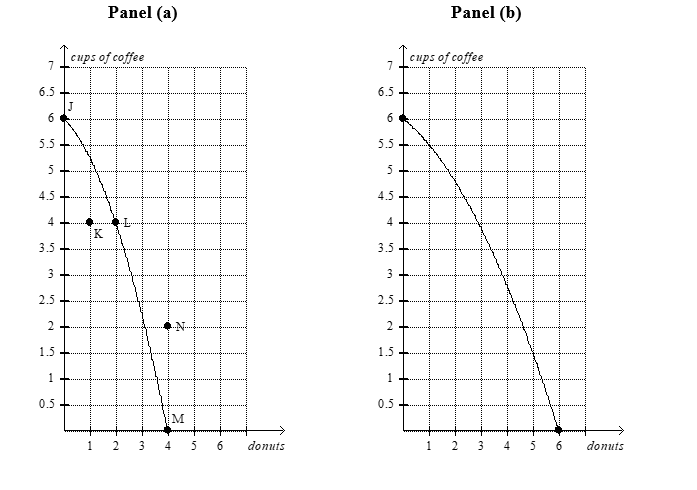 -Refer to Figure 2-8, Panel (a). The opportunity cost of moving from point K to point L is
 (Multiple Choice)
4.8/5 (58)
(58) The opportunity cost of something is what you give up to get it.
(True/False)
4.9/5 (82)
(82) Which of the following is an example of a normative, as opposed to positive, statement?
(Multiple Choice)
4.8/5 (90)
(90) Figure 2-9
 -Refer to Figure 2-9, Panel (a). The opportunity cost of one computer is highest when the economy produces
 (Multiple Choice)
4.8/5 (70)
(70) Almost all economists agree that local and state governments should
(Multiple Choice)
4.9/5 (86)
(86) Figure 2-2  -Refer to Figure 2-2. Boxes C and D of this circular-flow diagram represent
 (Multiple Choice)
4.9/5 (93)
(93) When an economy is operating at a point on its production possibilities frontier, then
(Multiple Choice)
4.9/5 (61)
(61) When constructing a production possibilities frontier, which of the following assumptions is not made?
(Multiple Choice)
4.8/5 (76)
(76) Assumptions can simplify the complex world and make it easier to understand.
(True/False)
4.8/5 (86)
(86) Figure 2-2
-Refer to Figure 2-2. If Box A of this circular-flow diagram represents firms, then which box represents households?
-Refer to Figure 2-2. If Box A of this circular-flow diagram represents firms, then which box represents households? (Multiple Choice)
4.9/5 (77)
(77) Economists who are primarily responsible for advising Congress on economic matters work in which agency?
(Multiple Choice)
4.9/5 (73)
(73) Figure 2-6  -Refer to Figure 2-6. Inefficient production is represented by which point(s)?
 (Multiple Choice)
4.9/5 (72)
(72) 
Filters
- Essay(0)
- Multiple Choice(0)
- Short Answer(0)
- True False(0)
- Matching(0)