



 Chat with AI
Exam 2: Thinking Like an Economist

Exam 1: Ten Principles of Economics347 Questions
Exam 2: Thinking Like an Economist535 Questions
Exam 3: Interdependence and the Gains From Trade442 Questions
Exam 4: The Market Forces of Supply and Demand569 Questions
Exam 5: Elasticity and Its Application503 Questions
Exam 6: Supply, Demand, and Government Policies556 Questions
Exam 7: Consumers, Producers, and the Efficiency of Markets460 Questions
Exam 8: Application: The Costs of Taxation422 Questions
Exam 9: Application: International Trade409 Questions
Exam 10: Measuring a Nations Income428 Questions
Exam 11: Measuring the Cost of Living436 Questions
Exam 12: Production and Growth417 Questions
Exam 13: Saving, Investment, and the Financial System473 Questions
Exam 14: The Basic Tools of Finance419 Questions
Exam 15: Unemployment571 Questions
Exam 16: The Monetary System423 Questions
Exam 17: Money Growth and Inflation388 Questions
Exam 18: Open-Economy Macroeconomic Models448 Questions
Exam 19: A Macroeconomic Theory of the Open Economy374 Questions
Exam 20: Aggregate Demand and Aggregate Supply471 Questions
Exam 21: The Influence of Monetary and Fiscal Policy on Aggregate Demand416 Questions
Exam 22: The Short-Run Trade-Off Between Inflation and Unemployment400 Questions
Exam 23: Six Debates Over Macroeconomic Policy235 Questions
Select questions type


Figure 2-14  -Refer to Figure 2-14. Points B and C represent infeasible outcomes for this economy.
 (True/False)
4.9/5  (73)
(73) Figure 2-7  -Refer to Figure 2-7. Which point on the graph best represents the fact that, because resources are scarce, not every conceivable outcome is feasible?
 (Multiple Choice)
4.9/5 (80)
(80) Figure 2-1  -Refer to Figure 2-1. Which arrow represents the flow of income payments?
 (Multiple Choice)
4.9/5 (83)
(83) Figure 2-11 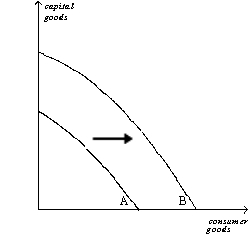 -Refer to Figure 2-11. The shift of the production possibilities frontier from A to B can best be described as
 (Multiple Choice)
4.9/5 (83)
(83) Figure 2-6  -Refer to Figure 2-6. Efficient production is represented by which point(s)?
 (Multiple Choice)
4.9/5 (85)
(85) The slope of a line is equal to the change in the x-variable divided by the change in the y-variable.
(True/False)
5.0/5 (71)
(71) The circular flow model is not used anymore because it fails to perfectly replicate real world situations.
(True/False)
4.7/5 (92)
(92) Which of the following is an example of a normative, as opposed to positive, statement?
(Multiple Choice)
4.9/5 (80)
(80) When a variable that is named on an axis of a graph changes, the curve shifts.
(True/False)
4.8/5 (85)
(85) Which of the following is not an assumption of the productions possibilities frontier?
(Multiple Choice)
4.9/5 (74)
(74) Figure 2-5  -Refer to Figure 2-5. A movement from point C to point D could be caused by
 (Multiple Choice)
4.8/5 (69)
(69) The trade-off between the production of one good and the production of another good can change over time because of technological advances.
(True/False)
4.8/5 (72)
(72) Instead of conducting laboratory experiments to generate data to test their theories, economists often
(Multiple Choice)
5.0/5 (79)
(79) If a line passes through the points (20,5) and (10,10), then the slope of the line is 1/2.
(True/False)
4.7/5 (77)
(77) For economists, conducting experiments is often difficult and sometimes impossible.
(True/False)
4.9/5 (88)
(88) The use of theory and observation is more difficult in economics than in sciences such as physics due to the difficulty in
(Multiple Choice)
4.9/5 (79)
(79) Which of the following trade-offs does the production possibilities frontier illustrate?
(Multiple Choice)
4.9/5 (81)
(81) Figure 2-15
Relationship between Price and Cups of Coffee  -Refer to Figure 2-15. Which of the following could result in a movement from point A to point B?
 (Multiple Choice)
4.9/5 (82)
(82) 
Filters
- Essay(0)
- Multiple Choice(0)
- Short Answer(0)
- True False(0)
- Matching(0)