



 Chat with AI
Exam 2: Thinking Like an Economist

Exam 1: Ten Principles of Economics347 Questions
Exam 2: Thinking Like an Economist535 Questions
Exam 3: Interdependence and the Gains From Trade442 Questions
Exam 4: The Market Forces of Supply and Demand569 Questions
Exam 5: Elasticity and Its Application503 Questions
Exam 6: Supply, Demand, and Government Policies556 Questions
Exam 7: Consumers, Producers, and the Efficiency of Markets460 Questions
Exam 8: Application: The Costs of Taxation422 Questions
Exam 9: Application: International Trade409 Questions
Exam 10: Measuring a Nations Income428 Questions
Exam 11: Measuring the Cost of Living436 Questions
Exam 12: Production and Growth417 Questions
Exam 13: Saving, Investment, and the Financial System473 Questions
Exam 14: The Basic Tools of Finance419 Questions
Exam 15: Unemployment571 Questions
Exam 16: The Monetary System423 Questions
Exam 17: Money Growth and Inflation388 Questions
Exam 18: Open-Economy Macroeconomic Models448 Questions
Exam 19: A Macroeconomic Theory of the Open Economy374 Questions
Exam 20: Aggregate Demand and Aggregate Supply471 Questions
Exam 21: The Influence of Monetary and Fiscal Policy on Aggregate Demand416 Questions
Exam 22: The Short-Run Trade-Off Between Inflation and Unemployment400 Questions
Exam 23: Six Debates Over Macroeconomic Policy235 Questions
Select questions type


In the markets for goods and services in the circular-flow diagram,
(Multiple Choice)
4.8/5  (93)
(93) Economists devise theories, collect data, and then analyze these data in an attempt to verify or refute their theories.
(True/False)
4.7/5 (79)
(79) Figure 2-4  -Refer to Figure 2-4. Suppose this economy is producing at point W. Which of the following statements would best explain this situation?
 (Multiple Choice)
4.8/5 (81)
(81) On a bowed production possibilities frontier, as you move down along the curve
(Multiple Choice)
4.9/5 (82)
(82) In the circular-flow diagram, which of the following items flows from firms to households through the markets for the factors of production?
(Multiple Choice)
4.8/5 (86)
(86) An economic outcome is said to be efficient if the economy is
(Multiple Choice)
4.8/5 (74)
(74) Figure 2-8
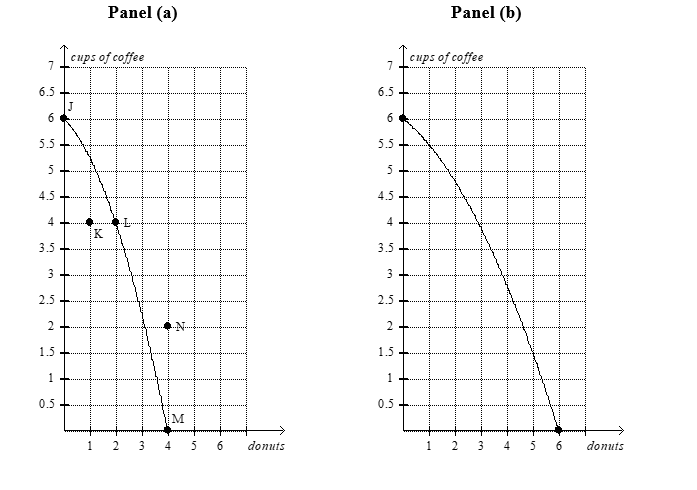 -Refer to Figure 2-8, Panel (a). The opportunity cost of one cup of coffee is highest when the economy produces
 (Multiple Choice)
4.8/5 (85)
(85) Table 2-5
Cooki=s (in dazens) Caffe (inguund) 1000 0 800 350 600 650 400 800 200 1000 0 1150
-Refer to Table 2-5. Table 2-5 shows one set of production possibilities. What is the opportunity cost of an increase in the production of coffee from 350 pounds to 650 pounds?
(Multiple Choice)
4.8/5 (85)
(85) Different values are not a reason for disagreement among economists.
(True/False)
4.8/5 (59)
(59) Points inside the production possibilities frontier represent feasible levels of production.
(True/False)
4.8/5 (79)
(79) Figure 2-2  -Refer to Figure 2-2. If households are sellers in the markets represented by Box D of this circular-flow diagram, then
 (Multiple Choice)
4.9/5 (69)
(69) According to economist John Maynard Keynes, a great economist must also be a(n)
(Multiple Choice)
4.7/5 (76)
(76) In the circular-flow diagram, the two types of markets in which households and firms interact are the markets for goods and services and the markets for factors of production.
(True/False)
4.9/5 (73)
(73) Since 1946, the president of the United States has received guidance from the Council of Economic Advisers.
(True/False)
5.0/5 (75)
(75) 
Filters
- Essay(0)
- Multiple Choice(0)
- Short Answer(0)
- True False(0)
- Matching(0)