



 Chat with AI
Exam 2: Thinking Like an Economist

Exam 1: Ten Principles of Economics347 Questions
Exam 2: Thinking Like an Economist535 Questions
Exam 3: Interdependence and the Gains From Trade442 Questions
Exam 4: The Market Forces of Supply and Demand569 Questions
Exam 5: Elasticity and Its Application503 Questions
Exam 6: Supply, Demand, and Government Policies556 Questions
Exam 7: Consumers, Producers, and the Efficiency of Markets460 Questions
Exam 8: Application: The Costs of Taxation422 Questions
Exam 9: Application: International Trade409 Questions
Exam 10: Measuring a Nations Income428 Questions
Exam 11: Measuring the Cost of Living436 Questions
Exam 12: Production and Growth417 Questions
Exam 13: Saving, Investment, and the Financial System473 Questions
Exam 14: The Basic Tools of Finance419 Questions
Exam 15: Unemployment571 Questions
Exam 16: The Monetary System423 Questions
Exam 17: Money Growth and Inflation388 Questions
Exam 18: Open-Economy Macroeconomic Models448 Questions
Exam 19: A Macroeconomic Theory of the Open Economy374 Questions
Exam 20: Aggregate Demand and Aggregate Supply471 Questions
Exam 21: The Influence of Monetary and Fiscal Policy on Aggregate Demand416 Questions
Exam 22: The Short-Run Trade-Off Between Inflation and Unemployment400 Questions
Exam 23: Six Debates Over Macroeconomic Policy235 Questions
Select questions type


In surveys of professional economists, fourteen propositions were endorsed by an overwhelming majority of respondents.
(True/False)
4.7/5  (84)
(84) Figure 2-14 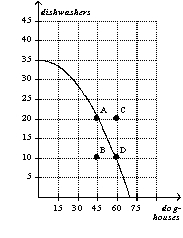 -Refer to Figure 2-14. Unemployment could cause this economy to produce at point B.
 (True/False)
4.8/5 (73)
(73) In the circular-flow diagram, which of the following items does not flow from firms to households?
(Multiple Choice)
4.9/5 (81)
(81) In the simple circular-flow diagram, the participants in the economy are
(Multiple Choice)
4.9/5 (68)
(68) Because almost all economists oppose policies that restrict trade among nations, policymakers do not restrict imports of certain goods.
(True/False)
4.9/5 (63)
(63) In economics, graphs serve two purposes: they offer a way to visually express ideas, and they provide a way of finding and interpreting patterns when analyzing economic data.
(True/False)
4.9/5 (74)
(74) John Maynard Keynes referred to economics as an easy subject,
(Multiple Choice)
4.8/5 (86)
(86) Figure 2-7  -Refer to Figure 2-7. In order to reach point L, the economy would have to
 (Multiple Choice)
4.8/5 (87)
(87) Among economic models, the circular-flow diagram is unusual in that it
(Multiple Choice)
5.0/5 (89)
(89) Which of the following areas of study typifies microeconomics as opposed to macroeconomics?
(Multiple Choice)
4.8/5 (89)
(89) In the circular-flow diagram, payments for labor, land, and capital flow from firms to households through the markets for the factors of production.
(True/False)
4.8/5 (69)
(69) Figure 2-14
-Refer to Figure 2-14. This economy fully employs its resources when it produces 35 dishwashers and zero doghouses.
-Refer to Figure 2-14. This economy fully employs its resources when it produces 35 dishwashers and zero doghouses. (True/False)
4.8/5 (69)
(69) Figure 2-1  -Refer to Figure 2-1. Which arrow represents the flow of spending by households?
 (Multiple Choice)
4.9/5 (80)
(80) In a certain economy, toys and greeting cards are produced, and the economy currently operates on its production possibilities frontier. Which of the following events would allow the economy to produce more toys and more greeting cards, relative to the quantities of those goods that are being produced now?
(Multiple Choice)
4.8/5 (62)
(62) Which of the following allows you to provide information about the relationship between two variables?
(Multiple Choice)
4.9/5 (72)
(72) 
Filters
- Essay(0)
- Multiple Choice(0)
- Short Answer(0)
- True False(0)
- Matching(0)