



 Chat with AI
Exam 28: Exchange Rates and the Open Economy

Exam 1: Thinking Like an Economist142 Questions
Exam 2: Comparative Advantage163 Questions
Exam 3: Supply and Demand181 Questions
Exam 4: Elasticity154 Questions
Exam 5: Demand144 Questions
Exam 6: Perfectly Competitive Supply159 Questions
Exam 7: Efficiency, Exchange, and the Invisible Hand in Action159 Questions
Exam 8: Monopoly, Oligopoly, and Monopolistic Competition147 Questions
Exam 9: Games and Strategic Behavior150 Questions
Exam 10: An Introduction to Behavioral Economics111 Questions
Exam 11: Externalities, Property Rights, and the Environment184 Questions
Exam 12: The Economics of Information127 Questions
Exam 13: Labor Markets, Poverty, and Income Distribution138 Questions
Exam 14: Public Goods and Tax Policy142 Questions
Exam 15: International Trade and Trade Policy164 Questions
Exam 16: Macroeconomics: The Birds Eye View of the Economy154 Questions
Exam 17: Measuring Economic Activity: GDP and Unemployment210 Questions
Exam 18: Measuring the Price Level and Inflation160 Questions
Exam 19: Economic Growth, Productivity, and Living Standards158 Questions
Exam 20: The Labor Market: Workers, Wages, and Unemployment121 Questions
Exam 21: Saving and Capital Formation144 Questions
Exam 22: Money Prices and the Federal Reserve107 Questions
Exam 23: Financial Markets and International Capital Flows104 Questions
Exam 24: Short-Term Economic Fluctuations: An Introduction124 Questions
Exam 25: Spending and Output in the Short Run146 Questions
Exam 26: Stabilizing the Economy: The Role of the Fed162 Questions
Exam 27: Aggregate Demand, Aggregate Supply, and Inflation159 Questions
Exam 28: Exchange Rates and the Open Economy157 Questions
Select questions type


The principal demanders of U.S. dollars in the foreign exchange market are:
(Multiple Choice)
4.9/5  (63)
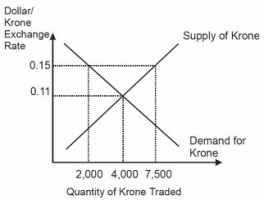
(63) Based on this figure, in order to maintain an exchange rate of $0.15 dollars per Norwegian krone, the Norwegian government will have to spend (in dollars)_____ worth of international reserves per period.
(Multiple Choice)
4.7/5 (63)
(63) The U.S. dollar exchange rate, e, expressed as Japanese yen per U.S. dollar, will depreciate when:
(Multiple Choice)
4.8/5 (72)
(72) An exchange rate that varies according to supply and demand for the currency in the foreign exchange market is called a ________ exchange rate.
(Multiple Choice)
5.0/5 (92)
(92) There is ________ connection between the strength of a country's currency and the strength of its ________.
(Multiple Choice)
4.7/5 (88)
(88) The U.S. dollar exchange rate, e, expressed as Japanese yen per U.S. dollar, will appreciate when:
(Multiple Choice)
4.9/5 (75)
(75) The purchasing power parity theory is not a good explanation of how nominal exchange rates are determined in the short run because:
(Multiple Choice)
4.8/5 (80)
(80) The purchasing power parity theory is a reasonably good explanation for nominal exchange rate determination:
(Multiple Choice)
4.9/5 (79)
(79) Holding all else constant, an increase in Mexican real GDP will ________ the demand for dollars in the foreign exchange market and ________ the equilibrium Mexican peso/U.S. dollar exchange rate.
(Multiple Choice)
4.9/5 (63)
(63) Large economies, such as the U.S. economy, should ________ adopt a flexible exchange rate, because giving up the power to stabilize the domestic economy via monetary policy ________.
(Multiple Choice)
4.8/5 (83)
(83) The impact of monetary policy through exchange rates tends to ________ the impact of monetary policy through real interest rates.
(Multiple Choice)
4.8/5 (77)
(77) The U.S. dollar exchange rate, e, expressed as Japanese yen per U.S. dollar, will depreciate when:
(Multiple Choice)
4.8/5 (84)
(84) Holding all else constant, a decrease in U.S. real GDP will ________ the supply for dollars in the foreign exchange market and ________ the equilibrium Mexican peso/U.S. dollar exchange rate.
(Multiple Choice)
4.9/5 (78)
(78) Suppose the price of gold is $300 per ounce in the United States and 2,400 pesos per ounce in Mexico. If purchasing power parity holds and if the price of oil is $25 per barrel in the United States, the price of oil is ________ pesos per barrel in Mexico.
(Multiple Choice)
4.7/5 (81)
(81) When a currency is undervalued, international reserves ________ and the country has a balance-of-payments ________.
(Multiple Choice)
4.9/5 (81)
(81) Under a flexible exchange rate system a decline in the value of a currency relative to other currencies is a called a(n)________ and under a fixed exchange rate system a decrease in the official value of a currency is called a(n)________.
(Multiple Choice)
4.8/5 (78)
(78) An alternative to maintaining an overvalued currency is to ________ the fundamental value of the exchange rate by ________ monetary policy.
(Multiple Choice)
4.9/5 (79)
(79) For a given nominal exchange rate and foreign price level, an increase in the domestic price level ________ the real exchange rate.
(Multiple Choice)
4.8/5 (72)
(72) For a given nominal exchange rate and domestic price level, a decrease in the foreign price level ________ the real exchange rate.
(Multiple Choice)
4.9/5 (85)
(85) The law of one price states that if transportation costs are relatively small, then the:
(Multiple Choice)
4.9/5 (84)
(84) 
Filters
- Essay(0)
- Multiple Choice(0)
- Short Answer(0)
- True False(0)
- Matching(0)