



 Chat with AI
Exam 27: Aggregate Demand, Aggregate Supply, and Inflation

Exam 1: Thinking Like an Economist142 Questions
Exam 2: Comparative Advantage163 Questions
Exam 3: Supply and Demand181 Questions
Exam 4: Elasticity154 Questions
Exam 5: Demand144 Questions
Exam 6: Perfectly Competitive Supply159 Questions
Exam 7: Efficiency, Exchange, and the Invisible Hand in Action159 Questions
Exam 8: Monopoly, Oligopoly, and Monopolistic Competition147 Questions
Exam 9: Games and Strategic Behavior150 Questions
Exam 10: An Introduction to Behavioral Economics111 Questions
Exam 11: Externalities, Property Rights, and the Environment184 Questions
Exam 12: The Economics of Information127 Questions
Exam 13: Labor Markets, Poverty, and Income Distribution138 Questions
Exam 14: Public Goods and Tax Policy142 Questions
Exam 15: International Trade and Trade Policy164 Questions
Exam 16: Macroeconomics: The Birds Eye View of the Economy154 Questions
Exam 17: Measuring Economic Activity: GDP and Unemployment210 Questions
Exam 18: Measuring the Price Level and Inflation160 Questions
Exam 19: Economic Growth, Productivity, and Living Standards158 Questions
Exam 20: The Labor Market: Workers, Wages, and Unemployment121 Questions
Exam 21: Saving and Capital Formation144 Questions
Exam 22: Money Prices and the Federal Reserve107 Questions
Exam 23: Financial Markets and International Capital Flows104 Questions
Exam 24: Short-Term Economic Fluctuations: An Introduction124 Questions
Exam 25: Spending and Output in the Short Run146 Questions
Exam 26: Stabilizing the Economy: The Role of the Fed162 Questions
Exam 27: Aggregate Demand, Aggregate Supply, and Inflation159 Questions
Exam 28: Exchange Rates and the Open Economy157 Questions
Select questions type


Refer to the accompanying figure. 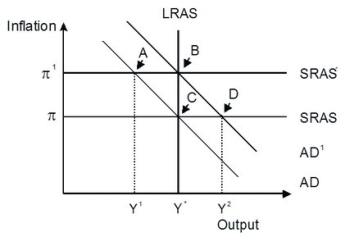 Starting from long-run equilibrium at point C, an adverse inflation shock that increases inflation from π to π¹ will lead to a short-run equilibrium at point ________ and eventually to a long-run equilibrium at point ________, if left to self-correcting tendencies.
 (Multiple Choice)
4.8/5  (79)
(79) Increases in inflation redistribute resources from ________-spending to ________-spending households and hence, ________ short-run equilibrium output.
(Multiple Choice)
4.7/5 (74)
(74) Refer to the accompanying figure. 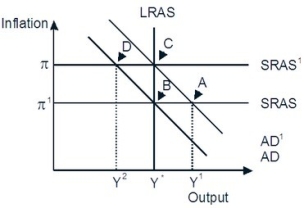 Starting from long-run equilibrium at point C, a decrease in government spending that decreases aggregate demand from AD¹ to AD will lead to a short-run equilibrium at ________ creating ________ gap.
 (Multiple Choice)
4.8/5 (71)
(71) In the given figure, the economy is initially in long-run equilibrium at point A. If there is an adverse supply shock that reduces potential output and shifts the long-run aggregate supply curve from LRAS to LRAS', then there is initially ________ gap and the short-run aggregate supply curve will ________. 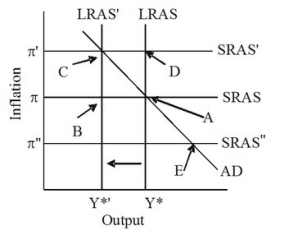
(Multiple Choice)
4.8/5 (77)
(77) If policymakers attempt to offset a favorable inflation shock with monetary ________, the resulting long-run equilibrium will be at ________ inflation rate compared to allowing the self-correcting mechanism return the economy to potential output.
(Multiple Choice)
5.0/5 (71)
(71) Refer to the accompanying figure. 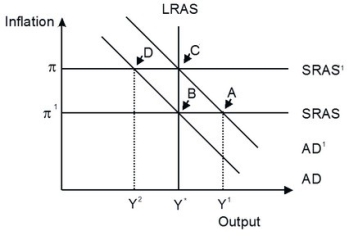 An economy in short-run equilibrium at point A has a(n)________ gap. The gap could be eliminated by the self-correcting mechanism of the economy and eventually achieve long-run equilibrium at point ________ or the central bank could intervene with monetary easing and the long-run equilibrium would be at point ________.
 (Multiple Choice)
4.8/5 (76)
(76) Which of the following will shift the aggregate demand curve to the left?
(Multiple Choice)
4.8/5 (72)
(72) A horizontal line showing the current rate of inflation, as determined by past expectations and pricing decisions is called the:
(Multiple Choice)
4.8/5 (83)
(83) Graphically long-run equilibrium occurs at the intersection of the aggregate demand curve and the:
(Multiple Choice)
4.9/5 (86)
(86) At a short-run equilibrium output equals ________, while at a long-run equilibrium output equals ________.
(Multiple Choice)
4.9/5 (82)
(82) When the Federal Reserve increases its target rate of inflation, it will set a ________ real interest rate at every inflation rate and the aggregate demand curve will ________.
(Multiple Choice)
4.9/5 (97)
(97) Because decreases in inflation increase planned spending and short-run equilibrium output:
(Multiple Choice)
4.9/5 (65)
(65) A downward shift in the Fed's policy reaction function is a(n)________ of monetary policy, and the aggregate demand curve ________.
(Multiple Choice)
4.7/5 (95)
(95) Graphically inflation shocks shift the ________ and shocks to potential shift the ________.
(Multiple Choice)
4.8/5 (78)
(78) The aggregate demand curve is downward sloping for all of the following reasons EXCEPT for the:
(Multiple Choice)
4.9/5 (90)
(90) As inflation decreases, households become ________ uncertain leading to ________ spending.
(Multiple Choice)
4.7/5 (84)
(84) When inflation equals the value determined by past expectations and pricing decisions and output equals the level of short-run equilibrium output consistent with that inflation, the economy is said to be in ________ equilibrium.
(Multiple Choice)
4.7/5 (68)
(68) Starting from long-run equilibrium, a large decrease in government purchases will result in a(n)________ gap in the short-run and ________ inflation and ________ output in the long-run.
(Multiple Choice)
4.7/5 (62)
(62) The output losses from an adverse inflation shock are ________ and the output losses from a fall in potential output are ________.
(Multiple Choice)
4.8/5 (72)
(72) When the economy is in short-run equilibrium, there will be ________ output gap.
(Multiple Choice)
4.8/5 (73)
(73) 
Filters
- Essay(0)
- Multiple Choice(0)
- Short Answer(0)
- True False(0)
- Matching(0)