



 Chat with AI
Exam 14: Public Goods and Tax Policy

Exam 1: Thinking Like an Economist142 Questions
Exam 2: Comparative Advantage163 Questions
Exam 3: Supply and Demand181 Questions
Exam 4: Elasticity154 Questions
Exam 5: Demand144 Questions
Exam 6: Perfectly Competitive Supply159 Questions
Exam 7: Efficiency, Exchange, and the Invisible Hand in Action159 Questions
Exam 8: Monopoly, Oligopoly, and Monopolistic Competition147 Questions
Exam 9: Games and Strategic Behavior150 Questions
Exam 10: An Introduction to Behavioral Economics111 Questions
Exam 11: Externalities, Property Rights, and the Environment184 Questions
Exam 12: The Economics of Information127 Questions
Exam 13: Labor Markets, Poverty, and Income Distribution138 Questions
Exam 14: Public Goods and Tax Policy142 Questions
Exam 15: International Trade and Trade Policy164 Questions
Exam 16: Macroeconomics: The Birds Eye View of the Economy154 Questions
Exam 17: Measuring Economic Activity: GDP and Unemployment210 Questions
Exam 18: Measuring the Price Level and Inflation160 Questions
Exam 19: Economic Growth, Productivity, and Living Standards158 Questions
Exam 20: The Labor Market: Workers, Wages, and Unemployment121 Questions
Exam 21: Saving and Capital Formation144 Questions
Exam 22: Money Prices and the Federal Reserve107 Questions
Exam 23: Financial Markets and International Capital Flows104 Questions
Exam 24: Short-Term Economic Fluctuations: An Introduction124 Questions
Exam 25: Spending and Output in the Short Run146 Questions
Exam 26: Stabilizing the Economy: The Role of the Fed162 Questions
Exam 27: Aggregate Demand, Aggregate Supply, and Inflation159 Questions
Exam 28: Exchange Rates and the Open Economy157 Questions
Select questions type


Consider a town with three residents. The residents' demand curves for various acres of a public park are shown below. 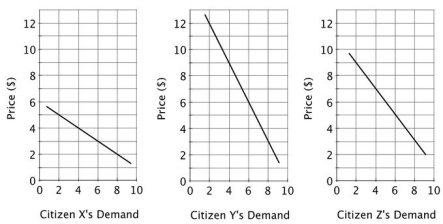 The public's willingness to pay for the 2ⁿᵈ acre of parkland is ________.
 (Multiple Choice)
4.7/5  (91)
(91) If the popular television show The Bachelor is shown on pay-per-view television every Monday at 9pm, then the demand curve for each episode is given below. 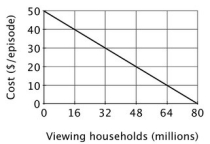 If the regulated pay-per-view charge were $30 per household, what would be the loss in total economic surplus relative to when there is no charge to watch an episode?
 (Multiple Choice)
4.9/5 (78)
(78) One justification for the creation of a federal level of government is:
(Multiple Choice)
4.8/5 (76)
(76) The problems of externalities and poorly formed property rights are:
(Multiple Choice)
4.8/5 (72)
(72) Consider a town with three residents. The residents' demand curves for various acres of a public park are shown below. 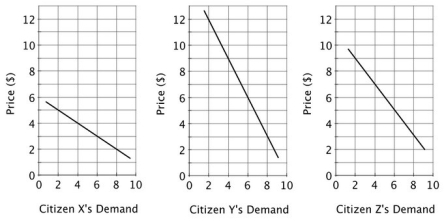 Suppose the town can purchase land for the park at a cost of $20 per acre. The optimal park size would be ________ acres.
 (Multiple Choice)
4.9/5 (71)
(71) The government can raise tax revenue and increase total economic surplus by taxing:
(Multiple Choice)
4.8/5 (88)
(88) There are ten states in the democratic nation of Katlandia, and each state has ten thousand residents. Although incomes vary, each Katlandian pays a tax equal to the total cost of all government projects divided by the number of residents in the country. Currently, two states each have one army base. An army base adds $2 million to a state's local economy each year. In addition, in terms of increased security, the annual marginal benefit to Katlandia of having an additional army base is shown below. The total cost of an army base is $8 million per year. 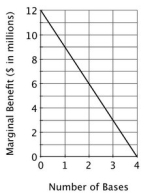 Suppose the department of defense proposes to build a third base in the state of New Porkswick. Apart from the value of the additional security to the nation, the state economy will benefit by ________ per resident, and each resident's taxes will increase by ________.
 (Multiple Choice)
4.7/5 (84)
(84) A good or service that is highly nonrival and highly nonexcludable is a(n)________ good.
(Multiple Choice)
4.9/5 (78)
(78) The presence of an unregulated negative externality means that the unregulated market equilibrium quantity is:
(Multiple Choice)
4.8/5 (69)
(69) If a boxing fight is shown on pay-per-view television every Saturday at 4pm, the demand curve for each fight is given below. 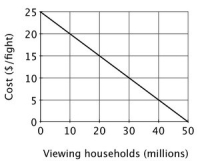 If there is a pay-per-view charge to watch a fight, the outcome is ________ because ________.
 (Multiple Choice)
4.9/5 (85)
(85) Beyond the provision of public goods, government exists to address:
(Multiple Choice)
4.9/5 (81)
(81) If a boxing fight is shown on pay-per-view television every Saturday at 4pm, the demand curve for each fight is given below. 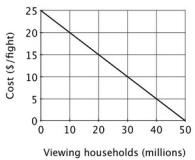 If the regulated pay-per-view charge to watch a fight were $5 per household, then what would be the loss in total economic surplus relative to when the there is no charge to watch the fight?
 (Multiple Choice)
4.8/5 (74)
(74) The deadweight loss from taxing a good will be smaller for goods:
(Multiple Choice)
4.9/5 (70)
(70) For many pure public goods like fireworks displays, weather forecasts, and television broadcasts the marginal cost of serving one more consumer is ________, and the optimal quantity of the public good occurs when ________.
(Multiple Choice)
4.9/5 (74)
(74) The table below shows the marginal benefit and marginal cost of purchasing an additional unit of 3 different public goods. Mar ginal benefit Marginal cost Total spending an the public Public pood 1 \ 20 \ 20 \ 1,500 Public pood 2 \ 15 \ 25 \ 800 Public pood 3 \ 10 \ 5 \ 700
The government is spending the socially optimal amount on:
(Multiple Choice)
4.7/5 (79)
(79) Curly pays $12,000 in taxes and earns $150,000. Moe pays $7,000 in taxes. If the tax system is proportional, then Moe's income is:
(Multiple Choice)
4.7/5 (87)
(87) Consider a town with three residents. The residents' demand curves for various acres of a public park are shown below. 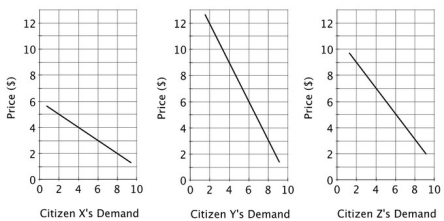 The public is willing to pay $14 for the ________ acre of parkland.
 (Multiple Choice)
4.9/5 (81)
(81) If low-income households spend a larger share of their income on food than do high-income households, then a tax on food is:
(Multiple Choice)
4.8/5 (87)
(87) 
Filters
- Essay(0)
- Multiple Choice(0)
- Short Answer(0)
- True False(0)
- Matching(0)