



 Chat with AI
Exam 21: Ecosystems

Exam 1: The Nature of Science94 Questions
Exam 2: Evaluating Scientific Claims90 Questions
Exam 3: Chemistry of Life102 Questions
Exam 4: Life Is Cellular88 Questions
Exam 5: How Cells Work89 Questions
Exam 6: Cell Division95 Questions
Exam 7: Patterns of Inheritance83 Questions
Exam 8: Chromosomes and Human Genetics92 Questions
Exam 9: What Genes Are83 Questions
Exam 10: How Genes Work98 Questions
Exam 11: Evidence for Evolution86 Questions
Exam 12: Mechanisms of Evolution84 Questions
Exam 13: Adaptation and Species85 Questions
Exam 14: The History of Life97 Questions
Exam 15: Bacteria and Archaea91 Questions
Exam 16: Plants, Fungi, and Protists84 Questions
Exam 17: Animals and Human Evolution88 Questions
Exam 18: General Principles of Ecology81 Questions
Exam 19: Growth of Populations82 Questions
Exam 20: Communities of Organisms83 Questions
Exam 21: Ecosystems87 Questions
Select questions type


Energy does not cycle through an ecosystem.This is because energy enters an ecosystem through photosynthesis as it changes to chemical energy.This is then used to fuel metabolic activities in
(Multiple Choice)
4.9/5  (90)
(90) Explain why only roughly 10 percent of the energy available in one trophic level is available in the next higher trophic level.
(Essay)
5.0/5 (81)
(81) A community of organisms together with the physical environment in which they live is known as a(n)
(Multiple Choice)
4.8/5 (84)
(84) Compare and contrast grassy marsh wetlands to bogs and explain why one of these freshwater biomes is more productive than the other.
(Essay)
4.8/5 (82)
(82) In the absence of ________,nutrient recycling within the ecosystem would completely stop.
(Multiple Choice)
4.9/5 (84)
(84) A grassland ecosystem has 400,000 kcal of energy stored in the primary producer level.Grasshoppers eat the grass,meadowlarks eat the grasshoppers,and a hawk eats the meadowlarks.How many kcals are now stored,and available,in the hawk?
(Multiple Choice)
4.9/5 (74)
(74) If there are 20,000 kcal available in the primary producer level of an ecosystem,how many kcal would be available in the secondary consumer level?
(Multiple Choice)
4.8/5 (90)
(90) Tuna are predatory fish that consume smaller,carnivorous fish that have fed on zooplankton.The zooplankton had fed on phytoplankton.When a person eats tuna,he or she is consuming the ________ trophic level of the food chain.
(Multiple Choice)
4.7/5 (80)
(80) What best explains the following observation: consumers directly use approximately 20 percent of a forest's net primary productivity (NPP),whereas decomposers directly use approximately 80 percent?
(Multiple Choice)
4.9/5 (71)
(71) The shallowest but most productive of the aquatic biomes are ________.These tidal ecosystems exist where rivers flow into the ocean.
(Short Answer)
4.8/5 (83)
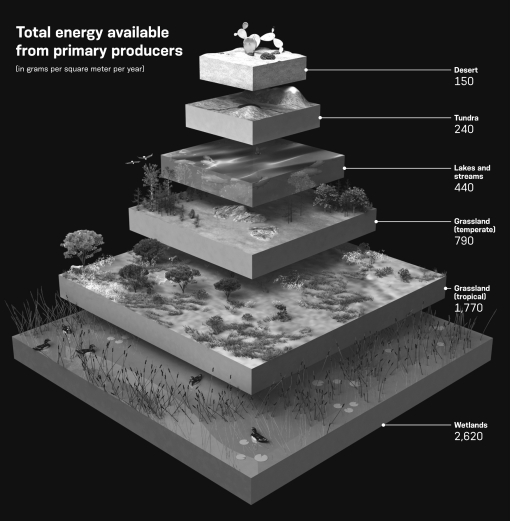
(83) The units used in the infographic below report total energy available from primary producers in indicated biomes in ________.
(Short Answer)
5.0/5 (74)
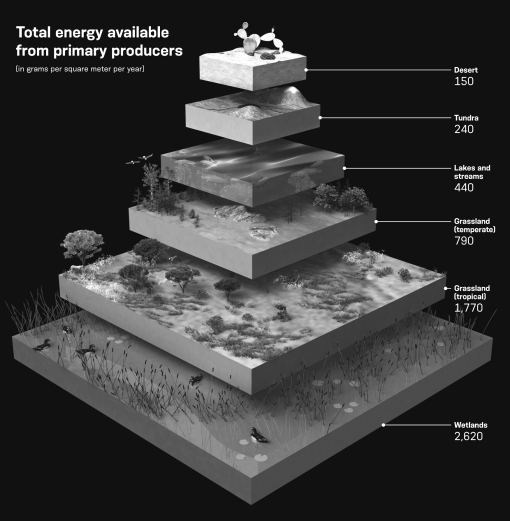
(74) Explain the difference in net primary productivity (NPP)between temperate grasslands and tropical grasslands.Include data units.
(Essay)
4.9/5 (70)
(70) Each level of an energy pyramid corresponds to a step in a food chain and is called a(n)________ level.
(Short Answer)
5.0/5 (96)
(96) All of the living organisms present in an ecosystem comprise the ________ or biotic portion of the ecosystem.
(Multiple Choice)
4.8/5 (91)
(91) Match each term to its correct description below.
-This biome is dominated by dense growths of drought-resistant plants that thrive through the alternating cool,rainy winters and hot,dry summers.The vegetation includes scrub oak,pine,mountain mahogany,and manzanita.It is inhabited by jackrabbits,gophers,lizards,and snakes.
(Multiple Choice)
4.8/5 (76)
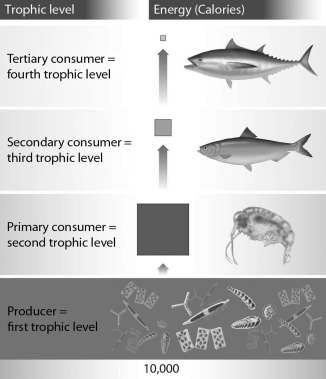
(76) Using the food chain shown below,explain how many calories are available in the consumer trophic levels and why.
(Essay)
5.0/5 (73)
(73) Ecologists often define an ecosystem with regard to how BOTH ________ are acquired and distributed by the biotic community.
(Short Answer)
4.8/5 (87)
(87) Why don't ecosystems always have sharply defined physical boundaries?
(Essay)
4.7/5 (73)
(73) 
Filters
- Essay(0)
- Multiple Choice(0)
- Short Answer(0)
- True False(0)
- Matching(0)