



 Chat with AI
Exam 6: Cell Division

Exam 1: The Nature of Science94 Questions
Exam 2: Evaluating Scientific Claims90 Questions
Exam 3: Chemistry of Life102 Questions
Exam 4: Life Is Cellular88 Questions
Exam 5: How Cells Work89 Questions
Exam 6: Cell Division95 Questions
Exam 7: Patterns of Inheritance83 Questions
Exam 8: Chromosomes and Human Genetics92 Questions
Exam 9: What Genes Are83 Questions
Exam 10: How Genes Work98 Questions
Exam 11: Evidence for Evolution86 Questions
Exam 12: Mechanisms of Evolution84 Questions
Exam 13: Adaptation and Species85 Questions
Exam 14: The History of Life97 Questions
Exam 15: Bacteria and Archaea91 Questions
Exam 16: Plants, Fungi, and Protists84 Questions
Exam 17: Animals and Human Evolution88 Questions
Exam 18: General Principles of Ecology81 Questions
Exam 19: Growth of Populations82 Questions
Exam 20: Communities of Organisms83 Questions
Exam 21: Ecosystems87 Questions
Select questions type


If crossing-over does not occur and homologous chromosome pairs are not independently assorted during meiosis I,resulting in all maternal chromosomes sorted to one cell while all paternal chromosomes are sorted to another cell,what would be the genetic results in the gametes produced at the end of meiosis II?

Free
(Multiple Choice)
4.9/5  (64)
(64) Correct Answer: Verified
C
What is the significance of crossing over?
Free
(Multiple Choice)
4.7/5 (83)
(83) Correct Answer:Verified
VerifiedB
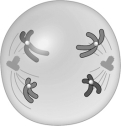
Match the event or stage of meiosis with the appropriate drawing.
-
Free
(Multiple Choice)
4.8/5 (72)
(72) Correct Answer:Verified
VerifiedC
Compare and contrast the incidence rate per 100,000 individuals versus deaths per 100,000 individuals for breast cancer in females and for prostate cancer in males presented in the infographic below.What does this suggest about the survivability of breast cancer and prostate cancer?

(Essay)
4.8/5 (77)
(77) Which two processes work in conjunction to create genetic diversity and maintain chromosome number?
(Multiple Choice)
4.9/5 (84)
(84) All of the following contribute to genetic uniqueness EXCEPT
(Multiple Choice)
4.7/5 (91)
(91) Chromosomes decondense and nuclear envelopes form during the ________ portion of mitosis.
(Short Answer)
4.9/5 (83)
(83) Explain which of the three cell division processes (mitosis,meiosis,binary fission)is most complex and summarize why it is necessary to promote genetic diversity and maintain a constant chromosome number in organisms.
(Essay)
4.7/5 (92)
(92) Match the event or stage of mitosis with the appropriate description.
-As new chromosomes reach the poles,the nuclear envelopes re-form,and the chromatin decondenses.
(Multiple Choice)
4.8/5 (80)
(80) Which processes associated with meiosis ensure genetic diversity in offspring? Name two processes that promote variation and explain how they operate.
(Essay)
4.8/5 (71)
(71) If a plant has a total of 18 chromosomes,how many chromosomes would be present in each of its gametes?
(Multiple Choice)
4.8/5 (72)
(72) According to the image below,during which phase of the cell cycle does the cell increase in size in preparation for division? 
(Multiple Choice)
5.0/5 (67)
(67) Sister chromatids are held together at a constriction point called a ________.
(Short Answer)
4.7/5 (76)
(76) The successful union of one male and one female gamete forms a new single cell known as a
(Multiple Choice)
4.9/5 (80)
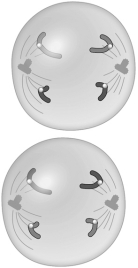
(80) Match the event or stage of meiosis with the appropriate drawing.
-
(Multiple Choice)
4.9/5 (90)
(90) Which of the following is a difference between binary fission and mitosis?
(Multiple Choice)
4.9/5 (80)
(80) A cell has completed S phase and is preparing to divide via mitosis.How is the genetic material arranged in G₂ phase?
(Essay)
5.0/5 (88)
(88) Cells spend the bulk of their time in the ________ stage of the cell cycle.
(Short Answer)
4.7/5 (84)
(84) 
Filters
- Essay(0)
- Multiple Choice(0)
- Short Answer(0)
- True False(0)
- Matching(0)