



 Chat with AI
Exam 3: Chemistry of Life

Exam 1: The Nature of Science94 Questions
Exam 2: Evaluating Scientific Claims90 Questions
Exam 3: Chemistry of Life102 Questions
Exam 4: Life Is Cellular88 Questions
Exam 5: How Cells Work89 Questions
Exam 6: Cell Division95 Questions
Exam 7: Patterns of Inheritance83 Questions
Exam 8: Chromosomes and Human Genetics92 Questions
Exam 9: What Genes Are83 Questions
Exam 10: How Genes Work98 Questions
Exam 11: Evidence for Evolution86 Questions
Exam 12: Mechanisms of Evolution84 Questions
Exam 13: Adaptation and Species85 Questions
Exam 14: The History of Life97 Questions
Exam 15: Bacteria and Archaea91 Questions
Exam 16: Plants, Fungi, and Protists84 Questions
Exam 17: Animals and Human Evolution88 Questions
Exam 18: General Principles of Ecology81 Questions
Exam 19: Growth of Populations82 Questions
Exam 20: Communities of Organisms83 Questions
Exam 21: Ecosystems87 Questions
Select questions type


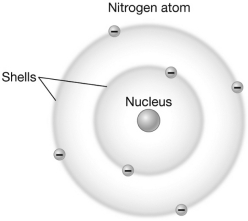
Nitrogen has an atomic number of 7 and an atomic mass number of 14.Using the image provided below,diagram the location and number of protons,neutrons,and electrons in nitrogen.

Free
(Essay)
4.9/5  (85)
(85) Correct Answer: Verified
The atomic number tells us the number of protons,whereas the atomic mass is the sum of protons and neutrons.Therefore,nitrogen has 7 protons,7 neutrons,and 7 electrons.In the diagram,students should demonstrate that there are 7 protons and 7 neutrons in the atomic nucleus.The 7 electrons should be drawn in the shells.
Which of the labeled areas of the water molecule pictured below possesses a partial negative charge? 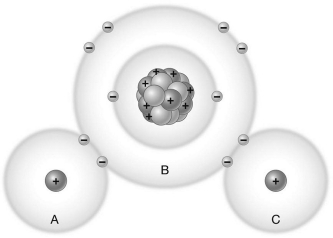
Free
(Multiple Choice)
4.9/5 (74)
(74) Correct Answer:Verified
VerifiedB
Match the type of bond associated with each description.Terms may be used more than once.
-Some structure in a protein molecule is due to weak electrical attractions.
(Multiple Choice)
4.9/5 (82)
(82) An atom that becomes charged due to the gain or loss of an electron is called a(n)________.
(Short Answer)
4.9/5 (92)
(92) A solution with a pH of 9 is more ________ than a solution with a pH of 7.
(Short Answer)
4.8/5 (73)
(73) During a study session,a Biology classmate holds up a bottle of water and mentions that there are both hydrogen bonds and covalent bonds found within the liquid.Explain your classmate's statement by describing the types of bonds that are found within your bottle of water.
(Essay)
4.9/5 (84)
(84) Lithium,with an atomic number of 3,has a tendency to lose electrons when it chemically bonds to another atom.What type of chemical bonds does lithium usually form with other atoms? Explain how you determined your answer.
(Essay)
4.9/5 (74)
(74) O₂,also termed atmospheric oxygen,is formed by a covalent bond between two oxygen atoms.This type of bond involves oxygen atoms
(Multiple Choice)
4.8/5 (94)
(94) Molecules with an uneven distribution of charge are described as ________.
(Short Answer)
4.8/5 (72)
(72) The weak electrical attractions that form between two water molecules are called ________ bonds.
(Short Answer)
4.8/5 (86)
(86) Which of the following is likely to participate in ionic bonding?
(Multiple Choice)
4.9/5 (82)
(82) The subatomic particles that possess a single negative charge,surround the nucleus,and are lost or gained by atoms called ions are the
(Multiple Choice)
4.9/5 (70)
(70) Match the type of bond associated with each description.Terms may be used more than once.
-An unequal sharing of electrons within an individual water molecule.
(Multiple Choice)
4.9/5 (81)
(81) Match the type of bond associated with each description.Terms may be used more than once.
-A positively charged sodium ion is attracted to a negatively charged chloride ion to form table salt.
(Multiple Choice)
4.8/5 (72)
(72) Macromolecules are typically formed by repetitively adding small monomers together.Which macromolecule is properly matched with the appropriate monomer?
(Multiple Choice)
4.9/5 (84)
(84) Which of the following could be built solely from glucose molecules?
(Multiple Choice)
4.8/5 (81)
(81) 
Filters
- Essay(0)
- Multiple Choice(0)
- Short Answer(0)
- True False(0)
- Matching(0)