



 Chat with AI
Exam 19: Growth of Populations

Exam 1: The Nature of Science94 Questions
Exam 2: Evaluating Scientific Claims90 Questions
Exam 3: Chemistry of Life102 Questions
Exam 4: Life Is Cellular88 Questions
Exam 5: How Cells Work89 Questions
Exam 6: Cell Division95 Questions
Exam 7: Patterns of Inheritance83 Questions
Exam 8: Chromosomes and Human Genetics92 Questions
Exam 9: What Genes Are83 Questions
Exam 10: How Genes Work98 Questions
Exam 11: Evidence for Evolution86 Questions
Exam 12: Mechanisms of Evolution84 Questions
Exam 13: Adaptation and Species85 Questions
Exam 14: The History of Life97 Questions
Exam 15: Bacteria and Archaea91 Questions
Exam 16: Plants, Fungi, and Protists84 Questions
Exam 17: Animals and Human Evolution88 Questions
Exam 18: General Principles of Ecology81 Questions
Exam 19: Growth of Populations82 Questions
Exam 20: Communities of Organisms83 Questions
Exam 21: Ecosystems87 Questions
Select questions type


A giant puffball mushroom can produce and release trillions of spores.With this many spores produced,why do giant puffball mushrooms undergo logistic growth in established habitats?

Free
(Multiple Choice)
4.9/5  (89)
(89) Correct Answer: Verified
C
Which of the following is a true statement based on the map shown below? 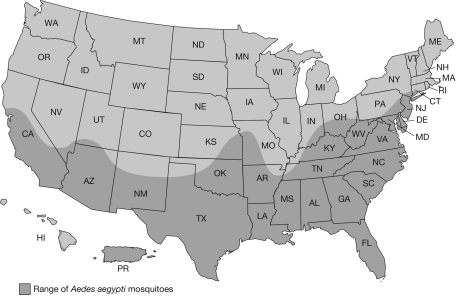
Free
(Multiple Choice)
4.8/5 (81)
(81) Correct Answer:Verified
VerifiedB
Which of the following statements describes a cyclical fluctuation?
Free
(Multiple Choice)
4.9/5 (88)
(88) Correct Answer:Verified
VerifiedA
Determine which examples are density-dependent population changes and which are density-independent population changes.
-A virus spreads through a population of wild dogs and 20 percent of the dogs die.
(Multiple Choice)
4.9/5 (89)
(89) Which of the following situations illustrates a link between the effects of density-dependent and density-independent factors?
(Multiple Choice)
4.9/5 (63)
(63) Which of the following populations would be MOST vulnerable to an outbreak of disease?
(Multiple Choice)
5.0/5 (67)
(67) Describe the shape of the growth pattern for a population undergoing exponential growth.When would a population experience this type of growth?
(Essay)
4.9/5 (69)
(69) In a neighborhood with an area of 500 acres,there are 3,000 mosquitoes.The population density in this neighborhood
(Multiple Choice)
5.0/5 (88)
(88) If a population is growing with no constraints on its resources,the population will
(Multiple Choice)
4.9/5 (75)
(75) A new species is introduced into a given area.The population size begins to grow slowly,then at a very rapid rate,and finally levels off at a stable number.This growth pattern is best represented by a(n)
(Multiple Choice)
4.9/5 (62)
(62) The top of the "S" in an S-shaped curve indicates that the population
(Multiple Choice)
5.0/5 (80)
(80) If we humans do not limit our population growth rate,we will exceed the ________ of our environment,leading to a larger population than the environment can support.
(Short Answer)
4.8/5 (78)
(78) The carrying capacity for Paramecia caudatum as shown in the figure below is 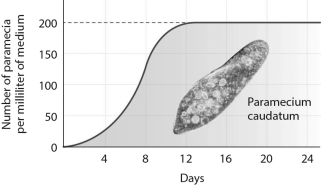
(Multiple Choice)
5.0/5 (86)
(86) Lynx feed on rabbits,and the growth curves for these two species fluctuate together.This relationship is an example of a(n)
(Multiple Choice)
5.0/5 (78)
(78) Is it reasonable to expect that all habitats suitable for a given organism will have the same carrying capacity for that organism?
(Multiple Choice)
4.9/5 (76)
(76) Determine which examples are density-dependent population changes and which are density-independent population changes.
-Yeast cells fill a broth-filled flask,resources become constrained,and growth is limited.
(Multiple Choice)
4.8/5 (92)
(92) You are told that the population size of mosquitoes is 50.What information would you need to allow you to determine the population density?
(Essay)
4.8/5 (74)
(74) The graph below shows the growth of a population of Paramecium caudatum.The greatest amount of daily growth occurred when the population was at approximately ________ percent of its carrying capacity. 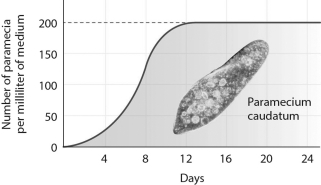
(Multiple Choice)
4.9/5 (77)
(77) Which of the following choices best explains why some introduced species experience an initial period of exponential growth when they first move from their native habitats into a new habitat?
(Multiple Choice)
5.0/5 (85)
(85) 
Filters
- Essay(0)
- Multiple Choice(0)
- Short Answer(0)
- True False(0)
- Matching(0)