



 Chat with AI
Exam 17: Animals and Human Evolution

Exam 1: The Nature of Science94 Questions
Exam 2: Evaluating Scientific Claims90 Questions
Exam 3: Chemistry of Life102 Questions
Exam 4: Life Is Cellular88 Questions
Exam 5: How Cells Work89 Questions
Exam 6: Cell Division95 Questions
Exam 7: Patterns of Inheritance83 Questions
Exam 8: Chromosomes and Human Genetics92 Questions
Exam 9: What Genes Are83 Questions
Exam 10: How Genes Work98 Questions
Exam 11: Evidence for Evolution86 Questions
Exam 12: Mechanisms of Evolution84 Questions
Exam 13: Adaptation and Species85 Questions
Exam 14: The History of Life97 Questions
Exam 15: Bacteria and Archaea91 Questions
Exam 16: Plants, Fungi, and Protists84 Questions
Exam 17: Animals and Human Evolution88 Questions
Exam 18: General Principles of Ecology81 Questions
Exam 19: Growth of Populations82 Questions
Exam 20: Communities of Organisms83 Questions
Exam 21: Ecosystems87 Questions
Select questions type


Consider that fossils of Homo erectus dating between 1.66 and 1.85 mya have been found scattered across Eastern Europe through China and Southeast Asia and dating back to 2.4 mya in Africa.The earliest known specimens of anatomically modern Homo sapiens in Africa date back to roughly 200,000 years ago and 40,000 to 60,000 years ago across Europe and Asia,with some at 115,000 years ago in India.Additionally,Homo neanderthalensis was present across Europe by 150,000 years ago and then spread into western Asia.If there were no evidence indicating the presence of any other early Homo species in Europe,propose a hypothesis that would be supported by this information.

Free
(Essay)
4.9/5  (80)
(80) Correct Answer: Verified
Homo erectus is a possible common ancestor to Homo neanderthalensis and Homo sapiens.
Possums are found throughout much of Central and North America.Although their bodies are covered in hair,their tails and ears are hairless.They have many teeth and opposable clawless "thumbs" on their rear appendages.They produce poorly developed young that live in mom's pouch for about two and a half months before climbing on her back.Possums are
Free
(Multiple Choice)
4.9/5 (82)
(82) Correct Answer:Verified
VerifiedD
According to the evolutionary tree shown below,when did hominins branch away from the other apes? 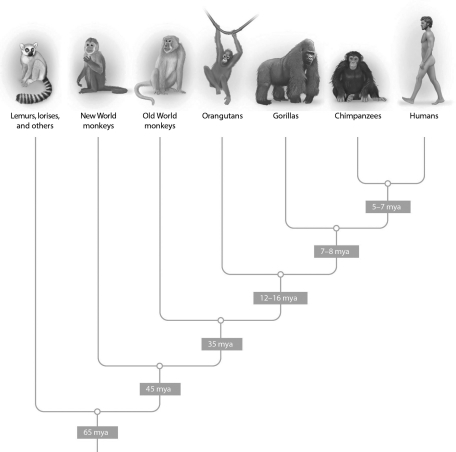
Free
(Multiple Choice)
4.8/5 (71)
(71) Correct Answer:Verified
VerifiedD
DNA from a fossil is found,and it is hypothesized that the mother was a Neanderthal and the father was a human.Which of the following would support this hypothesis?
(Multiple Choice)
4.9/5 (81)
(81) Match each correct evolutionarily significant character to the appropriate lettered box on the phylogenetic tree below.  -fur,mammary glands
 (Multiple Choice)
4.9/5 (81)
(81) Humans did not evolve from chimpanzees.Humans and chimpanzees share a ________.
(Short Answer)
4.9/5 (66)
(66) Match each correct evolutionarily significant character to the appropriate lettered box on the phylogenetic tree below.
-jaws
-jaws (Multiple Choice)
4.9/5 (74)
(74) Match each correct evolutionarily significant character to the appropriate lettered box on the phylogenetic tree below.
-backbone
-backbone (Multiple Choice)
4.8/5 (78)
(78) The positioning of the toe indicated by the arrow in the figure below suggests that the animal with this fossil hominid foot 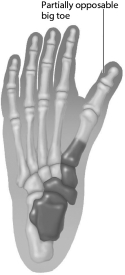
(Multiple Choice)
4.9/5 (84)
(84) You are a researcher excavating a site in a cave in Israel.There are many layers of sediment and primitive artifacts (flint tools for cutting and scraping)from ancestral Homo species within the cave.As you work your way deeper and deeper through the layers,you notice that artifacts in the deeper layers (laid before 350,000 years ago)do not show any signs of having been exposed to fire.Artifacts in layers less than 350,000 years ago show rapidly increasing evidence of exposure to fire.Your colleagues working in nearby caves and caves scattered around the eastern Mediterranean Sea have found similar evidence dating in the same time frames.The evidence is also consistent with that of European sites.What does this suggest about the use of fire by ancestral humans?
(Multiple Choice)
4.7/5 (83)
(83) Match each correct evolutionarily significant character to the appropriate lettered box on the phylogenetic tree below.
-skull
-skull (Multiple Choice)
4.9/5 (83)
(83) In 2012,researchers determined that the Neanderthal DNA had been introduced into the human genome between 90,000 and 40,000 years ago.Does this support the hypothesis that Neanderthal DNA present in the human genome is a remnant from a common hominin ancestor? Support your answer by indicating roughly when DNA from Neanderthals would have been introduced to the human genome if that Neanderthal DNA was a remnant from a common hominin ancestor.
(Essay)
4.9/5 (61)
(61) Match each correct evolutionarily significant character to the appropriate lettered box on the phylogenetic tree below.
-four limbs
-four limbs (Multiple Choice)
4.8/5 (79)
(79) When researchers determined that the jawbone of an Italian Neanderthal dating to around 43,000-45,000 years ago showed the presence of an intermediate chin and mitochondrial Neanderthal DNA,they hypothesized that the jawbone belonged to an individual who was the product of a mating between a modern human and a Neanderthal.This hypothesis would be further supported if the fossil had
(Multiple Choice)
4.9/5 (74)
(74) Consider that fossils of Homo erectus dating between 1.66 and 1.85 mya have been found scattered across Eastern Europe through China and Southeast Asia and dating back to 2.4 mya in Africa.The earliest-known specimens of anatomically modern Homo sapiens in Africa date back to roughly 200,000 years ago and 40,000 to 60,000 years ago across Europe and Asia,with some at 115,000 years ago in India.Additionally,Homo neanderthalensis was present across Europe by 150,000 years ago and then spread into western Asia.Concerning the out-of-Africa hypothesis,this suggests that
(Multiple Choice)
4.7/5 (93)
(93) The fossil of a male hominin is discovered,and it appears to share traits with both humans and Neanderthals.What could mitochondrial-DNA sequencing and whole-genome DNA sequencing convey about the fossil's parents?
(Essay)
4.8/5 (84)
(84) Compare and contrast amphibians with reptiles and birds using the phylogenetic tree shown below.
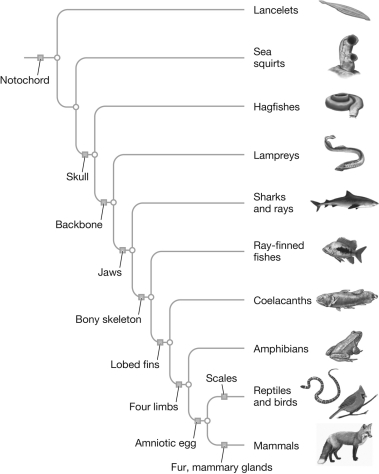
(Essay)
4.7/5 (79)
(79) You and your brother share the same father but have different mothers.Compare and contrast the mitochondrial and nuclear DNA profiles of you and your brother.
(Essay)
4.8/5 (69)
(69) It is possible that modern humans may have comingled with which of these other ancestors?
(Multiple Choice)
4.7/5 (90)
(90) The phylum Chordata includes several subgroups of organisms.To which of these subgroups would humans belong?
(Multiple Choice)
4.9/5 (73)
(73) 
Filters
- Essay(0)
- Multiple Choice(0)
- Short Answer(0)
- True False(0)
- Matching(0)