



 Chat with AI
Exam 17: Animals and Human Evolution

Exam 1: The Nature of Science94 Questions
Exam 2: Evaluating Scientific Claims90 Questions
Exam 3: Chemistry of Life102 Questions
Exam 4: Life Is Cellular88 Questions
Exam 5: How Cells Work89 Questions
Exam 6: Cell Division95 Questions
Exam 7: Patterns of Inheritance83 Questions
Exam 8: Chromosomes and Human Genetics92 Questions
Exam 9: What Genes Are83 Questions
Exam 10: How Genes Work98 Questions
Exam 11: Evidence for Evolution86 Questions
Exam 12: Mechanisms of Evolution84 Questions
Exam 13: Adaptation and Species85 Questions
Exam 14: The History of Life97 Questions
Exam 15: Bacteria and Archaea91 Questions
Exam 16: Plants, Fungi, and Protists84 Questions
Exam 17: Animals and Human Evolution88 Questions
Exam 18: General Principles of Ecology81 Questions
Exam 19: Growth of Populations82 Questions
Exam 20: Communities of Organisms83 Questions
Exam 21: Ecosystems87 Questions
Select questions type


Match each correct evolutionarily significant character to the appropriate lettered box on the phylogenetic tree below.  -amniotic egg
 (Multiple Choice)
4.8/5  (76)
(76) If a female's mitochondrial DNA was sequenced and compared to the sequence of mitochondrial DNA isolated from her mother's paternal grandmother (the mother of her mom's dad),she likely ________be a significant match because ________.
(Multiple Choice)
4.9/5 (83)
(83) Which of the following best describes the source of a human's DNA?
(Multiple Choice)
4.9/5 (74)
(74) Which of the following is the strongest evidence that suggests Homo sapiens may have intermingled with other species such as H.heidelbergensis and H.neanderthalensis?
(Multiple Choice)
4.9/5 (78)
(78) Which of the groupings of animals shown in the figures below are MOST closely related to each other? 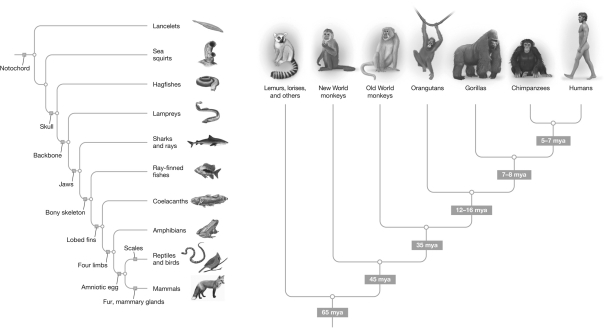
(Multiple Choice)
4.9/5 (82)
(82) If an animal's body can be sliced symmetrically along any number of vertical planes passing through the center of the animal,this displays ________ symmetry.
(Short Answer)
4.8/5 (83)
(83) Fossilized foot bones show that some hominids living between 3 and 3.5 mya walked upright but had partially opposable big toes.This suggests that
(Multiple Choice)
4.9/5 (80)
(80) In vertebrates,the dorsal notochord has evolved to become the cushioning discs between ________,the strong,hollow sections of the backbone.
(Short Answer)
4.9/5 (79)
(79) Fossil evidence indicates that the first members of the genus Homo arose in Africa approximately ________ years ago.
(Multiple Choice)
4.7/5 (87)
(87) Match each correct evolutionarily significant character to the appropriate lettered box on the phylogenetic tree below.
-bony skeleton
-bony skeleton (Multiple Choice)
4.7/5 (85)
(85) According to the phylogenetic tree below,which of the groups of animals listed would display radial symmetry? 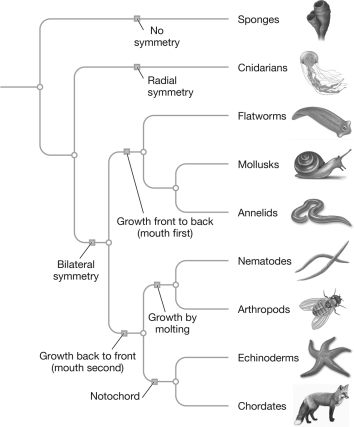
(Multiple Choice)
4.9/5 (71)
(71) Consider that fossils of Homo erectus dating between 1.66 and 1.85 mya have been found scattered across Eastern Europe through China and Southeast Asia and dating back to 2.4 mya in Africa.The earliest known specimens of anatomically modern Homo sapiens in Africa date back to roughly 200,000 years ago and 40,000 to 60,000 years ago across Europe and Asia,with some at 115,000 years ago in India.Additionally,Homo neanderthalensis was present across Europe by 150,000 years ago and then spread into western Asia.If there were no evidence indicating the presence of any other early Homo species in Europe,which of the following hypotheses might be supported by this information?
(Multiple Choice)
4.9/5 (70)
(70) Which of the following traits was likely deleterious for early hominins?
(Multiple Choice)
4.8/5 (79)
(79) Is it possible for Homo sapiens and Neanderthals to be related even if humans are not the direct descendants of Neanderthals?
(Multiple Choice)
4.8/5 (68)
(68) The hypothesis that Neanderthals evolved sometime after hominins migrated out of Africa would be supported by the presence of Neanderthal DNA in the
(Multiple Choice)
4.8/5 (82)
(82) Rafael is relaxing on the veranda of his beachfront home on the Gulf of Mexico when he notices a small (about 5 inches long)green quadruped clinging to the ceiling.As it begins to run down the wall,he catches it and notices that it is covered with dry scales,has a long tail,and has specialized toe pads that allow it to stick to surfaces.According to the figure below,this animal most likely belongs to which class? 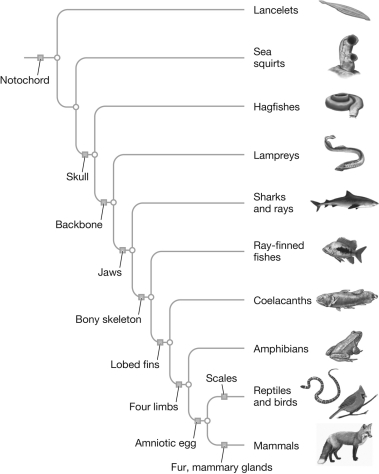
(Multiple Choice)
4.8/5 (88)
(88) All primates have opposable thumbs.This means the thumbs can be touched
(Multiple Choice)
4.8/5 (78)
(78) 
Filters
- Essay(0)
- Multiple Choice(0)
- Short Answer(0)
- True False(0)
- Matching(0)