



 Chat with AI
Exam 17: Animals and Human Evolution

Exam 1: The Nature of Science94 Questions
Exam 2: Evaluating Scientific Claims90 Questions
Exam 3: Chemistry of Life102 Questions
Exam 4: Life Is Cellular88 Questions
Exam 5: How Cells Work89 Questions
Exam 6: Cell Division95 Questions
Exam 7: Patterns of Inheritance83 Questions
Exam 8: Chromosomes and Human Genetics92 Questions
Exam 9: What Genes Are83 Questions
Exam 10: How Genes Work98 Questions
Exam 11: Evidence for Evolution86 Questions
Exam 12: Mechanisms of Evolution84 Questions
Exam 13: Adaptation and Species85 Questions
Exam 14: The History of Life97 Questions
Exam 15: Bacteria and Archaea91 Questions
Exam 16: Plants, Fungi, and Protists84 Questions
Exam 17: Animals and Human Evolution88 Questions
Exam 18: General Principles of Ecology81 Questions
Exam 19: Growth of Populations82 Questions
Exam 20: Communities of Organisms83 Questions
Exam 21: Ecosystems87 Questions
Select questions type


Based on the image below,which of the following identify the body segments of lobster? 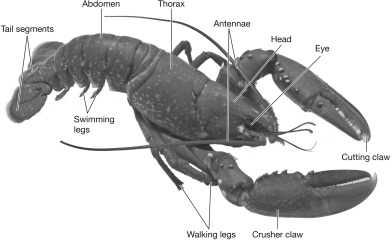
(Multiple Choice)
4.8/5  (81)
(81) The fossil record indicates that the first Homo sapiens originated between 400,000 and 300,000 years ago.Homo erectus,who had a brain larger than Homo habilis and a skull more similar to H.sapiens,probably migrated from Africa about 2 mya.The fact that these species often existed in the same locations at the same time and their fossils share certain characteristics while displaying some intermediate characteristics suggests that these prehistoric ________ species may have reproduced with each other.
(Short Answer)
4.9/5 (81)
(81) When researchers found a fossilized jawbone from a late (about 43,000-45,000 years ago)Italian Neanderthal,they noted that the shape of the jawbone suggested the individual had an intermediate chin instead of no chin like most Neanderthals.This would provide evidence supporting which of the following hypotheses?
(Multiple Choice)
4.9/5 (77)
(77) In light of the out-of-Africa hypothesis,which of the following is a parsimonious reason why species like Homo neanderthalensis,Homo floresinensis,and Homo erectus do not exist today?
(Multiple Choice)
4.8/5 (74)
(74) Baleen whales are large ocean-dwelling animals once hunted for their modified hair,baleen.The young are fully developed at birth and nurse on their mother's mammary glands.Baleen whales are
(Multiple Choice)
4.9/5 (76)
(76) Which of the following is an advantage of bipedalism in hominins?
(Multiple Choice)
4.8/5 (81)
(81) Examine the skulls shown in the figure below.What can be said regarding trends in braincase size and teeth over time? 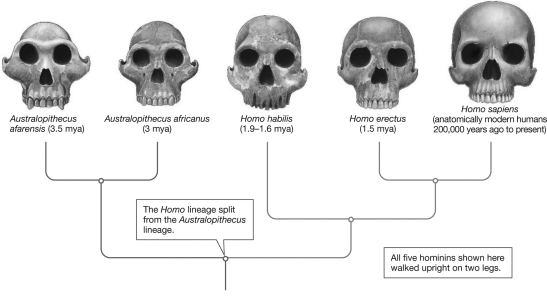
(Multiple Choice)
4.7/5 (90)
(90) Which of the primates shown in the figure below could act as an outgroup (a group closely related to the rest of the organisms on the tree,but it clearly stands apart)to be compared to the other primates when constructing an evolutionary tree? Support your answer.
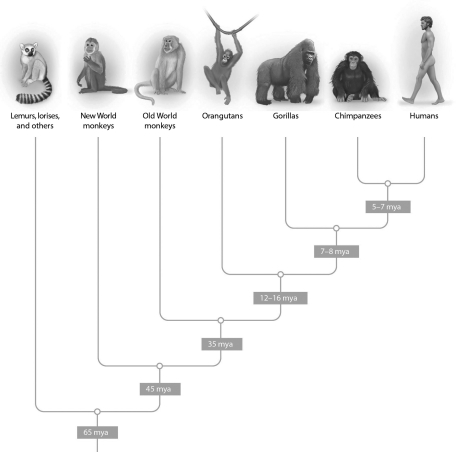
(Essay)
4.7/5 (79)
(79) You are a researcher excavating a site in a cave in Israel.There are many layers of sediment and primitive artifacts (flint tools for cutting and scraping)from ancestral Homo species within the cave.As you work your way deeper and deeper through the layers,you notice that artifacts in the deeper layers (laid before 350,000 years ago)do not show any signs of having been exposed to fire.
Artifacts in layers less than 350,000 years ago show rapidly increasing evidence of exposure to fire.Your colleagues working in nearby caves and caves scattered around the eastern Mediterranean Sea have found similar evidence dating in the same time frames.The evidence is also consistent with that of European sites.What does this suggest about the use of fire by ancestral humans?
(Essay)
4.9/5 (83)
(83) An archaeological dig in Africa discovers a collection of stone tools along with several skeletons in a cave.These bipedal skeletons date to about 3.5 million years ago and show no evidence of a partially opposable toe.Measurements indicate the brains would have been a little less than a third of the volume of modern humans.The teeth found on these skeletons look more like those of an ape than those of a human.This skeletal discovery is most likely which of the following?
(Multiple Choice)
4.8/5 (92)
(92) Which of the following best describes the source of a human's mitochondrial DNA?
(Multiple Choice)
4.9/5 (68)
(68) Which of the following could NOT be used to describe humans?
(Multiple Choice)
4.8/5 (66)
(66) All chordates have a dorsal ________,a flexible rod along the center of the body that is critical for development.
(Short Answer)
4.7/5 (71)
(71) Evidence indicates that archaic Homo sapiens gave rise to which of the following?
(Multiple Choice)
4.7/5 (91)
(91) Members of the "human" branch of the ape family,including modern humans as well as our extinct relatives,are properly referred to as ________.
(Short Answer)
4.8/5 (84)
(84) Fossil evidence from around the world indicates that anatomically modern humans first evolved in Africa about 195,000-200,000 years ago from a population of archaic Homo sapiens and then successfully migrated to and inhabited almost all continents by 13,000 years ago.During literally tens of thousands of years,modern humans lived alongside other ________ genera,eventually replacing them.
(Short Answer)
4.8/5 (79)
(79) Which of the following organisms are extant eutherian mammals and most closely related to humans?
(Multiple Choice)
4.7/5 (85)
(85) Damien is camping in the south central United States when he happens across an animal with several "armored" plates covering its back and shoulders.The plates are bony and separated by thin bands of flexible skin.The belly of this short-legged quadruped is covered with skin and soft fur.He also notices four young ones scurrying along behind the adult.This animal is most likely a(n)
(Multiple Choice)
4.8/5 (88)
(88) Which of the following is a feature of hominins that helps to distinguish them from other apes?
(Multiple Choice)
4.9/5 (71)
(71) 
Filters
- Essay(0)
- Multiple Choice(0)
- Short Answer(0)
- True False(0)
- Matching(0)