



 Chat with AI
Exam 19: Growth of Populations

Exam 1: The Nature of Science94 Questions
Exam 2: Evaluating Scientific Claims90 Questions
Exam 3: Chemistry of Life102 Questions
Exam 4: Life Is Cellular88 Questions
Exam 5: How Cells Work89 Questions
Exam 6: Cell Division95 Questions
Exam 7: Patterns of Inheritance83 Questions
Exam 8: Chromosomes and Human Genetics92 Questions
Exam 9: What Genes Are83 Questions
Exam 10: How Genes Work98 Questions
Exam 11: Evidence for Evolution86 Questions
Exam 12: Mechanisms of Evolution84 Questions
Exam 13: Adaptation and Species85 Questions
Exam 14: The History of Life97 Questions
Exam 15: Bacteria and Archaea91 Questions
Exam 16: Plants, Fungi, and Protists84 Questions
Exam 17: Animals and Human Evolution88 Questions
Exam 18: General Principles of Ecology81 Questions
Exam 19: Growth of Populations82 Questions
Exam 20: Communities of Organisms83 Questions
Exam 21: Ecosystems87 Questions
Select questions type


In nature,populations tend to experience unpredicted rises and falls in population size.This type of change is called a(n)________.
(Short Answer)
4.8/5  (80)
(80) The decrease in the availability of food or cover that accompanies increasing population size illustrates the concept of a(n)________ factor.
(Multiple Choice)
4.8/5 (88)
(88) A population of 100 individuals is undergoing exponential growth with a population doubling time of 1 year.What size will this population be in 2 years?
(Multiple Choice)
4.9/5 (76)
(76) Match each term to a statement listed below.
-unlimited growth of a population with no constraint on resources
(Multiple Choice)
4.8/5 (76)
(76) Match each term to a statement listed below.
-the maximum sustainable population size in a given environment
(Multiple Choice)
4.8/5 (86)
(86) For most populations,irregular fluctuations in size or density
(Multiple Choice)
4.7/5 (72)
(72) Match each term to a statement listed below.
-number of individuals within a population per unit of area
(Multiple Choice)
4.8/5 (79)
(79) Which of the following populations would be MOST likely to experience a J-shaped growth pattern?
(Multiple Choice)
4.8/5 (88)
(88) The figure below shows that the human population was small and relatively stable for nearly 12,000 years but has increased dramatically in the past 200 years.How might this increase in population growth be explained? 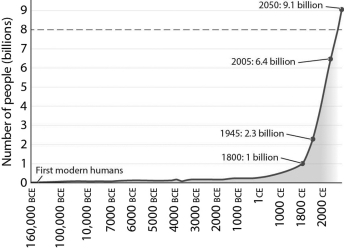
(Multiple Choice)
5.0/5 (88)
(88) According to the figure shown below,human populations began to experience exponential growth around 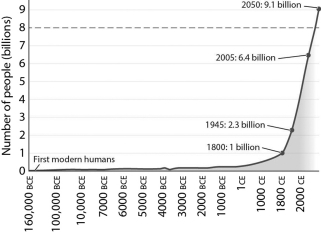
(Multiple Choice)
4.8/5 (80)
(80) A population is counted at 100 individuals in 1998.In 2006,a new count found 1,600 individuals.The doubling time for the population is ________ year(s).
(Multiple Choice)
4.7/5 (73)
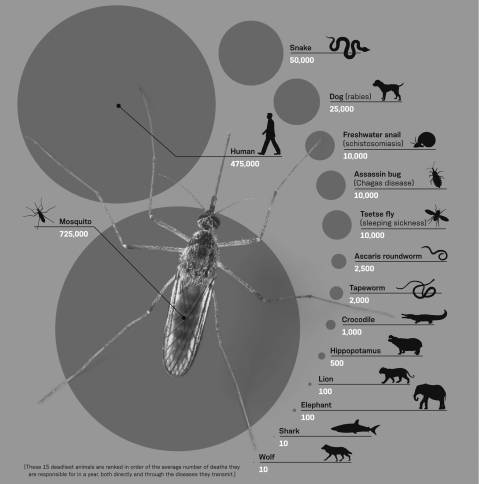
(73) Your friend is planning a trip to Africa.She mentions to you that that she is more worried about contracting sleeping sickness than she is worried about contracting mosquito-transmitted malaria after watching a TV show highlighting sleeping sickness.Based on the image below indicating the rank of the 15 deadliest animals,is her fear fact-based?
(Essay)
4.8/5 (84)
(84) Determine which examples are density-dependent population changes and which are density-independent population changes.
Correct Answer: Verified
Premises:
Responses:
(Matching)
4.8/5 (92)
(92) The carrying capacity of owls in an Alaskan forest is seven per square kilometer.What will happen if 12 owls are confined to a 1-square-kilometer area?
(Multiple Choice)
5.0/5 (78)
(78) Predation increases are responsible for density-________ changes in population size.
(Short Answer)
4.9/5 (62)
(62) A population will remain at a constant size when emigration equals immigration and
(Multiple Choice)
4.8/5 (69)
(69) According to the figure below,human populations are projected to reach carrying capacity in approximately ________ years. 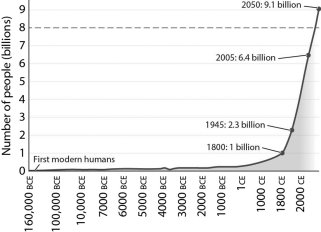
(Multiple Choice)
4.9/5 (80)
(80) Which of the following would likely occur as a population reaches carrying capacity?
(Multiple Choice)
4.9/5 (86)
(86) 
Filters
- Essay(0)
- Multiple Choice(0)
- Short Answer(0)
- True False(0)
- Matching(0)